Analyze how experimental results and claims are presented, scoped, and limited in a paper.Know what the science actually supports before you trust the answer.
Press Enter ↵ to analyze
Explore by Goal
"Two possibilities exist: either we are alone in the Universe or we are not. Both are equally terrifying."
- Arthur C. Clarke
Quick Explanation
Copied
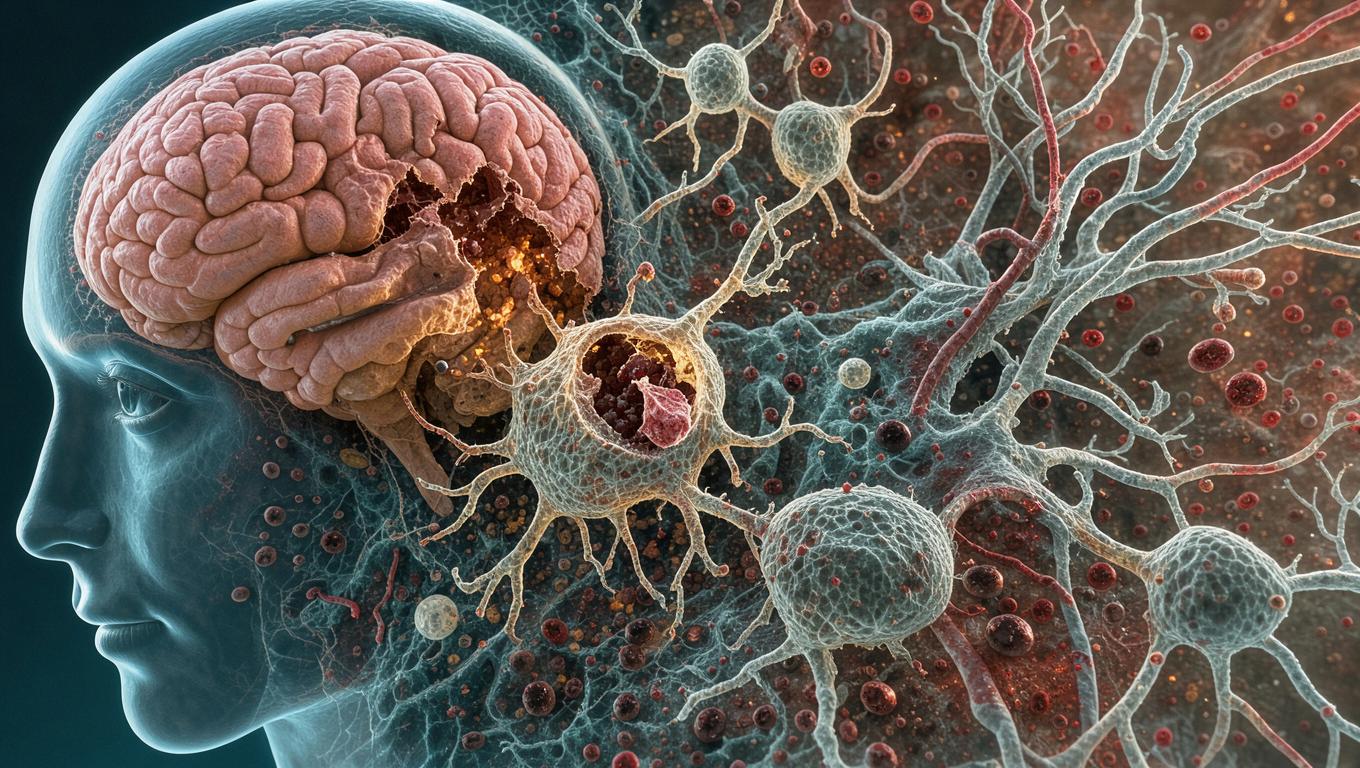
This narrative review by Eyolfson et al. synthesizes RmTBI pathophysiology, adolescent brain development, and microglia biology to propose that injury-activated microglia may derail developmental synaptic pruning and myelination, altering lifelong neurological trajectories — a well-framed but hypothesis-only paper with no original data.
Long Explanation
What the Paper Does
Eyolfson, Khan, Mychasiuk, and Lohman (University of Calgary; Journal of Neuroinflammation, 2020) present a narrative review, not an experimental study. Its explicit goal is to detail concepts in repetitive mild TBI (RmTBI), adolescent neurodevelopment, and microglia dynamics — developmental roles in neuronal number, synapse formation/elimination, and myelination — and to formulate a hypothesis that injury-shifted microglia phenotypes perturb these developmental programs, modifying long-term outcomes. Funded by NSERC and CIHR; no declared conflicts stated in the manuscript.
Strengths
Timely intersection of three literatures that are usually treated separately: pediatric/concussion epidemiology, developmental microglia biology, and neuroinflammation.
Grounded developmental mechanisms: the review's framing aligns with primary evidence that microglia actively regulate CNS myelination — a genetically distinct CD11c+ subset produces IGF-1 at ~sevenfold higher levels than CD11c− counterparts, and conditional IGF-1 deletion causes significant hypomyelination — and that microglia can synthesize complement components (C1q, C2, C3, C4, C9) upregulated by LPS/IFN-γ, the classical pruning cascade .
Clinically consequential framing: adolescent TBI as a risk factor for later neurodegeneration is increasingly supported experimentally; adolescent mice given TBI develop Parkinson's-like dopaminergic neuron loss, α-synuclein misfolding, and persistent neuroinflammation by middle age .
Critical Weaknesses and Blind Spots
No original data or systematic method: as a narrative review it is vulnerable to citation bias and selective framing; no search strategy, PRISMA flow, or evidence grading is reported.
The "M1/M2" style dichotomy of microglia activation is oversimplified: single-cell work shows microglial identity is highly context- and environment-dependent, with a core signature of 881 transcripts and culture alone altering ~33% of the signature . The review was written before this single-cell landscape was fully integrated into TBI models.
Sex as a biological variable: microglial developmental functions can be sex-specific — e.g., microglial Atg5 affects postnatal neurogenesis in female but not male 5xFAD mice — yet the review gives limited treatment to sex differences in RmTBI response, a major gap for a developmental-period injury.
Translational leap: the hypothesis rests largely on rodent data; human adolescent concussion microglia dynamics are essentially unobservable in vivo, so the central claim remains unfalsified in the species of interest.
Causality vs. correlation: post-injury microglial activation is described as causal in long-term deficits, but persistent inflammation after adolescent TBI has so far been demonstrated mainly as co-occurring with, not experimentally sufficient for, late pathology .
Verdict
A well-organized, hypothesis-generating review (novelty ~6/10; quality ~6/10). Its durable contribution is framing the adolescent window — when pruning and myelination are microglia-dependent — as a period of heightened vulnerability to RmTBI. To move forward, the field needs longitudinal single-cell/spatial transcriptomics after controlled RmTBI, sex-stratified designs, and causal tests (e.g., microglia-specific complement or IGF-1 manipulation during the post-injury window). Confidence in this assessment: moderate, based on the manuscript text and the cited primary literature.
Feedback:
Updated: November 01, 2026
BGPT Paper Review
Study Novelty
60%
A 2020 narrative review synthesizing known microglial developmental roles with RmTBI; the intersection framing was relatively fresh then but no new data or mechanisms are presented.
Scientific Quality
60%
Well-written scholarly synthesis, but no systematic search methodology, no original data, reliance on the oversimplified M1/M2 activation framework, and limited treatment of sex differences and human translatability.
Study Generality
70%
Concepts generalize to developmental neuroimmunology broadly, though focused specifically on adolescent RmTBI.
Study Usefulness
70%
Useful as a hypothesis-generating roadmap for experimental design in pediatric TBI neuroinflammation; cannot itself guide clinical practice.
Study Reproducibility
40%
No original experiments or data; reproducibility is not applicable beyond the narrative structure, and no search strategy is provided for the synthesis itself.
Explanatory Depth
60%
Mechanistic framing (complement-mediated pruning, microglial IGF-1 in myelination) is biologically literate but remains correlational and untested in the RmTBI context.
We'll email you the results when your analysis is finished.
Hypothesis Graveyard
"Microglia are purely protective responders to TBI" — undermined by evidence that complement-mediated pruning is a microglial developmental function that injury can hijack pathologically.
"M1/M2 polarization explains post-TBI microglial behavior" — superseded by single-cell atlases showing environment-defined, spectrum-like microglial states rather than binary phenotypes.

 Explore by Goal
 Quick Explanation
 Long Explanation
 Top Data Sources
 Ask a Follow-Up
 Key Insight
 Keep Exploring
 Hypothesis Graveyard
 Potential Experiments
 Discussion
