Check a paper's claims against linked experiments, exact results, stated scope, and limitations.Know what falsifiable science actually supports before you trust the answer.
Press Enter ↵ to search evidence
Explore by Goal
"Science is the systematic classification of experience."
- George Henry Lewes
Quick Explanation
Copied
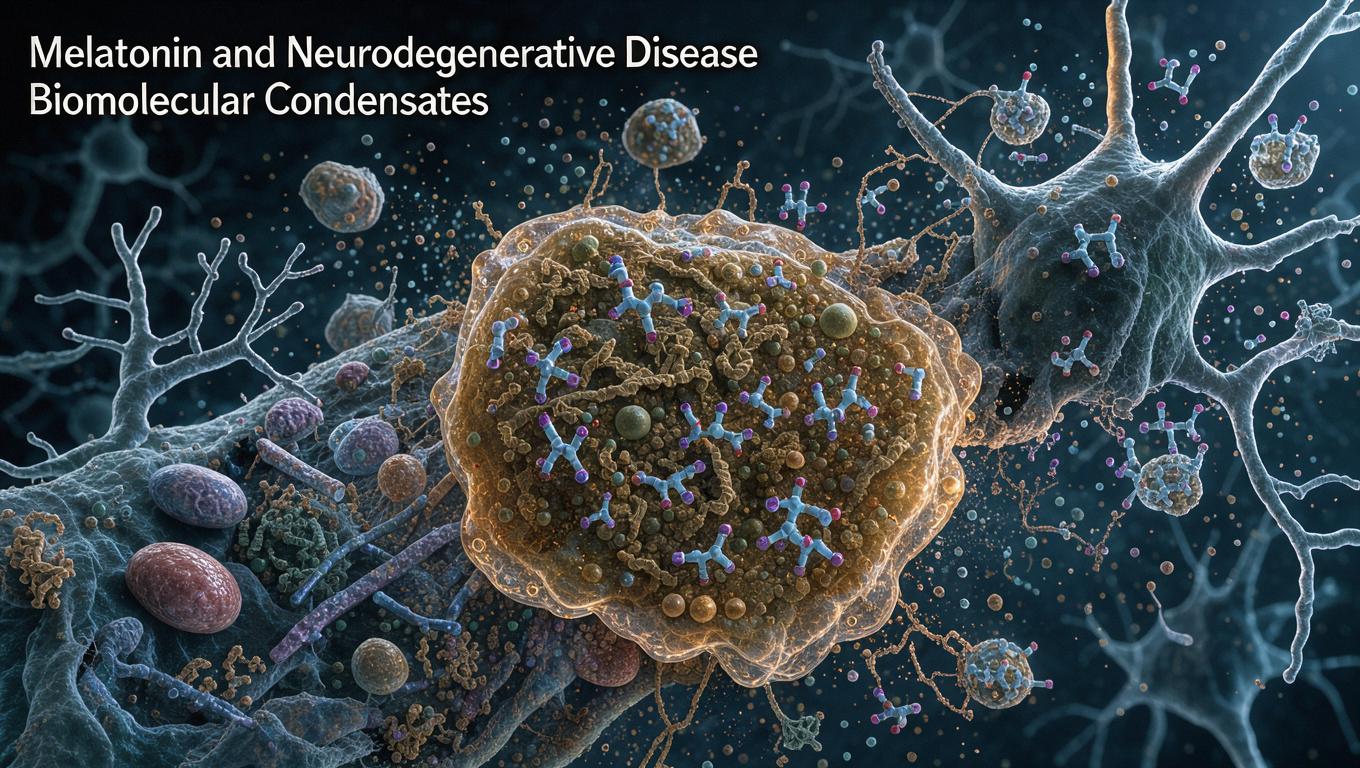
Loh & Reiter's Antioxidants review (10.3390/antiox10091483) is a hypothesis-rich synthesis linking melatonin, ATP hydrotropy, lipid raft stabilization, cardiolipin protection, and m6A regulation to biomolecular condensate dynamics in neurodegeneration — valuable but entirely speculative, with no direct experimental evidence connecting melatonin to condensate regulation.
Long Explanation
Melatonin condensate regulation: an ambitious but untested synthesis
This 2021 review by Loh (independent researcher) and Reiter (melatonin field veteran) proposes that melatonin regulates biomolecular condensates — membraneless organelles formed by liquid-liquid phase separation (LLPS) — through five interlinked mechanisms: maintaining cytosolic ATP as a biological hydrotrope, protecting cardiolipin from peroxidation, stabilizing nanoscopic lipid rafts, modulating PTMs (phosphorylation, SUMOylation, ubiquitination), and regulating m6A RNA methylation.
Key strengths: The paper identifies a genuinely novel intersection — no prior work connects melatonin to LLPS/condensate biology. The ATP-hydrotrope discussion is well-sourced (Patel et al. 2017 showed ATP dissolves FUS condensates at high concentrations; TDP-43 droplets dissolve at 1:1000 molar ratio). The cardiolipin-melatonin protection is supported by direct experiments showing micromolar melatonin inhibits CL peroxidation and mPTP opening in rat heart mitochondria.
Critical weaknesses: No experiment anywhere in the review demonstrates melatonin directly alters condensate formation, dynamics, or dissolution. Every mechanistic link is correlative or borrowed from adjacent fields. The m6A regulation by melatonin rests on one SSC experiment showing METTL3 downregulation and one senescence study showing YTHDF2 upregulation — neither tested in a neurodegeneration context. The evolutionary narrative (~3.5 Ga cyanobacteria melatonin-LLPS relationship) is speculative without direct fossil or molecular evidence.
What would falsify the hypothesis: Direct FRAT/FRAP measurements of condensate dynamics in melatonin-treated vs control neurons expressing FUS, TDP-43, or tau would be decisive. If melatonin does not alter droplet viscosity, exchange rates, or aggregation propensity in live cells at physiological concentrations (~0.1-1 nM plasma), the central claim collapses. Current evidence for melatonin reaching intracellular millimolar ATP-equivalent concentrations is absent.
Contradiction the authors acknowledge but do not resolve: PI3K/Akt activation by melatonin promotes stress granule assembly (pro-LLPS) while simultaneously being cited as neuroprotective via tau dephosphorylation (anti-aggregation). The review flags this as an "additional layer of complexity" without resolving whether melatonin is net pro- or anti-condensate in different contexts.
Translational relevance: The therapeutic implication — melatonin as a condensate-modulating agent for AD/PD/ALS — remains purely hypothetical. No clinical trial tests condensate outcomes. Available RCT evidence supports melatonin for sleep in COMISA (PSQI 3.8 vs 10.5 placebo, P<0.001) but does not address neurodegeneration or condensate biology.
Feedback:
Updated: November 23, 2026
BGPT Paper Review
Study Novelty
80%
First review connecting melatonin to LLPS/condensate biology — a genuinely new intersection of two mature but previously unlinked fields. Novelty is in the framing, not new data.
Scientific Quality
50%
No original experiments; purely theoretical synthesis. The >1100-reference bibliography shows scholarly effort, but the central claim (melatonin regulates condensates) is never directly tested. Multiple speculative evolutionary leaps and unresolved contradictions (PI3K pro-SG vs anti-tau aggregation) reduce rigor.
Study Generality
70%
The ATP-LLPS-lipid raft framework applies broadly across neurodegeneration and cancer, not just one disease. However, the melatonin-specific claims lack generalizability until experimentally validated.
Study Usefulness
50%
Useful as a hypothesis-generating roadmap for researchers entering the condensate-melatonin intersection. Not useful for clinical decision-making or immediate therapeutic application.
Study Reproducibility
20%
As a theoretical review with no original data, there are no methods to reproduce. Cited experiments from others are reproducible, but the integrated causal chain is not testable as presented without new experiments.
Explanatory Depth
60%
Mechanistic links are logically constructed and well-referenced but lack quantitative predictions or direct causal evidence at any single node connecting melatonin to condensate behavior.
We'll email you the results when your analysis is finished.
Hypothesis Graveyard
Melatonin acts as a direct hydrotrope dissolving protein aggregates in vivo: Rejected because plasma melatonin peaks at ~60 pg/mL (~260 pM), thousands-fold below the 2-8 mM required for hydrotropic activity, and BBB penetration cannot bridge this gap.
Tau hyperphosphorylation is purely pathogenic: The review correctly flags total chemical synthesis data showing site-specific phosphorylation inhibits K18 aggregation, complicating the simplistic 'more phospho-tau = worse' model.

 Explore by Goal
 Quick Explanation
 Long Explanation
 Top Data Sources
 Ask a Follow-Up
 Key Insight
 Keep Exploring
 Hypothesis Graveyard
 Potential Experiments
 Discussion
