Check whether claims match experiments, exact reported results, and stated limitations.Know what the science actually supports before you trust the answer.
Press Enter ↵ to review paper
Explore by Goal
"The most exciting phrase to hear in science, the one that heralds new discoveries, is not 'Eureka!' but 'That's funny...'"
- Isaac Asimov
Quick Explanation
Copied
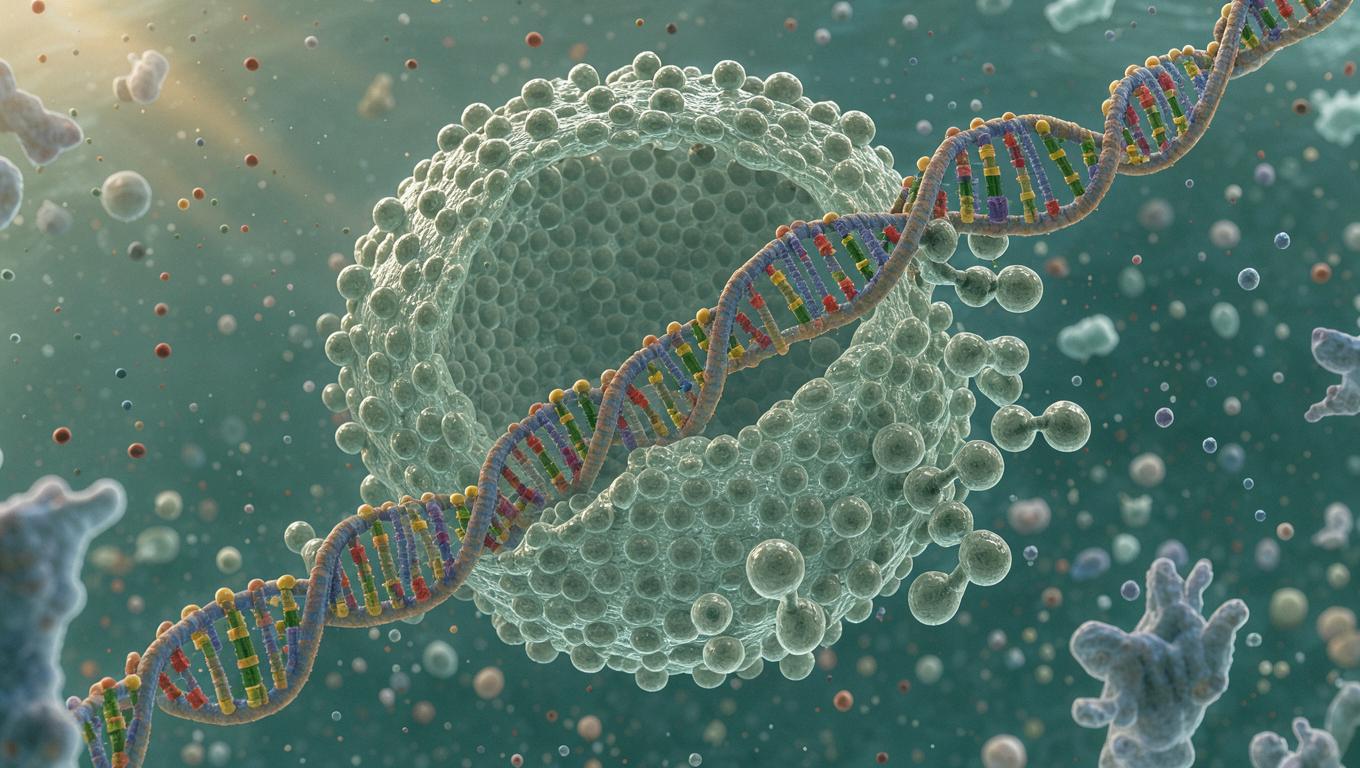
Dayani and Malmstadt report a novel hybrid nanocarrier in which cholesterol-conjugated 15-bp dsDNA covalently anchors a DOPC bilayer to a PEG-diacrylate hydrogel core, producing ~100 nm particles that remain intact in 20% serum for 136 h versus complete rupture of unanchored liposomes within 184 h, a chemically reversible (thermally meltable) cytoskeleton mimic with drug-delivery and self-assembly potential.
Long Explanation
Architecture and Validation
The authors fabricate hydrogel-cored liposomes where a cholesterol–TEG–ssDNA / acrydite–ssDNA duplex (15 bp, theoretical Tm ~55°C) spans the hydrogel–bilayer interface: cholesterol inserts into DOPC, acrydite copolymerizes with PEG-DA/PEG-MA inside the liposome lumen via thermally triggered APS/TEMED polymerization at 40°C—a liposome-core hydrogel method they note had only two prior precedents.
SEC (Sephacryl 200) shows hydrogel-liposomes and surfactant-stripped hydrogels elute identically in the void volume while surfactant-lysed plain liposomes release encapsulated rhodamine; TEM shows ~80 nm hydrogel cores; DNase treatment generates no low-MW H33342 species, implying all dsDNA resides inside the vesicle—consistent with polar DNA partitioning away from the outer leaflet.
Key stability result: anchored particles released only ~22% of ANTS payload over 184 h in 20% serum (n=3 trials, ±1 SD shown in paper), while hydrogel-only and plain liposomes achieved 100% release; DLS confirmed anchored particles avoided the serum-induced size growth seen in controls—an effect attributed to covalent anchoring raising the energy needed for bilayer delamination.
Critical Assessment
Strengths include internally consistent multi-method characterization (SEC, TEM, DLS, H33342 fluorescence dequenching) and clever controls: above-Tm SEC converts duplexes to ssDNA-nanogels, and DNA-1 titration saturates at ~9 µM with the characteristic H33342 blueshift, confirming ~20 solvent-accessible hybridization sites per nanogel—enabling DNA-programmed assembly.
Limitations: the DLS polydispersity is large (53±31 nm stripped nanogels), so the ~20-DNA count carries wide uncertainty; DOPC (fluid-phase) rather than PEGylated/stealth compositions were tested, and serum-stability comparisons to pegylated standards are absent; no in vivo, cytotoxicity, or immunogenicity data exist, so the drug-delivery framing is entirely a prototype claim; encapsulation efficiency for a model peptide was low (8–10%) and unchanged by the hydrogel, leaving cargo-loading advantages unproven. Notably, the paper itself flags these gaps—proposing degradable PEG cores and disulfide crosslinks as future work—so several apparent omissions are acknowledged rather than missed.
Conclusion (moderate confidence): the structural and stability claims are well-supported by convergent in vitro evidence; the biomimetic-cytoskeleton and drug-delivery applications remain extrapolations requiring cell/in vivo testing. Falsification would require showing DNA linkers fail to anchor under physiological shear, or that stability gains vanish in PEGylated formulations or whole serum complement.
Feedback:
Updated: October 27, 2026
BGPT Paper Review
Study Novelty
80%
First use of dsDNA as a covalent bilayer-to-hydrogel anchor in liposomes with thermally reversible, programmable connectivity; thermally triggered (non-photo) polymerization inside liposomes is also a first per the authors.
Scientific Quality
70%
Convergent multi-method characterization with good controls (DNase, above-Tm SEC, surfactant stripping, n=3 serum trials), but wide DLS polydispersity, uncertain ~20-DNA estimate, and no in vivo/cytotoxicity data cap the score.
Study Generality
70%
Platform generalizes to DNA-programmed nanogel assembly and cytoskeleton-mimetic membranes, though demonstrated only for DOPC/PEG-DA at ~100 nm.
Study Usefulness
70%
Directly useful for biomembrane biophysics and as a prototype for oligonucleotide delivery/self-assembling nanogel networks; clinical utility unproven.
Study Reproducibility
70%
Detailed recipes (ratios, temperatures, sequences in SI) support replication; reliance on SI sequences and unreported DLS fitting details slightly reduce confidence.
Explanatory Depth
60%
Mechanistic claims (anchoring raises delamination energy; polar DNA partitions internally) are plausible but qualitative; no quantitative mechanics or diffusion measurements of anchored bilayers.
We'll email you the results when your analysis is finished.
Hypothesis Graveyard
Photopolymerized lipid bilayers as the main route to stable liposomes—superseded here because covalent hydrogel anchoring achieves serum stability without modifying bilayer lipids, preserving native membrane physics.
Avidin-biotin hydrogel-bead anchoring—less programmable than dsDNA because it lacks thermal reversibility and orthogonal addressability.

 Explore by Goal
 Quick Explanation
 Long Explanation
 Top Data Sources
 Ask a Follow-Up
 Key Insight
 Keep Exploring
 Hypothesis Graveyard
 Potential Experiments
 Discussion
