Check whether claims match experiments, exact reported results, and stated limitations.Know what the science actually supports before you trust the answer.
Press Enter ↵ to review paper
Explore by Goal
"Look deep into nature, and then you will understand everything better."
- Albert Einstein
Quick Explanation
Copied
The JCI study identifies a nuclear KIF20A–SMARCA4 complex that sustains mitochondrial OXPHOS gene expression in triple-negative breast cancer stem cells; KIF20A depletion cut BCSC frequency ~3–10-fold in limiting-dilution assays and paprotrain synergized with carboplatin/paclitaxel, though validation rests on immunodeficient xenografts and a limited cell-line panel
Long Explanation
Mechanistic core: a kinesin as nuclear metabolic co-regulator
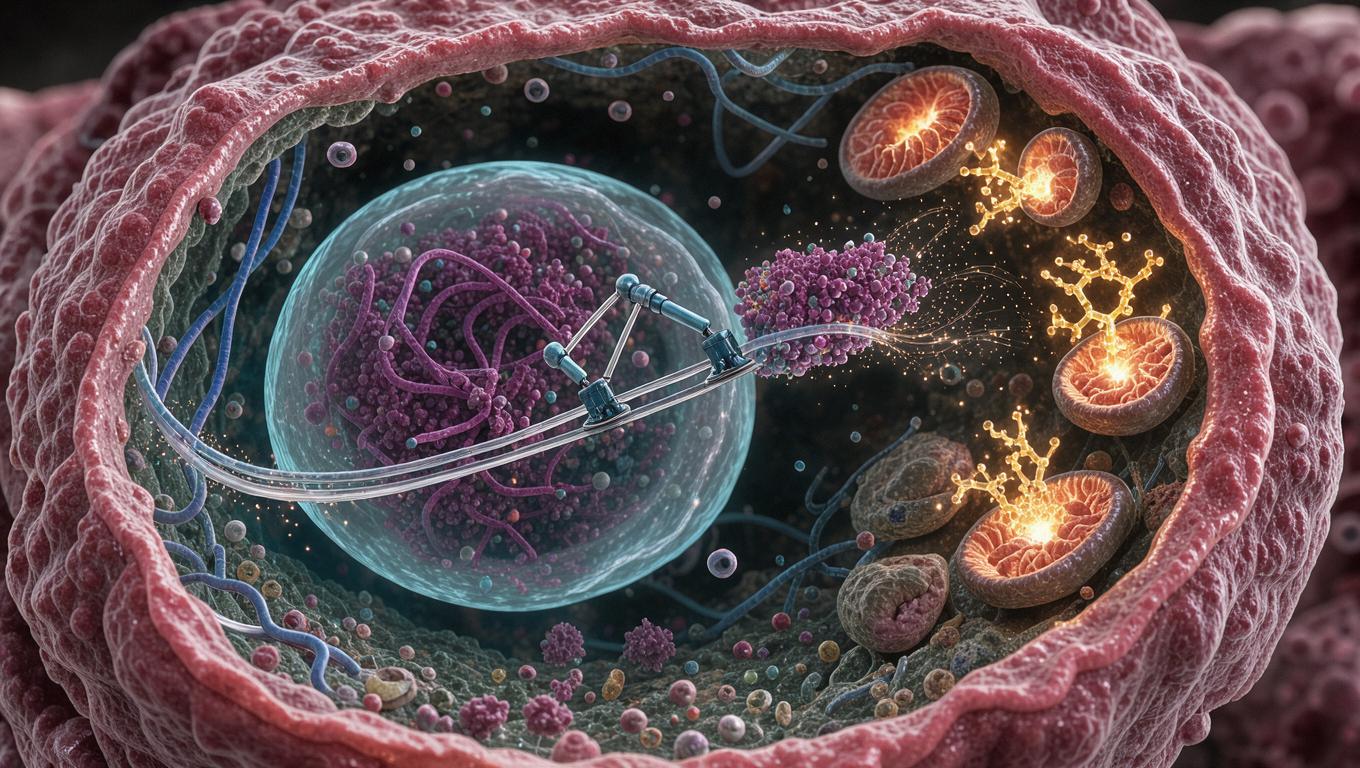
The paper's most novel claim is compartmental: KIF20A, a mitotic kinesin, enters the nucleus and co-occupies OXPHOS gene promoters with SMARCA4 (BRG1). Depletion downregulated 5 of 6 tested OXPHOS genes (NDUFB8, UQCRH, COX5B, COX8A, ATP5MF; SDHA as control), and mtDNA depletion with ethidium bromide abolished KIF20A-driven OCR changes, while cross-species mt-ND1 expression partially rescued mammosphere formation and OCR . Notably, SMARCA4 knockdown increased OXPHOS/OCR in their model — opposite direction to KIF20A — meaning the interaction is not a simple co-activation; the paper's interpretation of this asymmetry deserves scrutiny as a hidden assumption about complex stoichiometry.
Reported in vivo effect sizes. Extreme limiting dilution assays showed BCSC frequency falling from 1/315 to 1/1778 (MDA-MB-231) and 1/262 to 1/2735 (HCC1806) with two independent sgRNAs in NSG mice; paprotrain (100 mg/kg/week) reduced tumor initiation and enhanced carboplatin or paclitaxel efficacy . Two independent sgRNAs plus sgRNA-resistant rescue strengthens causal attribution, a key control the paper does include.
Context and external consistency
KIF20A's oncogenic role in breast cancer prognosis is independently supported: high KIF20A is an independent adverse prognostic marker and correlates with treatment resistance , and pharmacologic KIF20A suppression recapitulates cell-cycle arrest in colorectal cancer (docking −7.9 kcal/mol; CETSA; overexpression rescue) . The OXPHOS-stemness axis parallels known metabolic vulnerabilities of SWI/SNF-deficient tumors, where OXPHOS-targeting is listed among synthetic-lethal strategies .
Blind spots and falsification surface
Key gaps: only a subset of TNBC lines was studied; NSG mice exclude immune contributions (relevant since KIF20A-high/PD-L1-low predicts anti-PD-1 resistance in NSCLC with HR 6.61 for OS ); paprotrain's specificity is imperfect; and ChIP-PCR (not ChIP-seq) limits promoter-occupancy claims. The mechanism would be falsified if KIF20A loss failed to lower BCSC frequency in patient-derived organoids or PDX models, or if OXPHOS rescue by mt-ND1 did not restore stemness independently of chromatin effects. Whether SMARCA4's opposite effect on OCR reflects opposing BAF complex roles (cf. SMARCA4-driven state plasticity in SCLC ) remains unresolved.
Feedback:
Updated: October 27, 2026
BGPT Paper Review
Study Novelty
90%
First demonstration that a mitotic kinesin acts as a nuclear co-factor of SMARCA4 at OXPHOS promoters — a compartment-switching mechanism not previously reported for KIF20A, which had only known cell-cycle/trafficking roles.
Scientific Quality
90%
Strong causal chain (two sgRNAs, sgRNA-resistant rescue, pharmacologic confirmation, EtBr/mt-ND1 epistasis, deposited proteomics/RNA-seq). Caveats: disclosed Exelixis consultation (one author), limited TNBC line panel, ChIP-PCR rather than genome-wide ChIP, immunodeficient mice.
Study Generality
70%
TNBC/BCSC-specific, but the KIF20A–SMARCA4–metabolism motif plausibly extends to other SWI/SNF-deficient tumors; cross-cancer KIF20A prognostic data support broader relevance without direct evidence.
Study Usefulness
90%
Provides a testable dual-target strategy (KIF20A inhibition + standard chemo) with an existing tool compound (paprotrain), deposited datasets (GSE298177, PXD060031), and clear biomarker logic for BCSC-enriched chemoresistant TNBC.
Study Reproducibility
80%
Raw RNA-seq and proteomics publicly deposited, Supporting Data Values file provided, cell lines authenticated and mycoplasma-tested, ELDA statistical framework specified; paprotrain availability and ChIP-PCR protocol detail are minor gaps.
Explanatory Depth
90%
Multi-level mechanism from protein interaction through chromatin occupancy to mitochondrial respiration and tumor initiation, with epistasis experiments (mtDNA depletion, mt-ND1 rescue) that elevate it beyond correlation; SMARCA4 directional asymmetry remains partially unexplained.
Reanalyzing deposited GSE298177 RNA-seq and PXD060031 proteomics to quantify OXPHOS gene module suppression and BCSC signature changes upon KIF20A depletion in TNBC.
Get emailed when your analysis is done!
We'll email you the results when your analysis is finished.
Hypothesis Graveyard
'KIF20A affects BCSCs purely via canonical mitotic spindle function' — refuted by nuclear ChIP occupancy at OXPHOS promoters, SMARCA4 co-IP, and OCR effects occurring independently of cell-cycle effects.
'SMARCA4 and KIF20A co-activate OXPHOS transcription as partners' — undermined by the reported opposite direction of SMARCA4 knockdown (increased OXPHOS/OCR), indicating antagonistic or context-dependent roles.

 Explore by Goal
 Quick Explanation
 Long Explanation
 Top Data Sources
 Ask a Follow-Up
 Key Insight
 Keep Exploring
 Analysis
 Hypothesis Graveyard
 Potential Experiments
 Discussion
