Check whether claims match experiments, exact reported results, and stated limitations.Know what the science actually supports before you trust the answer.
Press Enter ↵ to review paper
Explore by Goal
"Science is the acceptance of what works and the rejection of what does not. That needs more courage than we might think."
- Jacob Bronowski
Quick Explanation
Copied
This 2013 study documents the first quantitative evidence of Acacia mangium invasion in Amazonian savannas, finding dispersed individuals up to 900 m from plantation edges 8-9 years after establishment, with facilitation by native tree crowns enabling nucleated regeneration .
Long Explanation
Core Findings and Evidence
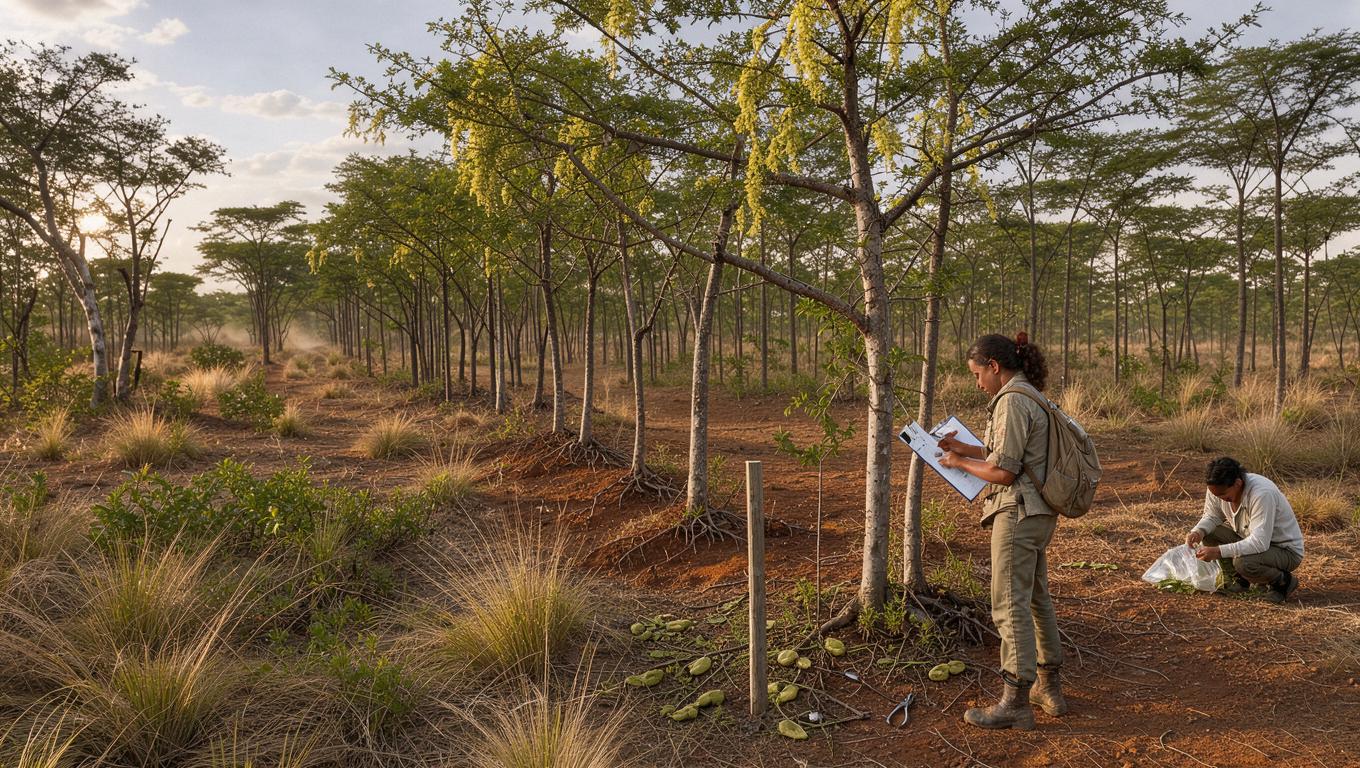
Aguiar Jr, Barbosa, Barbosa, Mourão Jr and colleagues inventoried all A. mangium and native trees in 14 plots (50 m wide × 1500 m long) across five plantation sites in north-eastern Roraima, Brazilian Amazonia . Within 8-9 years of plantation establishment, A. mangium individuals had dispersed up to 900 m from the plantation edge; most were juveniles, but reproductive adults established in two patterns: non-nucleated and nucleated beneath native tree species, with crown cover of the most abundant native savanna tree facilitating regeneration . The authors conclude that planting provides a continuous dispersal source and invasion is facilitated by savanna environmental conditions.
Caveat: The abstract reports presence up to 900 m but does not report per-section frequencies, so the figure only visualizes the reported maximum range; actual densities likely decline with distance.
Critical Assessment
Strengths: First study of forestry-driven tree invasion in Brazilian Amazonian savannas; systematic transect design with distance categories and statistical testing (correlations, goodness-of-fit); identifies both dispersal distance and recruitment mechanisms (facilitation), addressing two distinct invasion stages .
Limitations and blind spots: (1) Only five plantation sites in one region of Roraima — generalization across Amazonian savannas is untested; (2) no pre-plantation baseline data, so invasion rates cannot be separated from historical propagule pressure; (3) the facilitation claim (native crown cover aiding regeneration) is correlational — shade, seed dispersers, soil changes, or fire suppression are confounded; (4) no control sites distant from plantations to exclude other introduction pathways; (5) sampling occurs at a single time point 8-9 years post-planting, so temporal spread dynamics and future invasion trajectory are inferred, not measured; (6) management implications (e.g. buffer zones, eradication thresholds) are not quantified. Funding sources (Roraima State environmental/academic institutions, CNPq) appear public-academic, with no obvious industry conflict reported in the record.
Verdict
The paper makes a credible, well-designed observational contribution establishing A. mangium as an emerging invader in Amazonian savannas and highlighting facilitation as a key mechanism. Its conclusions are appropriately scoped to observed data, but longitudinal monitoring and replicated regional sampling would strengthen causal claims about spread rate and facilitation. Related work on A. mangium silviculture (e.g. mycorrhizal inoculation effects across soils) shows the species' broad edaphic tolerance, consistent with high invasion potential , and mixed plantations with N-fixing acacia alter soil microbial communities — both plausibly amplifying invasion feedbacks, though untested in the Roraima system.
Feedback:
Updated: October 27, 2026
BGPT Paper Review
Study Novelty
70%
First documentation of forestry-driven A. mangium invasion in Brazilian Amazonian savannas; the facilitation-by-native-crowns mechanism is an important addition to tree invasion ecology, though tree invasion via plantation escape is well documented globally.
Scientific Quality
60%
Systematic transect inventory with statistical testing is solid for an observational study, but absence of controls, single time point, five sites, and correlational facilitation evidence limit inferential strength.
Study Generality
60%
Findings speak to plantation-escape invasion broadly and savanna invasion ecology, but are region-specific and species-specific with untested generality across Amazonian savannas.
Study Usefulness
70%
Directly informs forestry planting policy in Roraima (buffer zones, risk assessment) and provides baseline data for invasion monitoring in a previously unstudied system.
Study Reproducibility
50%
Methods (plot dimensions, distance categories, statistical tests) are described at the protocol level in the abstract/TEI record, but raw data, exact test statistics, and site coordinates are not available in the supplied text.
Explanatory Depth
50%
Describes dispersal extent and recruitment patterns but mechanism of facilitation is inferred from correlation; no mechanistic tests (shade, fire, soil, dispersers).
We'll email you the results when your analysis is finished.
Hypothesis Graveyard
Plantation escape requires prior habitat disturbance: falsified as a universal requirement here because non-nucleated establishment occurred in open savanna, indicating disturbance is not obligatory for this species.
Wind dispersal dominates tree invasion: unlikely for A. mangium (arillate, animal-dispersed seeds), so the 900 m spread likely reflects animal dispersers or water routes — a mechanism the paper does not resolve.

 Explore by Goal
 Quick Explanation
 Long Explanation
 Top Data Sources
 Ask a Follow-Up
 Key Insight
 Keep Exploring
 Hypothesis Graveyard
 Potential Experiments
 Discussion
