Check a paper's claims against linked experiments, exact results, stated scope, and limitations.Know what falsifiable science actually supports before you trust the answer.
Press Enter ↵ to search evidence
Explore by Goal
"The day science begins to study non-physical phenomena, it will make more progress in one decade than in all the previous centuries of its existence."
- Nikola Tesla
Quick Answer
Copied
Kuijl et al. report that host kinase inhibition—centered on AKT1/PKB—blocks intracellular growth of S. typhimurium and M. tuberculosis, including MDR strains, via a chemical-genetics plus kinome-wide siRNA strategy identifying SopB–AKT1–PAK4/AS160–RAB14 signaling as the mechanistic axis .
Long Answer
Evidence and mechanism
The authors screened kinase inhibitors against intracellular Salmonella typhimurium in MCF7 cells (Lux-expressing SL12023, 18 h, luminescence plus c.f.u. and FACS confirmation); only H-89 blocked intracellular growth without impairing host-cell proliferation, and it did so in multiple cell lines including primary human macrophages .
Two design strengths stand out. First, H-89 analogues were synthesized to build a chemical profile: H-89, ETB067 and ETB275 inhibited intracellular growth in primary human macrophages, and the same chemical profile held for M. smegmatis and M. tuberculosis, suggesting a shared host kinase controlling unrelated pathogens . Second, a Dharmacon siRNA library of 779 smartpools (658 kinome candidates plus 121 kinase-associated/regulatory proteins) was screened by automated microscopy; hits clustered around AKT1, and the mechanism was traced to SopB-activated AKT1 controlling actin dynamics through PAK4 and phagosome-lysosome fusion through AS160 (TBC1D4)-RAB14 .
Critical appraisal
Reported strengths: reciprocal chemical genetics (inhibitor profile matched to RNAi hits), convergence across pathogens including MDR-M. tuberculosis, and controls showing H-89 had no direct antibacterial effect in broth or phagosome-mimicking conditions and did not reduce host viability. BGPT-noted caveats: the siRNA screen was performed in MCF7 cells rather than macrophages, so hit ranking may partly reflect that cell type; the paper states 'experiments repeated at least three times' for macrophage infections, but per-figure error bars and statistical tests are not visible in the supplied text; and kinase inhibitors like H-89 have known off-target profiles, so the paper's reliance on multiple analogues is appropriate but residual off-target risk remains. Potential confound: blocking host AKT1 could indirectly suppress bacterial growth via general host-stress effects; the paper partially addresses this by showing no viability loss, yet a fully matched inactive-analogue control across all cell types is not described in the supplied text. The host-directed approach is conceptually general—targeting conserved host pathways sidesteps resistance acquisition by the pathogen—but translation to patients is constrained by AKT's role in normal insulin/glucose signaling and cancer biology, which the paper does not evaluate.
What would change this conclusion
Failure of AKT1-specific inhibitors (beyond H-89 analogues) to phenocopy the siRNA knockdown; rescue experiments where constitutively active AKT1 restores intracellular growth despite inhibitor; or demonstration that SopB's AKT1 activation is dispensable for intracellular survival would falsify the proposed network. The paper presents the SopB-AKT1 axis as sufficient for the observed phenotype, but whether it is the sole or dominant route remains an open question.
Feedback:
Updated: November 21, 2026
BGPT Paper Review
Study Novelty
80%
Host-directed antibacterial therapy via a defined AKT1-centered kinase network was a relatively new concept in 2007; reciprocal chemical genetics linking inhibitor profiles to RNAi hits was methodologically fresh.
Scientific Quality
80%
Nature-level rigor with orthogonal approaches (chemical genetics, RNAi, microscopy, c.f.u.); red-flags are minimal but include reliance on H-89's promiscuous off-target profile and screening in MCF7 rather than macrophages.
Study Generality
80%
The host-kinase paradigm applies across unrelated pathogens (Salmonella, mycobacteria including MDR strains), suggesting broad host-directed therapeutic potential.
Study Usefulness
80%
Identifies host AKT1 as a druggable antibacterial target and maps the SopB-AKT1-PAK4/AS160-RAB14 pathway, directly informing host-directed antibiotic development.
Study Reproducibility
70%
Methods, strains, cell lines, and MOI are described and experiments repeated ≥3 times with duplicate wells, but per-figure statistics and some controls are described as 'not shown'.
Explanatory Depth
70%
Mechanistic depth is good: SopB→AKT1→PAK4 (actin) and AS160-RAB14 (phagosome-lysosome fusion) are mapped, though upstream SopB biochemistry and full network wiring remain incomplete.
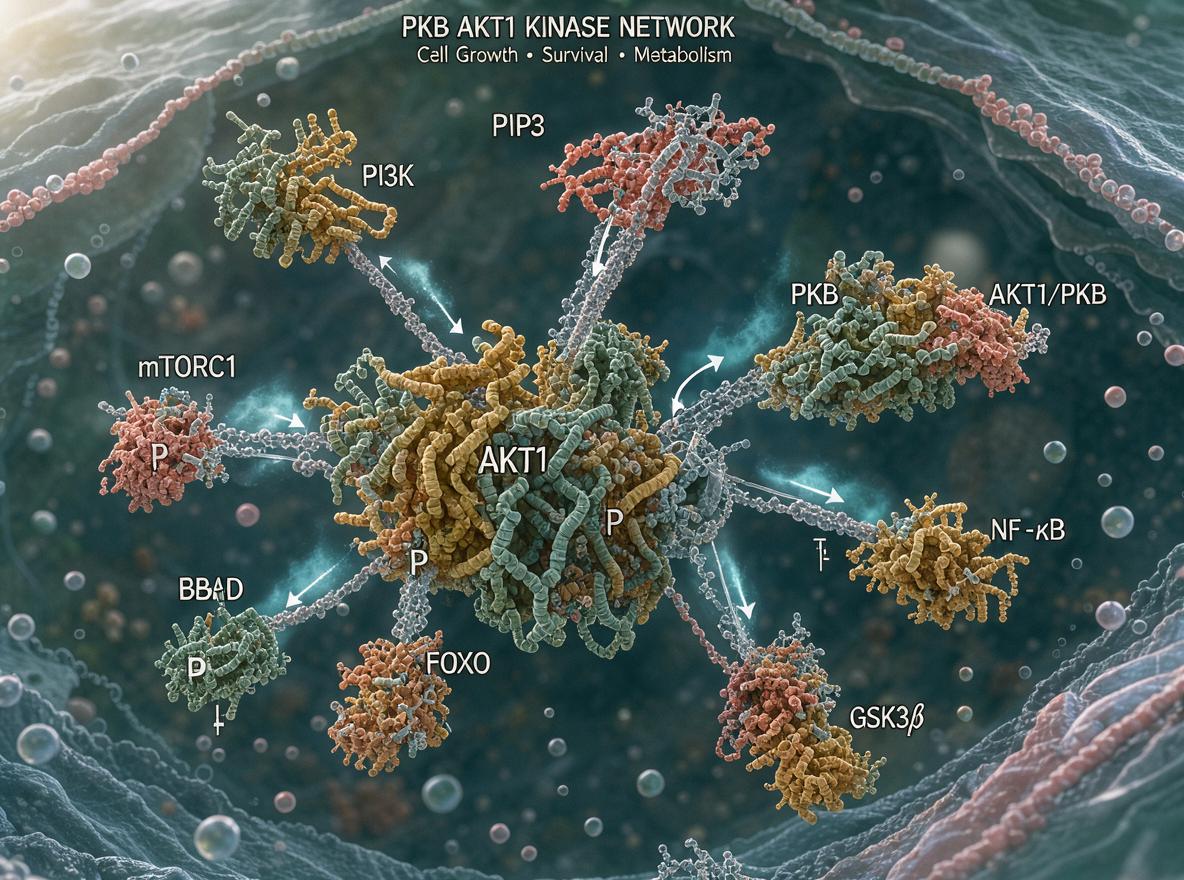
Mapping the SopB-AKT1-PAK4/AS160-RAB14 host kinase network from the Kuijl 2007 paper onto protein interaction databases to visualize pathway connectivity and identify druggable nodes.
Get emailed when your analysis is done!
We'll email you the results when your analysis is finished.
Hypothesis Graveyard
H-89 acts on PKA to block Salmonella growth: rejected because two other PKA inhibitors failed to phenocopy, pointing to off-PKA targets.
H-89 directly inhibits a bacterial kinase: rejected because bacterial growth was unaltered in broth and phagosome-mimicking conditions.

 Explore by Goal
 Quick Answer
 Long Answer
 Top Data Sources
 Ask a Follow-Up
 Key Insight
 Keep Exploring
 Analysis
 Hypothesis Graveyard
 Potential Experiments
 Discussion
