Check a paper's claims against linked experiments, exact results, stated scope, and limitations.Know what falsifiable science actually supports before you trust the answer.
Press Enter ↵ to search evidence
Explore by Goal
"The science of today is the technology of tomorrow."
- Edward Teller
Quick Explanation
Copied
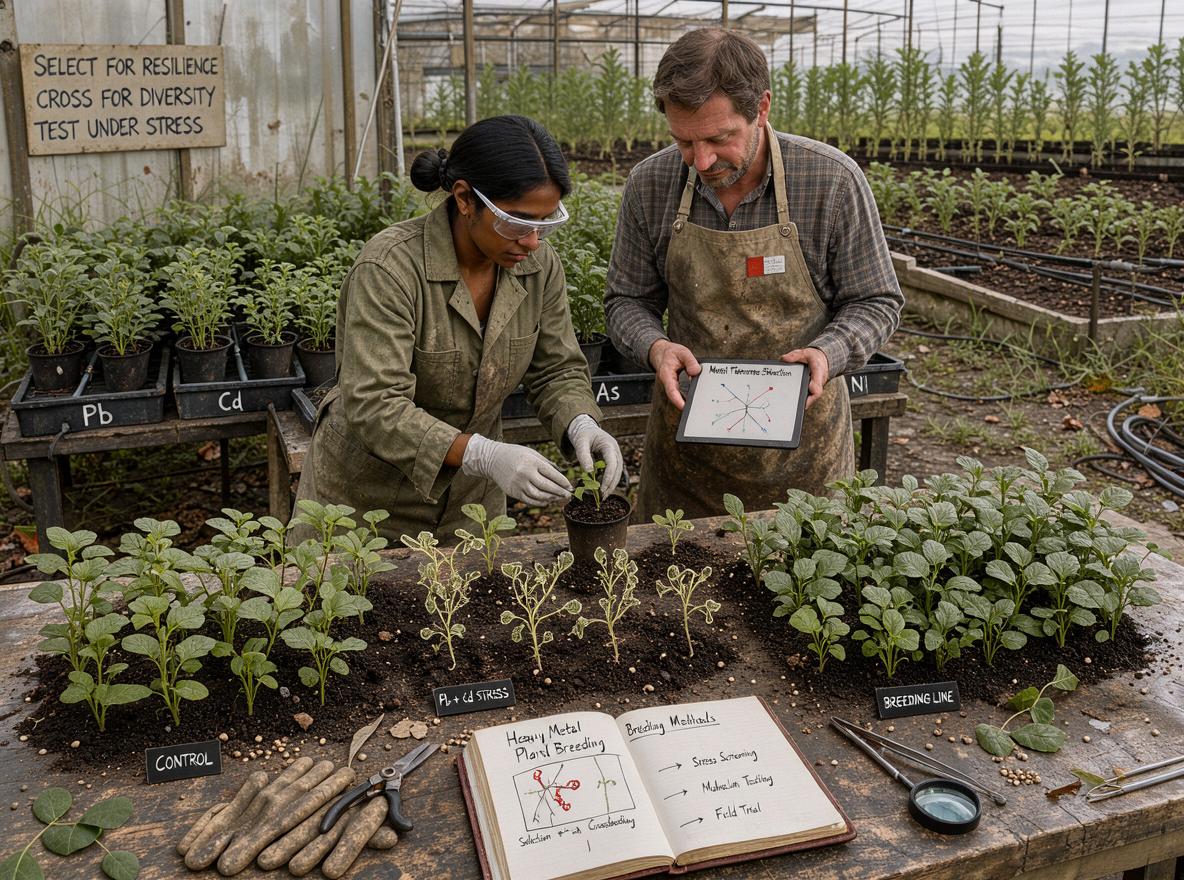
This 2015 review outlines a three-stage in vitro breeding pipeline (callus initiation → HM selection → regeneration) for developing heavy metal-resistant plants via somaclonal variation, concluding the method is non-GMO, cost-effective, and underutilized, with no commercialized HM-resistant variants existing at publication .
Long Explanation
Evidence Base of the Review
Ashrafzadeh and Leung synthesize the in vitro breeding workflow into three stages: callus induction, HM exposure during proliferation as selective agent, and regeneration of resistant variants. They report that sub-lethal single HM exposure is more commonly used than stepwise increases because prolonged subculture (4–8 months in >25% of studies) can reduce regeneration to under 10% .
Key mechanistic observations from cited studies include phytochelatin binding ~90% of Cd in resistant tomato cells and Cd/Pb excluder phenotypes in >50% and >70% of Indian mustard variants, respectively .
Critical Gaps and Limitations
The authors honestly acknowledge that regenerant resistance was not evaluated in early studies (Rout 1998/1999; Samantaray 1999/2001), a significant reproducibility gap . Notably absent: molecular characterization of somaclonal variants (needed to confirm non-GMO status), field validation, heritability testing beyond a few crops, and ecological impact assessment — consistent with later reviews of epigenetic somaclonal mechanisms . Comparing with contemporary genomic approaches (e.g., whole-genome sequencing of HM-resistant microbes, CRISPR transgene-free editing) shows the 2015 review's framing of "non-GMO public acceptance" is time-bound and less decisive today .
Verdict
A concise, well-structured conceptual review useful for teaching the pipeline, but the evidence base is thin (few studies, no commercialized variant, no molecular validation), and the framework has been partially superseded by transgene-free genome editing and mechanistic genomic approaches.
Feedback:
Updated: November 22, 2026
BGPT Paper Review
Study Novelty
60%
The review compiles the few existing somaclonal HM-resistance studies into a unified three-stage framework; conceptually it extends prior in vitro selection reviews (e.g., Rai et al. 2011) but adds HM-specific organization without introducing new experimental data.
Scientific Quality
70%
Well-organized and transparent about limitations (e.g., missing regenerant resistance evaluation in early studies), but relies on a small, older, heterogeneous literature; no systematic search strategy, quantitative meta-analysis, or molecular characterization is provided.
Study Generality
70%
Moderate depth: reviews mechanistic themes (phytochelatin binding, antioxidant enzymes, excluder vs. accumulator phenotypes) but stops short of molecular or epigenetic mechanistic detail that later literature has provided.
Study Usefulness
60%
Practically useful as a methodology primer for breeders exploring non-GMO HM-resistant lines, but no commercial variant exists and the technique is largely superseded by transgene-free CRISPR and genomic selection approaches.
Study Reproducibility
40%
As a review it reports summarized results from heterogeneous primary studies with inconsistent reporting (e.g., some studies never verified regenerant resistance); no new protocols, raw data, or standardized benchmarks are provided.
We'll email you the results when your analysis is finished.
Hypothesis Graveyard
Somaclonal variation is purely random and undirected — falsified by consistent enrichment of antioxidant and phytochelatin pathways across HM-selected variants, suggesting selection pressures target specific detoxification modules.

 Explore by Goal
 Quick Explanation
 Long Explanation
 Top Data Sources
 Ask a Follow-Up
 Key Insight
 Keep Exploring
 Hypothesis Graveyard
 Potential Experiments
 Discussion
