Check a paper's claims against linked experiments, exact results, stated scope, and limitations.Know what falsifiable science actually supports before you trust the answer.
Press Enter ↵ to search evidence
Explore by Goal
"The finding of the double helix thus brought us not only joy but great relief. It was unbelievably interesting and immediately allowed us to make a serious proposal for the mechanism of gene duplication."
- James Watson
Quick Explanation
Copied
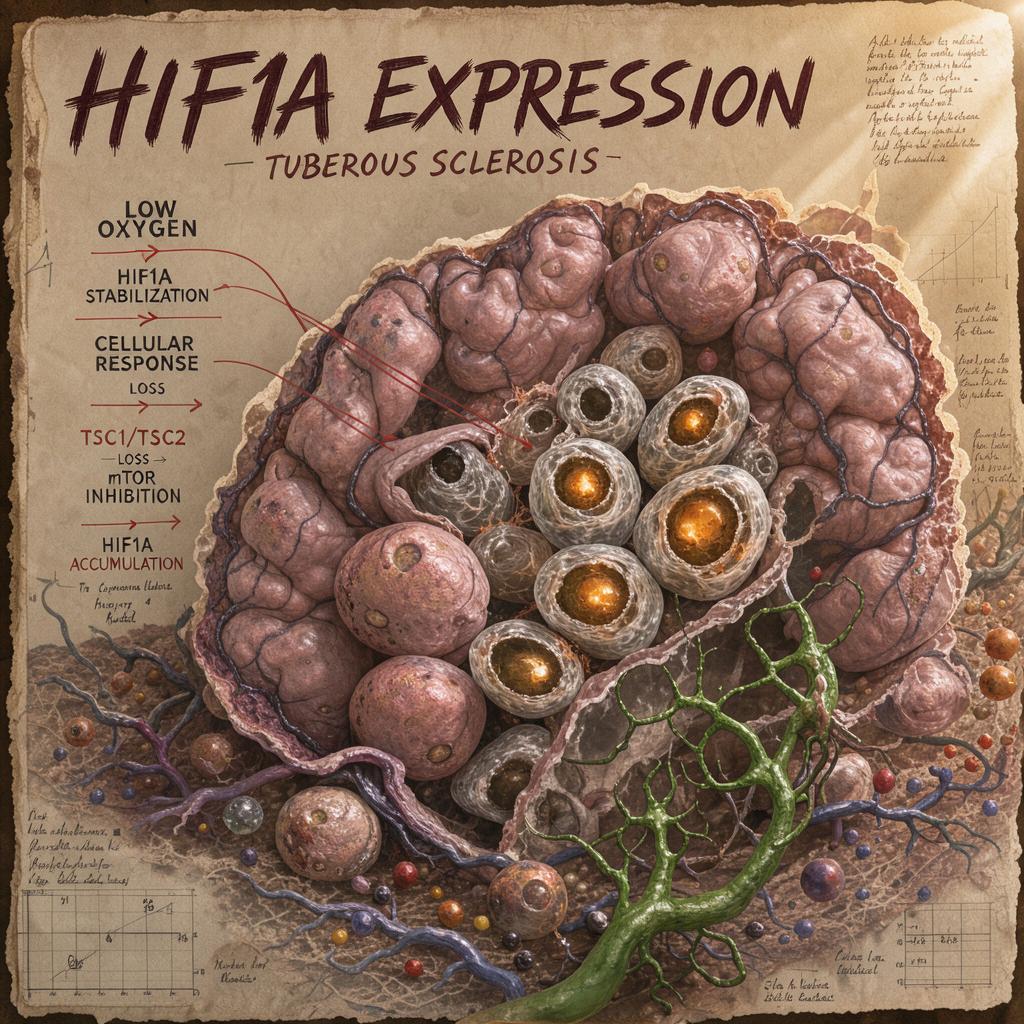
This in vivo study shows that HIF1a contributes to Tsc1-null dendritic overgrowth: HIF1a knockdown or dominant-negative HIF1a reduced dendritic complexity of Tsc1-null olfactory bulb neurons, while HIF1a overexpression in wild-type neurons increased dendritic complexity and drove a ~4-fold increase in HRE-luciferase activity (p<0.001)
Long Explanation
Core Findings and Evidence Chain
The paper (Zhang, Feliciano, Huang, Zhang, Bordey; Neuroscience Letters, 2016) builds on the authors' prior work showing that neonatal electroporation of Cre into Tsc1fl/mut mice yields olfactory bulb (OB) granule neurons with hyperactive mTORC1, elevated Hif1a mRNA, and dendritic overgrowth. Four in vivo manipulations form the causal chain: (1) Tsc1-null neurons show increased basal dendritic complexity vs heterozygous littermates (n=34 neurons/group, N=4 mice, P28); (2) shRNA knockdown of HIF1a reduces this overgrowth (n>20 neurons, N=4, P14); (3) a dominant-negative HIF1a (K532R) replicates the knockdown effect, guarding against shRNA off-targets; (4) HIF1a overexpression in wild-type neurons is sufficient to increase dendritic complexity (n=32, N=3) and produces a ~4-fold increase in HRE-driven luciferase activity (p<0.001, N=11 vs N=6) .
The HRE reporter result is the strongest quantitative evidence (4-fold, p<0.001); the morphological results are reported as significant but exact effect sizes (Sholl crossings, dendritic lengths) are only in figures, limiting quantitative re-analysis.
Critical Assessment
Strengths: in vivo design; two independent loss-of-function approaches (shRNA + dominant negative); sufficiency experiment (overexpression); blinded Sholl analysis; littermate controls matching TSC patient genetics (fl/mut) . Weaknesses the authors partially acknowledge: HIF1a knockdown causes substantial neuronal death, so reduced dendritic complexity could reflect sick/dying neurons rather than a specific morphogenic role — the overexpression experiment argues for sufficiency but does not cleanly dissociate survival from maturation. Sholl analyses were restricted to basal dendrites (apical dendrites excluded for technical reasons), so conclusions about "dendritic complexity" are partial. The NR1 mechanism is explicitly flagged as untested in TSC. Generalizability is limited to neonatal OB granule neurons; whether HIF1a drives overgrowth in cortical tubers or other mTORC1-hyperactive contexts remains untested. Broader context: mTORC1 is known to activate a HIF1a/SREBP metabolic transcriptional program in Tsc-null cells , making the neural extension plausible but consistent with what was already known biochemically — the novelty here is the dendritic phenotype link, not the pathway.
What would falsify or revise the conclusion: failure of HIF1a knockdown to reduce overgrowth with a validated, non-toxic knockdown (e.g., inducible or partial knockdown preserving survival); HIF1a overexpression failing to alter dendrites in cortical neurons; or demonstration that dnHIF1a phenocopies toxicity rather than transcriptional blockade. Small N (3–4 mice/group) also means replication with larger cohorts is warranted .
Feedback:
Updated: November 23, 2026
BGPT Paper Review
Study Novelty
70%
First in vivo demonstration linking HIF1a to dendritic overgrowth in Tsc1-null neurons, but the mTORC1-HIF1a axis was already established; the dendritic phenotype link is the new contribution.
Scientific Quality
70%
Rigorous dual loss-of-function approach with littermate controls, but small N (3-4 mice/group), shRNA toxicity confound acknowledged by authors, effect sizes confined to figures, and no direct NR1 testing.
Study Generality
60%
Conclusions are restricted to neonatal OB granule neurons via electroporation; whether the mechanism operates in cortical tubers or other brain regions is untested, though the authors frame it as broadly relevant to mTORC1-hyperactive states.
Study Usefulness
70%
Establishes HIF1a as a mediator of disease-relevant dendritic pathology, guiding target identification, though the authors themselves note pharmacological HIF1a inhibition is neuron-lethal, limiting direct translation.
Study Reproducibility
70%
Methods are detailed (electroporation parameters, plasmids from Addgene, analysis software), but no data deposition; Sholl and length values only in figures; moderate cohort sizes support feasible replication.
Explanatory Depth
60%
Demonstrates necessity and sufficiency of HIF1a but leaves the downstream mechanism (NR1 hypothesis) explicitly untested; mechanistic depth is correlational beyond the HRE reporter.
Simulating Sholl analysis power calculations and comparing dendritic complexity distributions across Tsc1-null, shHIF1a-rescued, and HIF1a-overexpression conditions using reported sample sizes to identify replication requirements.
Get emailed when your analysis is done!
We'll email you the results when your analysis is finished.
Hypothesis Graveyard
HIF1a reduction rescues TSC dendritic overgrowth purely via restored mTORC1 feedback — unsupported because HIF1a is downstream of, not regulating, mTORC1 in this model, and dnHIF1a phenocopies knockdown.
Dendritic overgrowth in TSC is solely rapamycin-sensitive mTORC1 signaling independent of transcription factors — weakened by this paper showing a downstream transcriptional mediator contributes independently in vivo.

 Explore by Goal
 Quick Explanation
 Long Explanation
 Top Data Sources
 Ask a Follow-Up
 Key Insight
 Keep Exploring
 Analysis
 Hypothesis Graveyard
 Potential Experiments
 Discussion
