Check each claim against its experiments, reported results, scope, and stated limitations.Know what the science actually supports before you trust the answer.
Press Enter ↵ to start review
Explore by Goal
"The whole of science is nothing more than a refinement of everyday thinking."
- Albert Einstein
Quick Explanation
Copied
Engineered hygrochastic seedpods (crack-opening wooden and dissolving PVA/BA shells with wax diffusion timers) held seeds in measurable microclimates ~2-3 °C warmer and drier than soil and accelerated early seedling emergence in indoor and irrigated field trials without growth penalties . The mechanism is plausible and directly measured, but the field test was irrigated at a single site with one-month monitoring, so natural-rainfall gating and long-term establishment remain untested .
Long Explanation
What the paper shows
This preprint demonstrates two moisture-responsive seedpods: a crack-opening maple-veneer pod and a dissolving poly(vinyl alcohol)/boric acid (PVA/BA) pod, both gated by beeswax-carnauba coatings acting as diffusion-limited timers. Enclosed sensors showed pod interiors ran ~2-3 °C above soil with RH stabilized near 80-85% while surrounding soil was near saturation, and these differences persisted after opening . Activation delay scaled with wax loading: wooden pods from ~3 h to 48 h with an inner wax barrier; PVA/BA disintegration from ~60 h to 129 h with concentration, consistent with Fickian square-root-of-time sorption (n=7 sorption specimens) .
Efficacy and statistics
Indoor (n=8 seeds/treatment/species), wooden 1 h pods reached ~62-64% predicted B. lenta emergence by week 3 vs ~26-27% control; P. menziesii wooden 48 h hit 86% week-1 emergence vs 19% control. However, most pairwise contrasts were uncertain after Holm correction (only P. strobus 1 h vs control significant, p=0.025), and height growth showed no design effect (Betula p=0.207; Pinus p=0.878; P. menziesii p=0.367) . The field trial (150 seeds/treatment, two blocks, irrigated ~43% soil moisture) showed wooden 48 h leading at first emergence on Day 12 (24%) and final emergence 64-77% for pods .
Critical assessment
Strengths: the methodological advance is real—enclosing an air cavity enables direct microclimate measurement rather than inference from plant performance, and the wax-timer design space is quantitatively characterized. Statistical treatment (GLS with AR(1) errors, Holm adjustment, µ-CT verification of root emergence) is appropriately conservative and honestly reported.
Weaknesses and blind spots: (1) the field test was irrigated, so the core ecological claim—gating against natural rainfall variability and false-start rains—was never tested; (2) only one field site and one field species; (3) monitoring pods were larger (2.59 cm³) than germination pods (~370 mm³) and pod-size effects were not studied, creating a scale-transfer gap between the mechanism data and the efficacy data; (4) no field-level uncertainty or significance tests for emergence contrasts are reported in the text; (5) small activation-time replicates (n=3 for PVA/BA); (6) microclimate data come from one representative 48-h dataset. The authors acknowledge most of these . A further unstated assumption is that warmer/drier cavities cause earlier emergence—causation is inferred, not isolated by factorial manipulation of temperature and timing.
What would falsify the central claim: unirrigated trials where pod-protected seeds fail to outperform direct sowing under erratic rainfall, or sensor data showing no interior-soil microclimate differential in full-size pods. Data are promised on Zenodo, aiding reproducibility .
Feedback:
Updated: October 08, 2026
BGPT Paper Review
Study Novelty
80%
First demonstration of engineered temporal gating of the post-dispersal seed microclimate with direct in-pod sensing; prior seed-enhancement technologies were conformal, non-gating, and unmeasured, though bioinspired deployment carriers exist.
Scientific Quality
70%
Careful statistics (GLS/AR1, Holm correction) and honest limitations, but irrigated single-site field test, one representative microclimate trace, small n for PVA/BA timing (n=3), scale mismatch between sensing and germination pods, and no factorial isolation of the causal mechanism.
Study Generality
60%
Focused on restoration tree species at one site; the gating-plus-microclimate concept generalizes to direct seeding broadly, but evidence base is narrow.
Study Usefulness
70%
Directly actionable for restoration engineering: programmable activation hours-to-days and measurable microclimates open a new design space, though cost/throughput preclude landscape deployment today.
Study Reproducibility
60%
Detailed fabrication recipes (materials, wax temperatures, mold dimensions) and promised Zenodo data; however, no full statistical tables in text and pod-size/soil variability complicate exact replication.
Explanatory Depth
70%
Fickian diffusion timer model plus microclimate measurements give mechanistic grounding, but the link between warmer/drier cavities and emergence timing is correlational, not experimentally isolated.
We'll email you the results when your analysis is finished.
Hypothesis Graveyard
Seedpods act mainly as granivore protection like natural hygrochastic structures—the data show wildlife disturbances affected all treatments equally and no protection effect was isolated, so microclimate/timing, not predation, is the better-supported mechanism.
Pelleting and coating failures are due to poor materials—the paper shows they fail structurally (no air volume, no gating), reframing the problem as geometric/architectural rather than chemical.

 Explore by Goal
 Quick Explanation
 Long Explanation
 Top Data Sources
 Ask a Follow-Up
 Key Insight
 Keep Exploring
 Hypothesis Graveyard
 Potential Experiments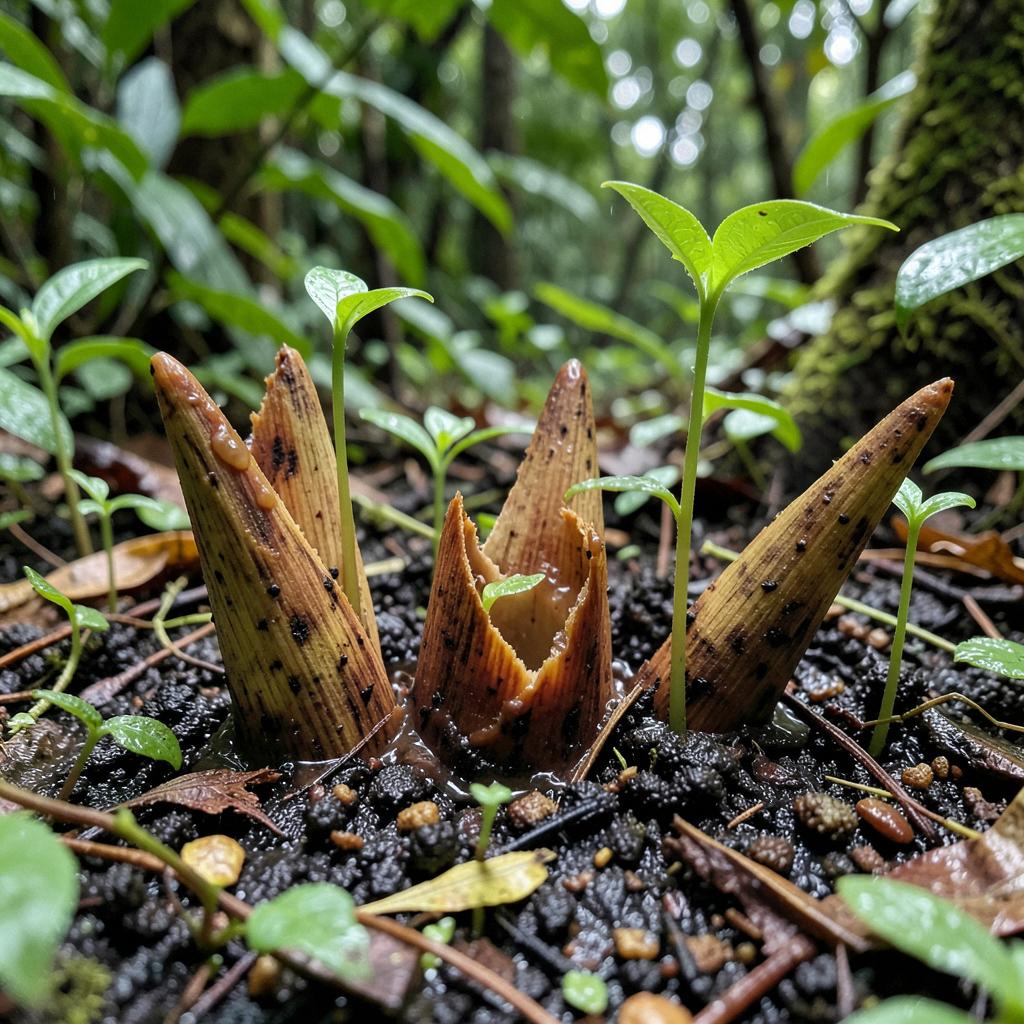
 Discussion