Analyze how experimental results and claims are presented, scoped, and limited in a paper.Know what the science actually supports before you trust the answer.
Press Enter ↵ to analyze
Explore by Goal
"The most beautiful thing we can experience is the mysterious. It is the source of all true art and science."
- Albert Einstein
Quick Explanation
Copied
This Pfizer structure-based design study identified a novel allosteric site at the dimer interface of human liver glycogen phosphorylase a (HLGPa), and exploited it rationally: linking two chloroindole carboxamide ligands boosted potency ~2000-fold to 6 nM (CP-526,423) . The work is a landmark of ligand-linking drug design, though its central limitation—absence of direct in vivo validation in this paper—was later partly addressed by independent canine efficacy data .
Long Explanation
The Central Discovery: A Novel Allosteric Site at the Dimer Interface
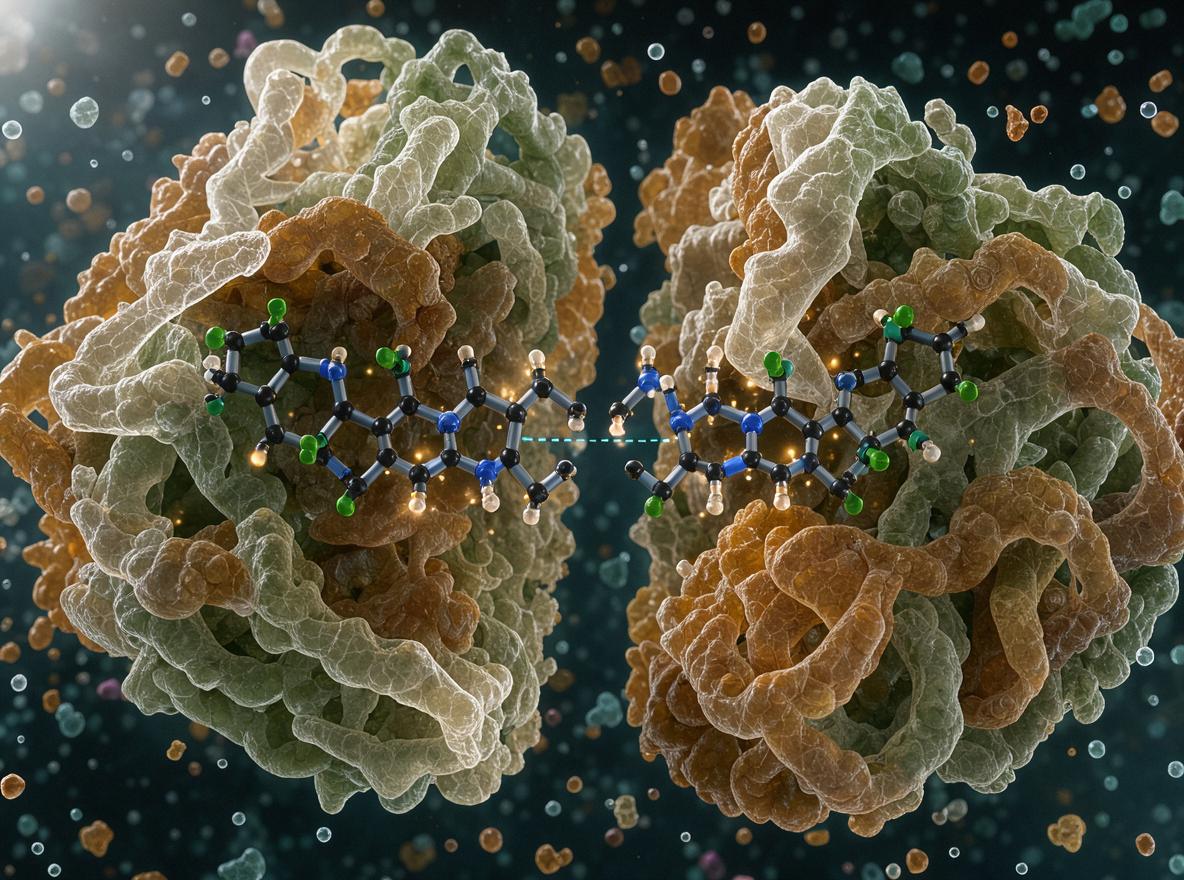
Rath et al. (Pfizer) solved two X-ray crystal structures of human liver glycogen phosphorylase a (HLGPa) complexed with indole-2-carboxamide inhibitors: HLGPa/GlcNAc/CP-403,700 at 2.4 Å resolution (PDB 1EXV) and HLGPa/GlcNAc/CP-526,423 at 2.2 Å (PDB 1EMG) . The site is genuinely novel: two inhibitor molecules bind near the molecular 2-fold axis within a solvent-filled cavity at the dimer interface, forming one continuous composite binding pocket spanning both subunits. This was contrary to the authors' initial hypothesis that these glucose-sensitizing inhibitors bound the caffeine site—synergy with caffeine correctly indicated a distinct locus.
Structurally, the site has two distinct environments: a hydrophobic chloroindole pocket (Arg60, Lys191 aliphatic chains plus six hydrophobic residues, burying 266 Ų of hydrophobic surface) and a second, polar/solvent-exposed region built from both subunits. Critically, in the active conformation, the side chains of Arg60, Val64, and Lys191 sterically occlude this site and must move to accommodate binding—providing a plausible mechanistic basis for how binding stabilizes the inactive conformation.
The Masterstroke: Structure-Guided Ligand Linking
Recognizing that the two bound CP-403,700 molecules sit within 6 Å of each other, the team applied Jencks' ligand-additivity principle and covalently joined two chloroindole carboxamide units. The resulting bis-indole CP-526,423 inhibits HLGPa with an IC50 of 6 nM—a ~2000-fold improvement over its unlinked analog CP-305,494—and the crystal structure confirms a single molecule spans both pockets (chloroindole r.m.s.d. of 0.34 Å versus CP-403,700) . This is a textbook demonstration of entropic advantage in fragment linking—rarely executed so cleanly then.
The graph shows the glucose-synergy data: within the physiologic glucose range, potency strengthens nearly 8-fold, a mechanism the authors emphasize as hypothecemia-protective—inhibition deepens precisely when glucose is abundant.
Allosteric Mechanism and Independent Validation
Functionally, CP-403,700 behaves as a classic Monod-Wyman-Changeux allosteric effector: it doubles the rate of PP1-mediated dephosphorylation of Ser14 and synergizes with active-site inhibitors . Later thermodynamic work on related indole-site inhibitors (AVE5688, AVE2865, AVE9423) confirmed enthalpy-driven binding preferential to the inactive b-form, supporting the site's physiological relevance . In vivo validation came from canine studies using CP-316819, where GP inhibition completely suppressed basal hepatic glucose output and blocked glucagon-stimulated output by diverting flux into glycogen synthesis .
Critical Limitations and Blindspots
Species and isoform gaps: The concurrent rabbit-muscle GPb structure of CP-320,626 (Oikonomakos et al.) confirmed site conservation, but muscle isoform relevance matters differently—skeletal muscle concerns were later tested in rats, where CP-316819 reduced GP activation without impairing force production .
Crystal artifacts: Both structures required GlcNAc co-crystallization (CP-403,700 alone failed to yield crystals), so the reported conformation may partially depend on the active-site ligand; the authors acknowledge minimal effort to crystallize without it.
In vitro IC50 vs pharmacology: All potency data derive from malachite-green phosphate-release assays in purified enzyme; hepatocyte-level and human PK data were absent from this paper—arguably its largest gap at publication.
Industry context: As a Pfizer-discovery paper with an accompanying EPO patent, positive-result framing toward therapeutic potential is expected; claims of "most potent inhibitors to date" were accurate then but did not survive into approved drugs—no GP inhibitor for diabetes ever reached the clinic.
Bottom line: The structural work is rigorous, the ligand-linking result is reproducible from reported data, and the mechanistic claims were independently corroborated. The paper overpromised only in therapeutic translation—a caveat of the era, not a flaw of the science.
Feedback:
Updated: November 01, 2026
BGPT Paper Review
Study Novelty
90%
First crystallographic description of a previously unknown allosteric site on the heavily-studied (60+ years biochemically, 30+ crystallographically) liver phosphorylase, plus a textbook demonstration of ligand-linking yielding 2000-fold potency gain.
Scientific Quality
90%
High-resolution structures with complete refinement statistics (R/Rfree 0.236/0.280 and 0.233/0.264), deposited coordinates (1EXV, 1EMG), duplicated assays, and an independently confirmed rabbit-muscle analog structure. Main weakness: GlcNAc was required for crystallization, and CP-403,700-alone crystals were not attempted seriously.
Study Generality
80%
Advances allosteric-drug-design methodology (dimer-interface pockets, ligand linking) applicable beyond phosphorylase, though the specific site biology is enzyme-class specific.
Study Usefulness
90%
Directly enabled second-generation inhibitor design and established the structural foundation for the entire indole-site GP inhibitor program later validated thermodynamically (2008) and in vivo (canine, 2011).
Study Reproducibility
80%
Coordinates deposited in PDB; assay conditions (buffer, pH, DMSO, temperature) fully specified; IC50s averaged from duplicate triplicate determinations. CP-526,423 synthesis deferred to a later publication, slightly reducing reproducibility.
Explanatory Depth
90%
Mechanistic explanation is deep: side-chain occlusion in the active conformation (Arg60, Val64, Lys191), burial energetics (266 sq. A hydrophobic surface), synergy with glucose/caffeine, and 2-fold dephosphorylation acceleration all form a coherent allosteric model.
We'll email you the results when your analysis is finished.
Hypothesis Graveyard
These glucose-sensitizing inhibitors bind the caffeine site. Falsified by the authors' own synergy data: caffeine synergized with rather than competed with the compounds, correctly predicting a distinct locus confirmed crystallographically.
Two separate inhibitor molecules are independently required per dimer. Falsified by CP-526,423 crystallography showing one molecule spans both pockets with 0.34 Angstrom conservation of each chloroindole pose.

 Explore by Goal
 Quick Explanation
 Long Explanation
 Top Data Sources
 Ask a Follow-Up
 Key Insight
 Keep Exploring
 Hypothesis Graveyard
 Potential Experiments
 Discussion
