Check each claim against its experiments, reported results, scope, and stated limitations.Know what the science actually supports before you trust the answer.
Press Enter ↵ to start review
Explore by Goal
"We cannot solve our problems with the same thinking we used when we created them."
- Albert Einstein
Quick Explanation
Copied
This 2018 Gut study convincingly links gut microbiota to T cell recruitment in colorectal cancer: bacteria-triggered chemokines (CCL5, CXCL9/10) in tumour cells, antibiotic blockade of induction in intracecal xenografts, and microbiota-infiltration-survival correlations in 93 patients support a causal-chain model, though human evidence remains correlational.
Long Explanation
Mechanistic chain from bacteria to T cell recruitment
The paper (Cremonesi et al., Gut, 2018) builds a three-tier argument: (1) in 62 fresh Swiss CRC samples plus 31 German samples, defined chemokine signatures correlate with specific T cell subsets (CCL5/CXCL9/CXCL10 with CTLs; CCL17/CCL22/CXCL12 with Th1/Tregs; CXCL13 with Tfh; CCL20 with Th17); (2) purified EpCAM+ tumour cells express these chemokines, and TLR agonists or heat-killed Fusobacterium nucleatum, B. fragilis and E. coli induce them in vitro; (3) in NSG mice, intracecal LS180 xenografts showed markedly higher chemokine expression than intraperitoneal xenografts, and ampicillin/vancomycin in drinking water dramatically reduced expression . Adoptive transfer of human CRC-derived TILs confirmed superior homing to intracecal vs intraperitoneal tumours, giving the model a functional endpoint rather than expression-only readouts.
Clinical corroboration and its limits
16S rRNA sequencing of 27 German tumours stratified by CD3 density found Alloprevotella, Treponema and Desulfovibrio enriched in CD3-high tumours, Lachnospiraceae/Ruminococcaceae abundance correlating with CCR5/CXCR3-ligand expression, and microbiota-cluster membership predicting survival (log-rank test) . TCGA validation (n=311) reproduced the chemokine-marker clustering and survival benefit. Critical caveats the authors partly acknowledge: correlations between 16S and immune markers were weak-to-moderate (e.g., IRF-1 r=0.267), causality in humans is not demonstrated, the antibiotics used only target Gram-positive/anaerobic subsets, and Fusobacteria paradoxically induced chemokines in vitro despite enrichment in poorly infiltrated tumours—consistent with F. nucleatum TIGIT-mediated immune inhibition the authors cite but do not resolve. The small discovery cohorts (n=27 for microbiota analyses), lack of a pre-registered hypothesis, and absence of deposited sequencing accession numbers limit reproducibility and leave strain-level specificity unidentified.
Overall verdict: mechanistically coherent and unusually multi-level (human correlation → cell line → organoid → xenograft → adoptive transfer), but the human leg is associative; confidence in the microbiota→chemokine→T cell chain is high in mice, moderate in humans.
Feedback:
Updated: October 14, 2026
BGPT Paper Review
Study Novelty
70%
First direct demonstration that gut commensal bacteria trigger chemokine production by CRC tumour cells and thereby control T cell trafficking; chemokine-TIL correlations were partly known, but the microbiota→chemokine causal link was new in 2018.
Scientific Quality
80%
Multi-tier design (human cohorts, TCGA validation, organoids, xenografts, adoptive transfer) is strong; weaknesses: small microbiota cohort (n=27), weak-moderate correlations, no deposited 16S accession, unaddressed Fusobacteria paradox, two-antibiotic-only depleting regimen.
Study Generality
70%
Mechanism likely applies broadly to mucosal tumours exposed to microbiota, but evidence is CRC-specific and xenograft models in immunodeficient mice limit extrapolation to fully competent immunity.
Study Usefulness
80%
Opens testable microbiota-modulating strategies to enhance T cell infiltration and provides chemokine signatures as prognostic biomarkers, directly relevant to immunotherapy response prediction in CRC.
Study Reproducibility
60%
Detailed methods and supplementary tables provided, but no public accession for 16S/qPCR data; xenograft and adoptive-transfer protocols are described but require specialized facilities.
Explanatory Depth
80%
Connects PRR/TLR sensing on tumour cells to chemokine induction, receptor expression on TILs, homing behaviour, and survival outcomes—though which specific TLRs and bacterial ligands mediate the effect remains undefined.
We'll email you the results when your analysis is finished.
Hypothesis Graveyard
Total bacterial load determines T cell infiltration — falsified by the authors' own weak 16S-IRF-1 correlation (r=0.267) versus stronger family-specific correlations; specific taxa, not load, drive recruitment.
Fusobacteria uniformly worsen prognosis by excluding T cells — complicated by this study showing F. nucleatum induces T cell-recruiting chemokines in vitro and by cited evidence that Fusobacteria can also promote favourable low-Foxp3 T cell differentiation via IL-12/TGF-β.

 Explore by Goal
 Quick Explanation
 Long Explanation
 Top Data Sources
 Ask a Follow-Up
 Key Insight
 Keep Exploring
 Hypothesis Graveyard
 Potential Experiments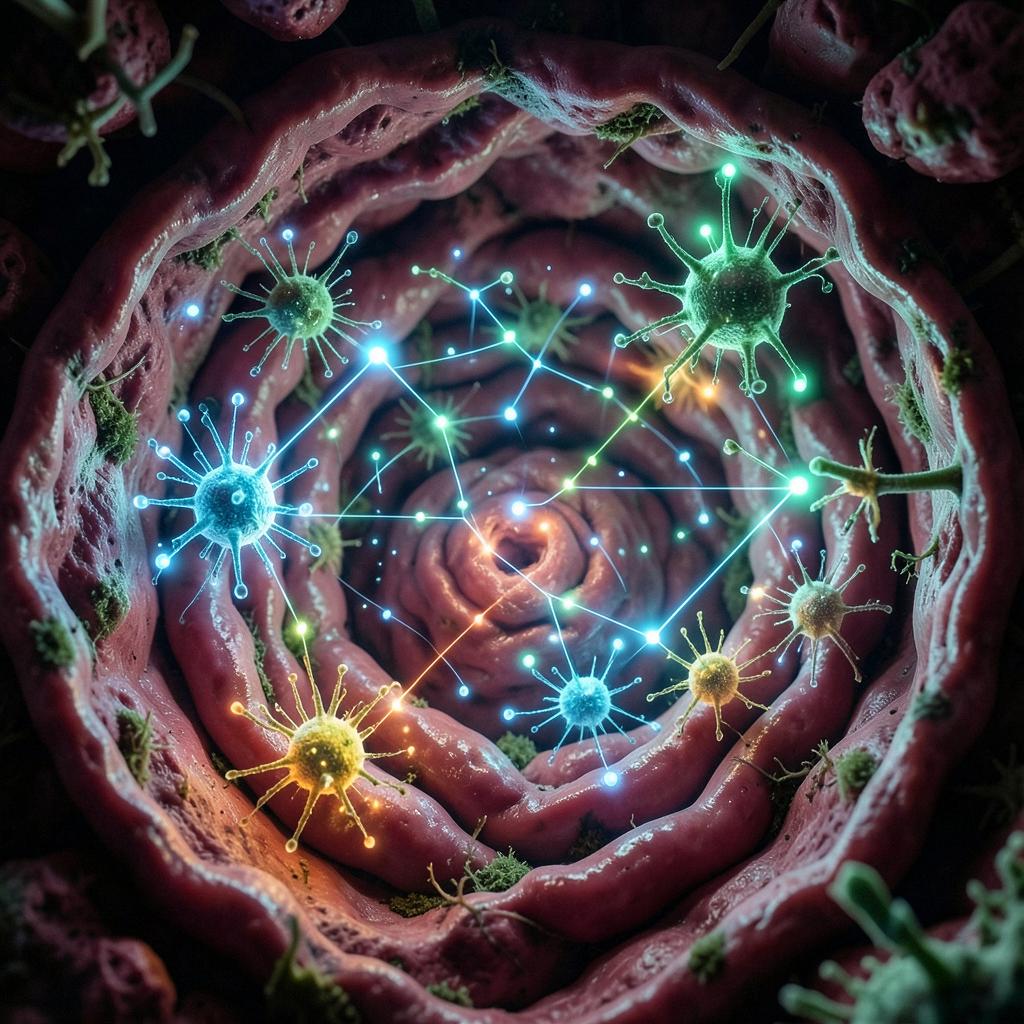
 Discussion