Check each claim against its linked experiments, results, and falsification criteria.Know what the science actually supports before you trust the answer.
Press Enter ↵ to check claims
Explore by Goal
"The most important scientific revolutions all include, as their only common feature, the dethronement of human arrogance from one pedestal after another of previous convictions about our centrality in the cosmos."
- Stephen Jay Gould
Quick Explanation
Copied
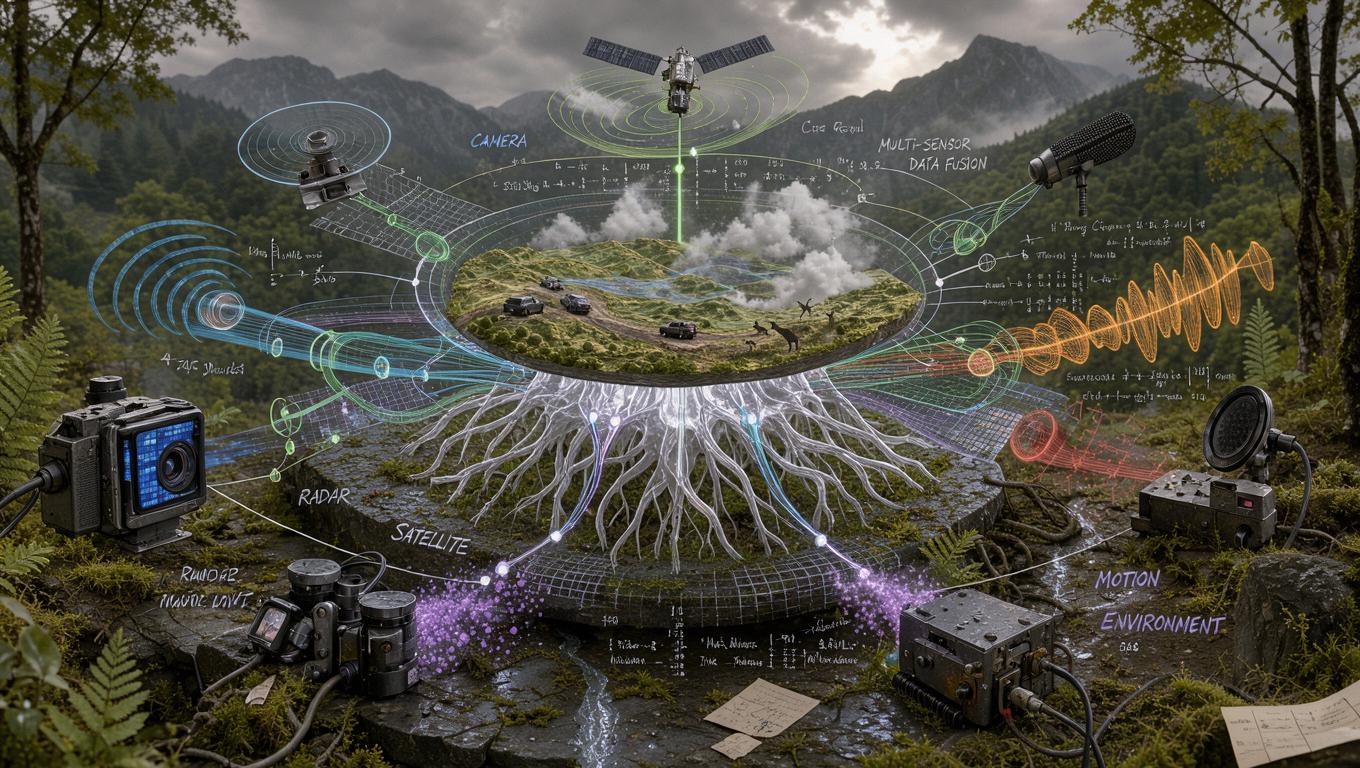
Klečka et al. (2020) present a purely theoretical probabilistic taxonomy of multi-sensor SLAM—three fusion archetypes (conditionally independent, super-observation, partially collective mapping) and a geometrical-entities common-map concept—with no experiments, benchmarks, or implementation . The conceptual contribution is sound but the core claim—that the common-map archetype yields superior robustness—remains unvalidated conjecture, and the authors themselves acknowledge this.
Long Explanation
What the Paper Claims
The paper formalizes multi-sensor SLAM as a probabilistic extension of the standard Bayes-recursion framework (observation model p(z|x,m), motion model p(x|x,u)) and proposes three archetypes of cross-modality structure: (1) conditionally independent per-sensor maps linked only via the motion model, (2) "super-observation"—synchronized isochronous observations fused in preprocessing, and (3) "partially collective mapping"—a shared common map m[com] plus modality-specific residuals, with fusion implicitly embedded in estimation . The strongest logical point is the intersection-vs-union argument: super-observation fails whenever any single sensor leaves its valid domain, whereas a common map degrades gracefully.
Critical Assessment
Strengths: The deduction from standard SLAM theory is mathematically coherent and correctly anchored in canonical sources (Thrun, Durrant-Whyte, Cadena) . The sensor taxonomy (low-DOF, inertial, modality-profile, local-structure, reference-frame link) is a genuinely useful practical contribution. The hypothesis-testing segmentation criterion (reprojection-error statistic vs. critical value, Eq. 21-22) is a concrete, falsifiable mechanism.
Weaknesses: The paper is entirely theoretical—no implementation, datasets, or quantitative results exist, and the authors admit experiments are deferred to future work . Key unstated risks: the variance-reduction criterion (Eq. 25) is acknowledged as computable only experimentally, so the claimed sensor-contribution test cannot select sensors a priori; segmentation of heterogeneous observations into common geometrical entities is an NP-hard combinatorial problem the paper hand-waves via hypothesis testing; the static-environment assumption excludes the very degraded-sensor conditions the robustness argument targets; and the fusion benefit is asserted, not derived—cross-modality constraint coupling could equally amplify correlated errors. Writing quality issues ("thee" for "three", broken reference [18]) and a thin journal venue suggest limited peer-review rigor.
How to falsify: Benchmark partially collective mapping against a well-tuned super-observation baseline on heterogeneous-sensor public datasets (e.g., Kaist, Oxford RobotCar); if map accuracy or robustness does not improve—especially when one sensor degrades—the central claim fails .
Feedback:
Updated: November 07, 2026
BGPT Paper Review
Study Novelty
70%
The three-archetype taxonomy and partially collective mapping concept are a fresh conceptual lens on multi-sensor SLAM in 2020, though closely adjacent prior work (geometric-entity SLAM, feature-level fusion SLAM) already existed and is correctly cited.
Scientific Quality
60%
Coherent derivation but zero empirical validation, acknowledged-only-computable sensor-contribution criterion, static-environment assumption, unresolved segmentation complexity, typos/broken references, and a low-tier venue all cap quality.
Study Generality
70%
The probabilistic archetype framework applies broadly across sensor modalities and SLAM variants (online/full), but assumes static environments and single-robot settings.
Study Usefulness
70%
The sensor taxonomy and the intersection-vs-union robustness argument give designers a principled lens for choosing fusion architecture; utility is limited until validated implementations exist.
Study Reproducibility
40%
No code, data, or algorithmic pseudo-code; equations are abstract with undefined implementation details (projection functions g, hypothesis-generation strategy).
Explanatory Depth
60%
The Bayes-level derivations are clear, yet practical mechanisms (segmentation search, constraint fitting, cross-modality calibration) remain surface-level and untested.
We'll email you the results when your analysis is finished.
Hypothesis Graveyard
'More sensors always improve SLAM'—contradicted by the paper's own Eq. 25 analysis showing sensors must satisfy a measurable variance-reduction condition, and by low-DOF sensors contributing none.
'Feature-level fusion is universally superior to decision-level'—the archetype analysis shows fusion level trades robustness domain against estimation coupling; no single level dominates.

 Explore by Goal
 Quick Explanation
 Long Explanation
 Top Data Sources
 Ask a Follow-Up
 Key Insight
 Keep Exploring
 Hypothesis Graveyard
 Potential Experiments
 Discussion
