Check whether claims match experiments, exact reported results, and stated limitations.Know what the science actually supports before you trust the answer.
Press Enter ↵ to review paper
Explore by Goal
"If the brain were so simple we could understand it, we would be so simple we couldn't."
- Lyall Watson
Quick Explanation
Copied
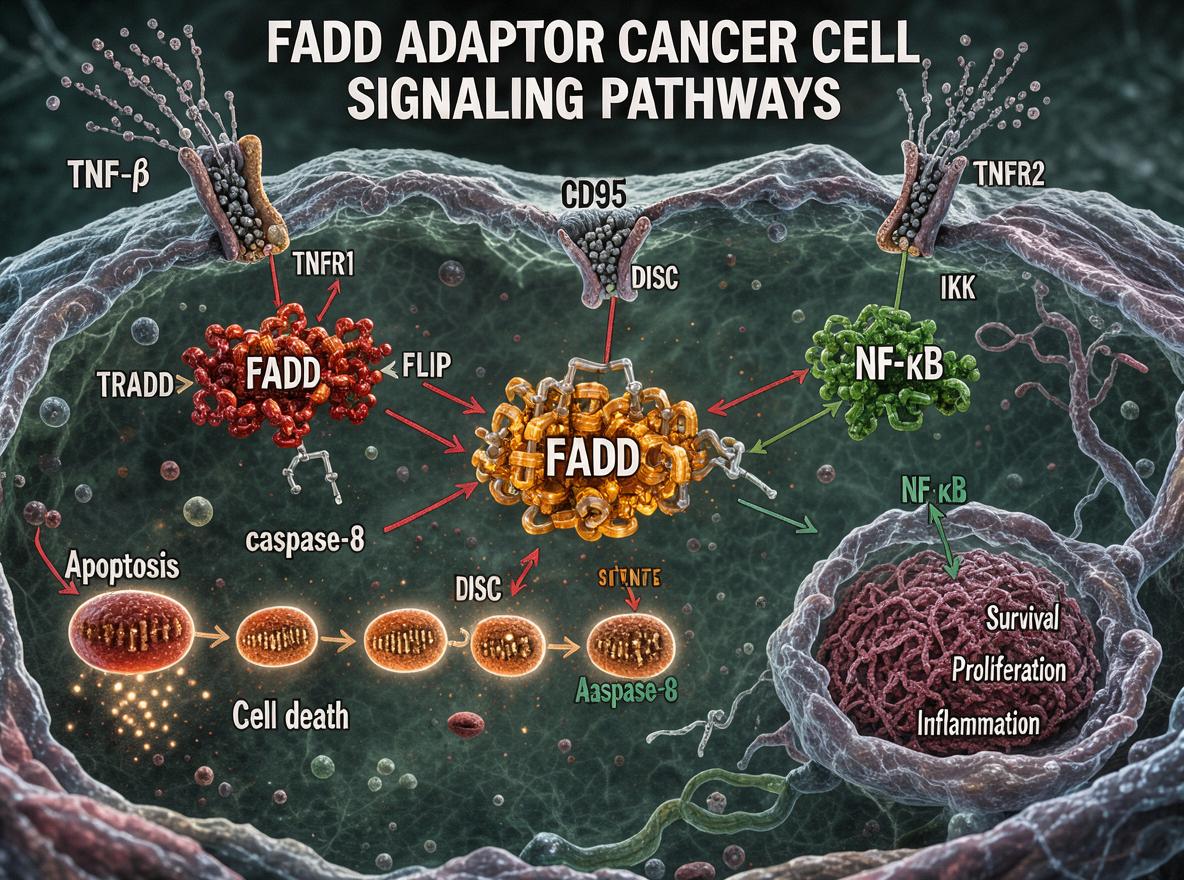
FADD is a dual-function death-domain adaptor whose loss promotes tumor survival, immune evasion, and chemoresistance across mouse and human models, making its restoration a therapeutic opportunity
Long Explanation
Evidence Supporting the Tumor-Suppressor Role of FADD
The review presents converging evidence from mouse and human studies that loss of FADD protein expression contributes to tumor development and progression. In a RAG-1-deficient transgenic model expressing a FADD dominant-negative mutant in lymphocytes, thymic lymphoblastic lymphoma developed with age, whereas FADD-sufficient RAG-1−/− mice remained tumor-free . In the gsp thyroid transgenic model, FADD protein was highly expressed in all non-pathological and most hyperplastic glands but was low or absent in adenomas/adenocarcinomas . Critically, in a retrospective study of 70 consecutive de novo AML patients treated homogeneously, 2/3 expressed low or no FADD protein at diagnosis, and absent/low FADD was an independent prognostic factor for poor response to chemotherapy—persisting even within standard- and good-risk cytogenetic/molecular subgroups .
Multiple Advantages Conferred by FADD Loss
The review synthesizes at least four non-mutually-exclusive mechanisms by which FADD absence advantages cancer cells :
Immune escape: FADD-deficient tumor cells resist Fas- and TNF-α-mediated apoptosis from cytotoxic TIL
Chemoresistance: Anthracyclines and etoposide kill via FADD-dependent death receptor pathways; FADD loss abrogates this
Tumor counterattack: FADD loss permits innocuous co-expression of Fas/FasL or TNF-α/TNF-R1, enabling tumor cells to kill TIL
Proliferative advantage: In FADD-lacking thyrocytes, agonistic anti-Fas antibody accelerated growth via a Daxx-mediated pathway
Phosphorylation, Cell Cycle, and Therapeutic Implications
Human FADD Ser194 (mouse Ser191) phosphorylation is cell-cycle regulated . Subsequent work resolved the kinase logic: Aurora-A phosphorylates FADD at S203, priming Plk1-mediated S194 phosphorylation; the doubly phosphorylated FADD recruits caspase-8 and triggers both apoptotic and RIP1-driven necrotic death . This mechanistic depth exceeds what the 2005 review could state and strengthens the phosphorylation-chemosensitivity link.
On the therapeutic side, the review notes that carboplatin upregulates FADD mRNA and protein in SCC-9/SCC-25 tongue carcinoma cells, restoring Fas sensitivity . However, the review also acknowledges that FADD mRNA was normal in mouse thyroid tumors and human AML despite low protein, indicating post-transcriptional regulation varies by tumor type .
Blindspots and Critical Limitations
Narrative review bias: As a non-systematic review, the synthesis relies on prior studies with potential publication bias toward FADD-centric conclusions; no PRISMA methodology or quantitative meta-analysis is attempted
Small AML cohort: The 70-patient retrospective study has limited statistical power and has not, to the review's knowledge, been independently validated at the time of writing
Nuclear FADD undercharacterized: The review admits nuclear FADD's survival function was reported but mechanistically unexplored
DEF (death effector filaments) may be artifacts: The review itself questions whether in vitro DEF formation from FADD overexpression reflects physiological reality
Missing mechanism: The molecular pathway for FADD-mediated lymphocyte survival during cell cycle progression was not described
What Has Changed Since 2005
Later structural work has resolved the DISC assembly at atomic resolution: FADD-procaspase-8-cFLIP DED complexes reveal a type III-II-III CSS-driven self-assembly mechanism for caspase-8 tDED, with cFLIP hierarchically capping or promoting local caspase-8 activation . Additionally, FADD has been shown to negatively regulate RIP1-dependent necroptosis during T-cell expansion , and to be essential for glucose uptake and survival of thymocytes via Glut1 regulation . These findings expand the FADD functional repertoire well beyond what the 2005 review anticipated.
Bottom line: This 2005 review accurately synthesized the dual-role (death/survival) and tumor-suppressor evidence for FADD. Its central prognostic AML claim was well-supported by a prospective-like retrospective design with homogeneous treatment. The main weakness is narrative (non-systematic) methodology and the small AML cohort. Subsequent work has largely validated and extended its framework.
Feedback:
Updated: October 27, 2026
BGPT Paper Review
Study Novelty
50%
The 2005 review synthesized already-published findings (1995–2004) into a unified cancer framework; most claims were derived from prior work by the same or related groups, so conceptual novelty is moderate rather than groundbreaking.
Scientific Quality
70%
A well-organized narrative review with a strong central thesis supported by converging mouse and human evidence. However, it lacks systematic methodology, does not quantitatively synthesize across studies, and the key AML prognostic claim derives from a single 70-patient retrospective cohort without independent validation at time of writing.
Study Generality
70%
The review integrates apoptosis, cell cycle, immunology, and tumor biology across multiple cancer types (AML, thyroid, lymphoma, melanoma) and species (mouse/human), providing broad conceptual value. However, some claims are context-dependent and the tumor counterattack hypothesis remains controversial.
Study Usefulness
70%
Establishes FADD loss as a prognostic marker and therapeutic target concept; identifies phosphorylation and expression restoration as actionable axes. However, it does not provide clinical protocols, validated biomarkers, or drug candidates.
Study Reproducibility
80%
As a review, reproducibility depends on cited primary studies, which generally used standard methods (Western blot, flow cytometry, IHC, mouse genetics). The review clearly attributes claims to specific primary papers with sample sizes where available.
Explanatory Depth
80%
Provides detailed mechanistic depth on DISC assembly, phosphorylation-dependent cell cycle regulation, nuclear/cytoplasmic localization, and multiple tumor-benefit models. Gaps remain in the molecular pathway for FADD-mediated lymphocyte survival and post-transcriptional FADD regulation.
We'll email you the results when your analysis is finished.
Hypothesis Graveyard
DEF (death effector filaments) as physiological mediators of FADD-induced apoptosis: Largely falsified by lack of in vivo confirmation and overexpression artifacts; structural work now shows physiologic DISC assembly is nucleation-limited and receptor-driven, not spontaneous filament formation.
Tumor counterattack as universal immune escape mechanism: Controversial and not generalizable; Restifo and others showed colon cancer cells do not kill T cells via Fas, so this mechanism is context-dependent rather than universal.

 Explore by Goal
 Quick Explanation
 Long Explanation
 Top Data Sources
 Ask a Follow-Up
 Key Insight
 Keep Exploring
 Hypothesis Graveyard
 Potential Experiments
 Discussion
