Go beyond summaries to locate specific, verifiable claims and sources within research.Know what falsifiable science actually supports before you trust the answer.
Press Enter ↵ to search paper
Explore by Goal
"Science is the systematic classification of experience."
- George Henry Lewes
Quick Explanation
Copied
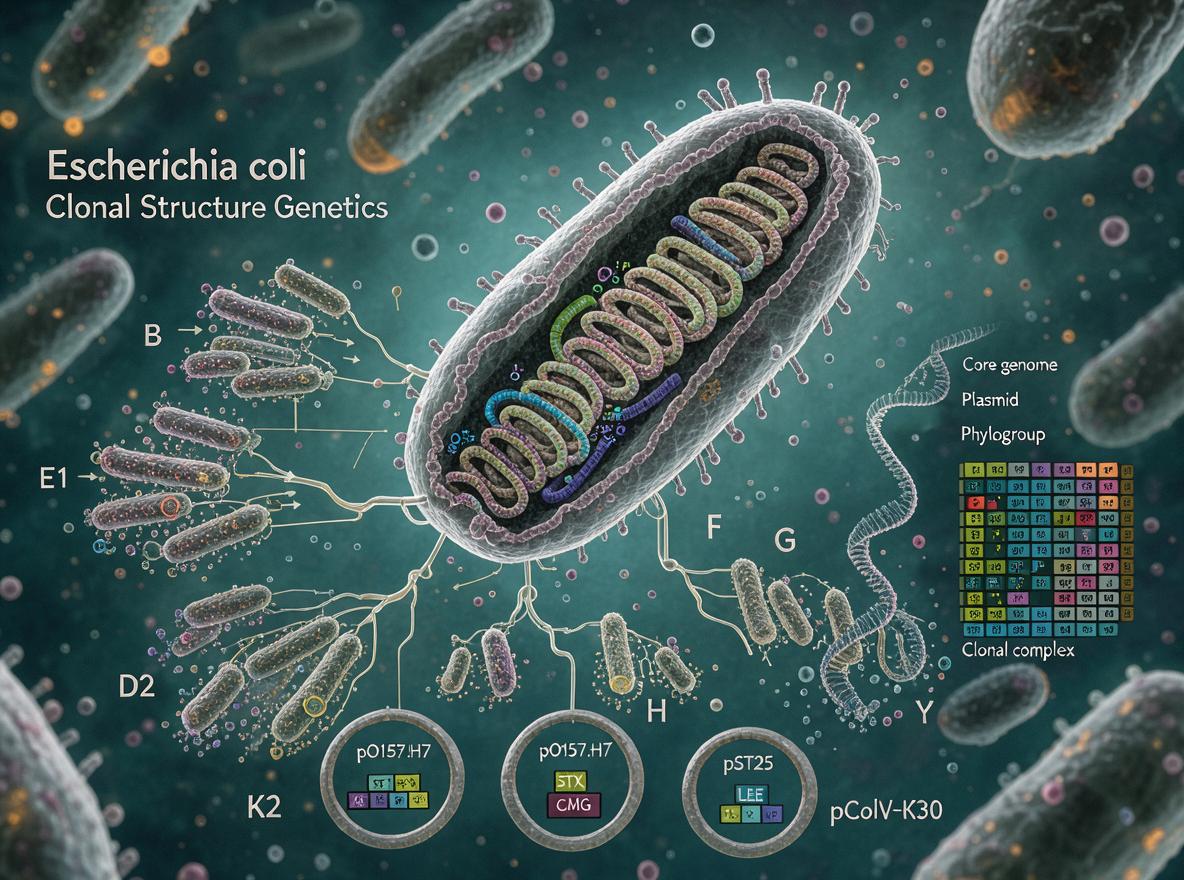
Ochman and Selander's multilocus enzyme electrophoresis of 142 E. coli K1 isolates resolved 14 electrophoretic types across 12 chromosomal enzyme loci, showing that most isolates belong to a few geographically widespread clones and that O serogroup is an unreliable proxy for clonal identity—the two common O1:K1 clones differ at 5 of 12 loci. This independently confirmed Achtman et al.'s OMP-based findings and became foundational evidence for the clonal structure paradigm in E. coli population genetics, later refined but not overturned by MLST and genomics.
Long Explanation
What the Paper Showed
Analyzing 142 K1 isolates (O1, O18, O16, O7 serogroups; collected 1941–1981 from Europe and North America) at 12 chromosomal enzyme loci via starch-gel electrophoresis, Ochman and Selander identified only 14 distinct electrophoretic types (ETs) among 26 alleles—most isolates fell into a handful of geographically widespread clones . Two key findings: (1) the two common O1:K1 clones (ETa and ETe) differ at 5 of 12 loci—no more related than random isolates—despite sharing a serotype; (2) ETe/OMP9 O1:K1 isolates are nearly identical to ETf/OMP9 O18:K1 isolates, differing at only 1 locus, implicating the O-antigen LPS as a horizontally variable virulence determinant .
Independence and Convergence of Evidence
The study's strength lies in triangulation: OMP patterns (Achtman et al.), LPS chemistry, biotype, fimbriation, and enzyme electrophoresis all agree on the same clonal groupings, despite assaying different molecule classes . The work extended Selander and Levin's earlier multilocus framework and preceded the large-scale survey of over 1,600 E. coli and 123 Shigella isolates, in which all 12 enzymes were polymorphic and 77% of Shigella allozymes were shared with E. coli—reinforcing clonal, phylogenetically deep structure . Follow-up work extended the same logic to uropathogenic clones shared across humans, dogs, and cats, with between-source differentiation of only ~1% (G_ST ≈ 0.01) .
Critical Limitations
Reported/inferred: Only 12 enzyme loci could miss recombination elsewhere in the genome; the K1-focused sample may not represent global E. coli diversity; the neutrality assumption for allozymes is asserted, not tested; one isolate (191) came from a rat, a rare non-human exception . Later reviews noted a persistent field-wide bias toward pathogenic strains that could inflate apparent clonality relative to commensal diversity . What would falsify the conclusion: genome-wide evidence that same-serogroup isolates recombine freely across chromosomal loci, erasing clonal clusters—a scenario modern genomics partially does, since recombination is frequent but structured by phylogroup.
Confidence: High that the reported ET/serotype discordance is real; moderate that "basically clonal, very limited recombination" was fully correct—later genomics showed recombination is substantial but phylogenetically constrained, preserving the clone concept as the organizing principle.
Feedback:
Updated: November 25, 2026
BGPT Paper Review
Study Novelty
90%
Among the first multilocus electrophoretic demonstrations that E. coli serotypes do not map to chromosomal clones, directly challenging serotype-as-unit thinking and launching the clonal-structure paradigm later refined by MLST and genomics.
Scientific Quality
90%
Careful, well-controlled electrophoretic methods; findings independently corroborate Achtman et al.'s OMP data; published in PNAS with NIH funding; minor weaknesses include small locus count, no statistical test of clonality, and untested neutrality assumption.
Study Generality
80%
Focused on K1 isolates of four O serogroups, but the clonal-structure inference and serotype-genotype decoupling generalize broadly to bacterial population genetics and shaped later MLST frameworks.
Study Usefulness
90%
Founded the practice of multilocus chromosomal typing over serotyping, directly informing epidemiology, vaccine target thinking, and the eventual design of MLST; demonstrated that virulence traits track clones, not serotypes.
Study Reproducibility
70%
Methods (starch-gel electrophoresis, 12 enzymes, strain list with electromorph table) are fully described and reproducible with historical isolates, but no digital data deposition existed and raw gels are unavailable.
Reconstructing the paper's Table 1 electromorph matrix, computing pairwise genetic distances among the 14 ETs, and performing PCA to visually reproduce the Fig. 1 clone-clustering result from the K1 isolate data.
Get emailed when your analysis is done!
We'll email you the results when your analysis is finished.
Hypothesis Graveyard
Serotypes as fundamental population units: falsified by this paper—same-serogroup isolates can be phylogenetically distant, and serotype distribution inconsistently maps to ETs.
Panmictic (randomly recombining) E. coli populations: weakened by multilocus disequilibrium across studies, though later genomics showed recombination is frequent but phylogenetically constrained.

 Explore by Goal
 Quick Explanation
 Long Explanation
 Top Data Sources
 Ask a Follow-Up
 Key Insight
 Keep Exploring
 Analysis
 Hypothesis Graveyard
 Potential Experiments
 Discussion
