Check a paper's claims against linked experiments, exact results, stated scope, and limitations.Know what falsifiable science actually supports before you trust the answer.
Press Enter ↵ to search evidence
Explore by Goal
"The saddest aspect of life right now is that science gathers knowledge faster than society gathers wisdom."
- Isaac Asimov
Quick Answer
Copied
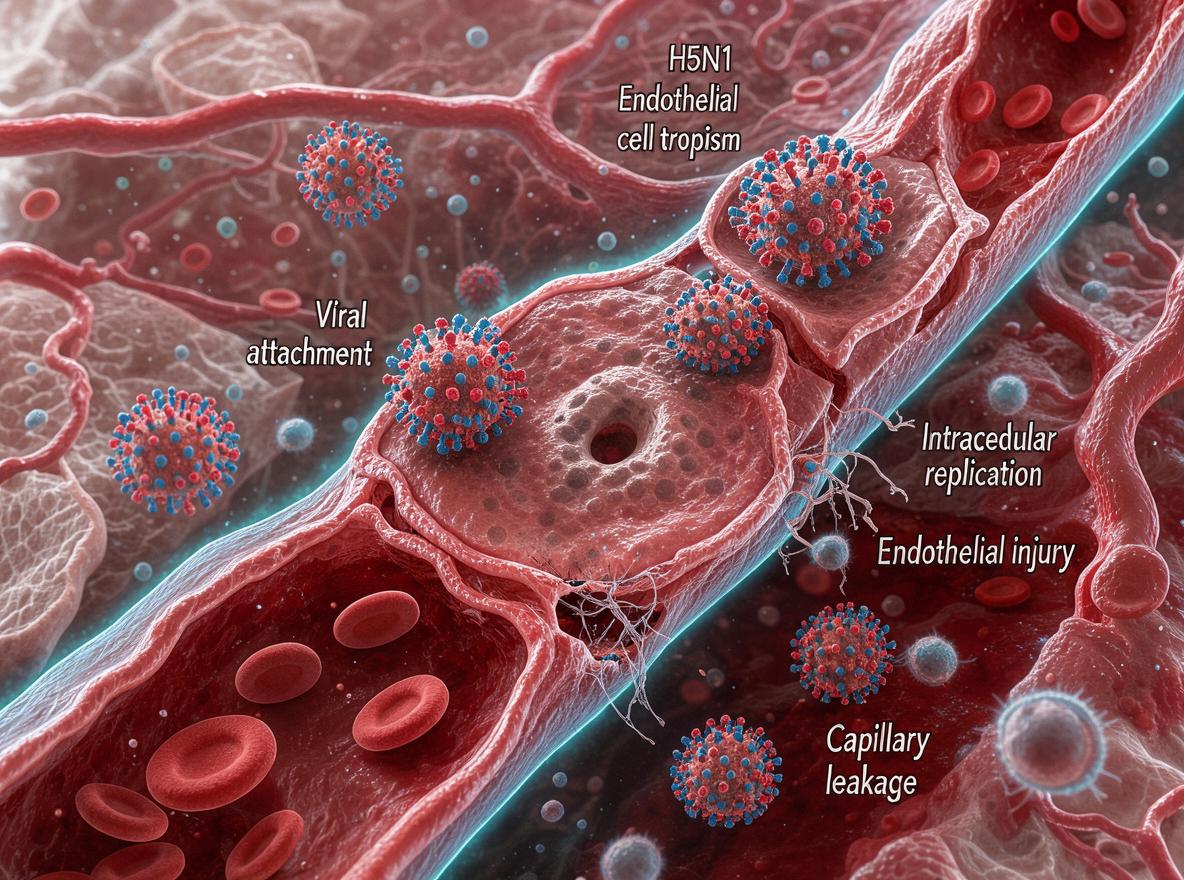
This 2017 PLOS Pathogens study (Tundup et al.) shows, using isogenic H5N1 (A/Vietnam/1203/2004) viruses with miRNA-restricted cell tropism, that blocking replication in endothelial cells (miR-126 targets) ameliorates disease, limits vascular leakage, and prevents extrapulmonary spread in mice and ferrets despite similar peak lung titers, while hematopoietic restriction (miR-142) lowers cytokines but does not prevent lethality . Notably, a 2025 wild-bird pathology study found no evident endothelial tropism in H5N1-infected black-headed gulls, suggesting this mechanism may be host- or clade-specific rather than universal .
Long Answer
Core Claim and Mechanistic Framework
Tundup et al. engineered four miRNA target sites into the 3'UTR of the NP segment of A/Vietnam/1203/2004 H5N1: miR-126 (endothelial-restricted, H5N1-126T), miR-142 (hematopoietic-restricted, H5N1-142T), and a scrambled control (H5N1-ScrbT). In A549 and LA-4 epithelial cells all three viruses replicated equivalently (~10^7 PFU/mL); H5N1-126T replication was ablated in human (HMVEC) and mouse (MS1) endothelial cells, while H5N1-142T was suppressed in THP-1, BMDC, and J774 cells .
Approximate survival outcome from reported figure description; exact numerators are stated only as "all but one survived" for 126T.
Key Results Across Two Species
Despite similar peak lung titers by day 5–8 post-infection, H5N1-126T infected mice showed reduced weight loss (~10–15% at 25 PFU vs >25% for controls), lower lung cytokines (IFN-β, IL-6, IL-1β, TNFα, CCL2, MIP-1α), reduced Evans Blue vascular leakage, and no detectable extrapulmonary virus (brain, kidney, spleen) on day 8, even with an intact HA multibasic cleavage site; intracerebellar injection confirmed H5N1-126T can replicate in brain, implying the spread defect is vascular, not a tissue replication barrier. The ferret experiment (n=6/group, single run) showed H5N1-126T caused no weight loss or neurological signs while ScrbT ferrets were euthanized by day 6; nasal wash titers were similar, but lung infection occurred in only 1/3 vs 3/3 ferrets, and olfactory bulb/brain spread was reduced. Notably, 142T mice had some cytokines lower than 126T yet still died, meaning hypercytokinemia alone is insufficient — direct endothelial barrier disruption matters. The HALo (multibasic site-deleted) control showed no virulence difference among tropism variants, ruling out miR-126-specific attenuation independent of endothelial tropism .
Context in Current H5N1 Evidence
Systemic, blood-borne dissemination consistent with a hematogenous/endothelial route was also documented in cats via gelatin-capsule gastrointestinal exposure, with viral RNA in plasma and PBMC and all tested organs by day 4 . However, recent natural wild-bird pathology found no evident endothelial tropism despite multisystemic disease , and 2025 organoid work shows VN1203 (the same strain used here) elicits strong IFN/cytokine responses whereas contemporary cattle-derived TX37-H5N1 suppresses STAT-IRF signaling while replicating more efficiently (9.12 vs 8.55 log10 PFU/mL) — indicating endothelial-tropism-driven immunopathology may be strain- and host-context dependent .
Critical Appraisal and Blindspots
Single strain, clade 1 VN1203: Whether clade 2.3.4.4b viruses behave identically is untested here.
Ferret experiment run once, n=3–6/group: Authors acknowledge insufficient statistical power .
miRNA targeting artifacts: miR-126/142 have many host targets; even a scrambled-target control and HALo comparison mitigate but cannot fully exclude off-target effects on viral fitness.
Species extrapolation: Human lung microvascular endothelial susceptibility to H5N1 was shown only in vitro (HMVEC); human in vivo endothelial infection remains inferred, not directly demonstrated.
Falsifiability: Findings would be weakened by an independently validated H5N1-126T-like virus retaining full virulence despite endothelial restriction, or by showing clade 2.3.4.4b mammalian lethality does not depend on endothelial infection.
Conclusion: A rigorous, well-controlled mechanistic demonstration that endothelial tropism is a determinant (not the sole determinant) of H5N1 virulence in mice and ferrets, supporting combined antiviral + barrier-protective + immunomodulatory strategies. Confidence: moderate-high for mice; moderate for ferrets; uncertain generality to contemporary 2.3.4.4b strains and humans.
Feedback:
Updated: November 24, 2026
BGPT Paper Review
Study Novelty
80%
First in vivo demonstration in two mammalian models that endothelial cell tropism itself determines H5N1 lethality at equal lung titers, using the isogenic miRNA-tropism toolkit; builds on prior tenOever-group methodology but asks a new causal question.
Scientific Quality
80%
Strong controls (scrambled-target, HALo multibasic-deleted, intracerebellar replication check, flow-cytometric in vivo cell typing). Weaknesses: ferret experiment single run with n=3-6 and acknowledged lack of power; single VN1203 strain; survival numerators partly inferred from figures; no direct human tissue validation.
Study Generality
80%
Establishes a transferable pathogenesis principle (barrier-cell tropism drives lethality beyond viral load and cytokine levels) applicable to H7N7, H7N9, 1918, and possibly other vascular-invasive viruses, though demonstrated here only for one H5N1 strain.
Study Usefulness
80%
Directly motivates combination therapy (antiviral + immunomodulation + endothelial barrier protection) and provides an experimental framework for zoonotic risk assessment of emerging H5N1 clades, which remains highly relevant given current bovine 2.3.4.4b spillovers.
Study Reproducibility
70%
Reverse-genetics construction, target sequences, doses, and assay protocols are fully described and Sanger-verified; however, ABSL3 requirements, single-run ferret study, and figure-only some quantitative data reduce independent replication ease.
Explanatory Depth
80%
Links endothelial infection to hypercytokinemia, barrier permeability (Evans Blue), and hematogenous extrapulmonary spread in a causal chain, and disentangles cytokine vs. direct-barrier contributions via the 142T vs 126T contrast; stops short of molecular mechanism of endothelial barrier disruption.
Comparing H5N1 replication titers and cytokine levels from VN1203 versus TX37 organoid datasets to quantify how strain-specific innate-immune suppression relates to endothelial-tropism-driven pathogenesis.
Get emailed when your analysis is done!
We'll email you the results when your analysis is finished.
Hypothesis Graveyard
Hypercytokinemia alone is the lethal mechanism of H5N1: falsified here because H5N1-142T lowered lung cytokines below the 126T group yet mice still died, while 126T survived with modest residual cytokines.
Lung viral burden determines H5N1 virulence: weakened because all three tropism viruses reached similar peak lung titers yet produced divergent survival outcomes.

 Explore by Goal
 Quick Answer
 Long Answer
 Top Data Sources
 Ask a Follow-Up
 Key Insight
 Keep Exploring
 Analysis
 Hypothesis Graveyard
 Potential Experiments
 Discussion
