Check a paper's claims against linked experiments, exact results, stated scope, and limitations.Know what falsifiable science actually supports before you trust the answer.
Press Enter ↵ to search evidence
Explore by Goal
"Nothing in life is to be feared, it is only to be understood. Now is the time to understand more, so that we may fear less."
- Marie Curie
Quick Answer
Copied
This Nature Communications study reports NIR-driven hydrogenated MoO3 nanomachines that orally deliver active hydrogen to irradiated mouse intestines, raising 30-day survival from 10% to 80% after lethal 16 Gy abdominal irradiation via RONS scavenging, macrophage polarization, and microbiota modulation — a strong preclinical proof-of-concept with translational gaps (male mice only, external NIR required, no human validation).
Long Answer
What the paper demonstrates
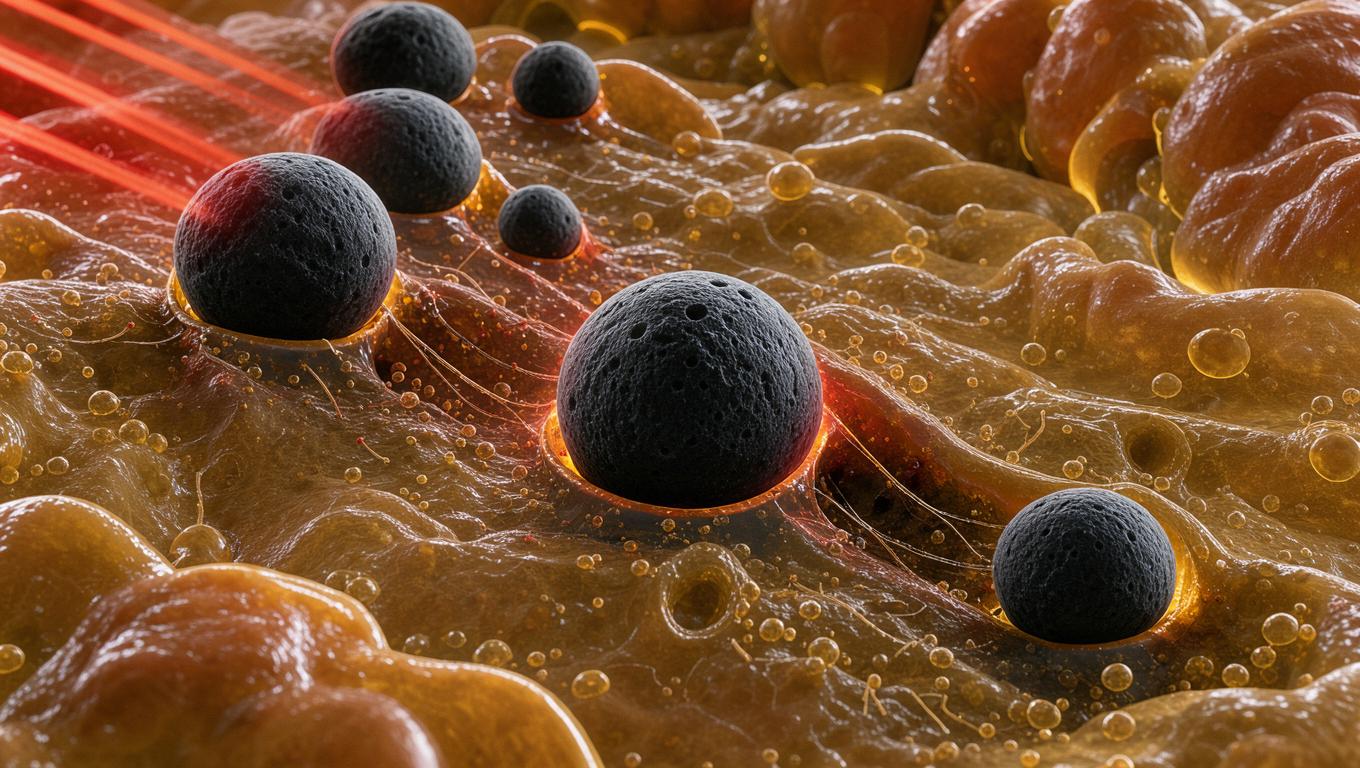
Yin et al. synthesized ~200 nm spherical HxMoO3@SA@COS nanomachines that store ~1.59 mmol/g of active hydrogen (confirmed independently by methylene blue and CoQ10 assays) with a 46.5% photothermal conversion efficiency at 808 nm . Key quantitative outcomes:
The 80% vs 46.5% vs 10% 30-day survival hierarchy (16 Gy TAI, n=10–11/group) is the decisive in vivo result, with NIR propulsion adding ~34 percentage points over passive nanomachines — consistent with their Cy5 biodistribution showing NIR-enhanced intestinal retention at 4 and 8 h post-gavage .
Mechanistic evidence and its quality
The authors carefully controlled for a key alternative explanation: MoO3-x (Mo IV/V only) failed to reduce methylene blue, arguing active hydrogen — not Mo valence cycling — drives RONS scavenging. ESR confirmed •OH/•O2⁻ removal, and pH-responsive degradation (stable at pH 1.2, degrading in pH 6.8–7.4 via MoO4²⁻) addresses clearance. In vivo, SOD/MDA, 3-NT, 4-HNE, TNF-α/IL-6, γ-H2AX, and Nrf2/CD206/iNOS staining all improve dose-dependently with the +NIR group best . The microbiota arm (16S, PRJNA1157809) reports restored Chao1/Shannon diversity and increased Akkermansia, though the authors explicitly flag the goblet-cell/mucin/Akkermansia correlation as requiring further validation, not causation.
Blind spots and confounds BGPT flags
Thermal confound: In vivo abdominal temperature reached 42.5 °C (+7.5 °C vs PBS). Mild hyperthermia itself is anti-inflammatory and M1→M2-promoting; the paper cites this (ref 62) for the +NIR macrophage effect but does not include a hyperthermia-only control separating motility benefits from photothermal heating.
Sex bias: Only male mice were used; the justification ("no sexual dimorphism reported" for RONS scavenging) is an assumption, not evidence.
Translation gap: External 808 nm light at 1 W/cm² for 3×10 min cycles is required; the authors themselves note proton/carbon-ion validation and implantable NIR sources as needed next steps .
Only a single survival cohort per treatment; no power analysis or preregistration is stated in the available text.
Overall: high-quality, internally consistent preclinical nanomedicine work with honest disclosure of mechanism gaps; the main untested leap is mouse-to-human translation and separating thermal from motile contributions.
Feedback:
Updated: November 21, 2026
BGPT Paper Review
Study Novelty
90%
First report of active-hydrogen (not molecular H2) storage/release in self-thermophoretic spherical nanomachines for intestinal radioprotection; combines nanomotor delivery, hydrogen medicine, and microbiome modulation in a new drug-free paradigm, though individual components (H2 radioprotection, thermophoretic motors, mucus-penetrating coatings) are established fields.
Scientific Quality
80%
Rigorous characterization (XRD, XPS, 1H NMR, ESR), an explicit control (MoO3-x) against the Mo-valence alternative explanation, independent dual hydrogen quantification, and source data/16S deposition are strengths. Deductions: no hyperthermia-only control, male-only mice, single survival cohort per arm, no preregistration/power statement, and microbiota causality unproven (acknowledged by authors).
Study Generality
80%
The active-hydrogen delivery concept extends beyond radiation enteritis to inflammatory bowel disease and any mucus-barrier-limited gut therapy, and the spherical self-thermophoresis finding generalizes Janus-motor design; however efficacy is only shown for gamma irradiation in one mouse strain.
Study Usefulness
90%
Radiation enteritis lacks effective clinical treatments affecting >90% of pelvic/abdominal radiotherapy patients; a drug-free, orally dosed platform with demonstrated 8-fold survival improvement and 6-month biosafety data is highly valuable preclinically, though clinical translation requires in situ light delivery solutions.
Study Reproducibility
80%
Detailed wet-chemistry synthesis protocols, instrument models, doses, irradiation parameters, and deposited 16S data (PRJNA1157809) plus Source Data files support replication; incomplete reproducibility stems from reliance on the authors' COMSOL parameters and the absence of code for thermal simulations.
Explanatory Depth
80%
The paper dissects mechanism at multiple levels: redox potentials, bandgap engineering, MB/CoQ10 hydrogen quantification, ESR radical confirmation, valence-state tracking, finite-element thermal simulations, and multi-organ in vivo readouts. Mechanism of the macrophage M2 shift and Akkermansia link remains correlational, tempering full depth.
We'll email you the results when your analysis is finished.
Hypothesis Graveyard
Molecular H2 gas released from the particles explains the radioprotection: falsified internally — headspace GC detected no H2 release in HxMoO3@SA in PBS, and the MoO3-x (valence-only) control failed MB reduction, isolating active hydrogen as the active species.
Mo valence cycling (Mo5+/Mo4+) alone scavenges RONS: weakened by the MoO3-x negative control and by ESR showing Mo(V) disappearance tracks hydrogen insertion/release kinetics.

 Explore by Goal
 Quick Answer
 Long Answer
 Top Data Sources
 Ask a Follow-Up
 Key Insight
 Keep Exploring
 Hypothesis Graveyard
 Potential Experiments
 Discussion
