Check each claim against its experiments, reported results, scope, and stated limitations.Know what the science actually supports before you trust the answer.
Press Enter ↵ to start review
Explore by Goal
"We are just an advanced breed of monkeys on a minor planet of a very average star. But we can understand the Universe. That makes us something very special."
- Stephen Hawking
Quick Explanation
Copied
This landmark 2008 study (Surlykke et al., Proc. R. Soc. B) provides the first field measurements of echolocation directionality, showing Daubenton's bats emit far narrower sonar beams in the wild (20° half-amplitude at 55 kHz) than in the laboratory (40°), with source levels ~8 dB higher, implying bats actively widen mouth opening and boost intensity for natural hunting.
Long Explanation
Central Finding and Significance
Surlykke, Pedersen & Jakobsen provide the first ever field measurement of sonar beam directionality in freely flying bats, using a linear microphone array over a Danish pond to reconstruct flight paths and sound emission patterns of Myotis daubentonii. They report highly directional calls in the wild: half-amplitude angles narrow from 25° at 45 kHz to 14° at 75 kHz, confirming the piston radiation model's prediction that directionality increases with frequency
Field vs. Laboratory Contrast
The most striking result is the behavioral plasticity: the same species emitted calls with double the beam width (40° vs 20° at 55 kHz) and ~8 dB lower source level (111 vs 119 dB SPL) in the lab vs field. Using the piston model, the authors calculate equivalent piston radii of 6.4 mm (field) vs 3.4 mm (lab), suggesting bats simply open their mouths wider to focus energy forward when hunting naturally
Critical Assessment and Limitations
Pseudo-replication risk: 195 calls from ~5–15 bats over two years; individual identity was not confirmed genetically, though multiple bats were visually observed
Beam = flight direction assumption: Head may turn independently of flight path; the authors partially mitigated this by excluding turning calls and requiring maximum intensity on the nearest microphone.
Single species, single habitat: Generalization to other bats, habitats, or call types (buzz phase) is inferred, not measured.
Mealworm supplementation: Bats were baited, potentially biasing approach trajectories and motivation.
Broader Context and Legacy
Later work on harbor porpoises confirmed similarly narrow beams in odontocetes (horizontal 13.1°, vertical 10.7°, DI=24 dB) , and the centenary review by Moss and colleagues situates this finding as foundational for understanding 'acoustic gaze' as an active-sensing principle shared across bats and toothed whales . The idea that frequency increase costs 'peripheral sonar width' rather than range remains a genuinely influential reframing.
What Would Change the Conclusion?
Measurements of bats with confirmed head orientation (e.g., high-speed video + thermal tracking), individual-marked populations, and non-trawling species in cluttered forest would test generality. If beam widths in the field matched laboratory values for other species/habitats, the 'field-narrowing' claim would need revision.
Feedback:
Updated: September 06, 2026
BGPT Paper Review
Study Novelty
90%
First-ever field measurement of echolocation beam directionality in free-flying bats, overturning lab-based assumptions that sonar beams are broad; genuinely pioneering for bioacoustics and active sensing.
Scientific Quality
80%
Rigorous acoustics, TOAD positioning, reflection-removal (BATIRON), and piston-model validation. Weaknesses: no individual ID (pseudo-replication risk), beam assumed equal to flight direction, mealworm baiting, single species/site.
Study Generality
70%
Piston model and frequency-directionality relationship generalize across mouth-emitting species, but empirical data are from one vespertilionid trawling bat in one habitat.
Study Usefulness
80%
Reframed biosonar as a narrow, actively focused 'acoustic gaze'; influenced odontocete beam studies, sensory ecology, eavesdropping/communication distance estimates, and bioinspired sonar design.
Study Reproducibility
60%
Methods (array geometry, TOAD cross-correlation, harmonic filtering, atmospheric compensation) are detailed, but depend on custom software (SIGPRO, BATIRON), wild bat availability, and no public data/code were archived.
Explanatory Depth
70%
Explains directionality mechanistically via the piston model (frequency × emitter size) and links field-lab differences to mouth gape and DI (+5.5 dB), though vertical beam structure and neural control remain unexplored.
We'll email you the results when your analysis is finished.
Hypothesis Graveyard
'Bats emit broad sonar beams (~40-50°) as measured in restrained/lab conditions' — falsified for natural search flight: field beams are roughly half as wide, because restraint and lab contexts suppress mouth opening and intensity.
'Higher call frequencies primarily cost detection range via atmospheric attenuation' — incomplete: increased directionality at higher frequencies recovers on-axis energy, shifting the true cost to sonar cone width ('peripheral hearing').

 Explore by Goal
 Quick Explanation
 Long Explanation
 Top Data Sources
 Ask a Follow-Up
 Key Insight
 Keep Exploring
 Hypothesis Graveyard
 Potential Experiments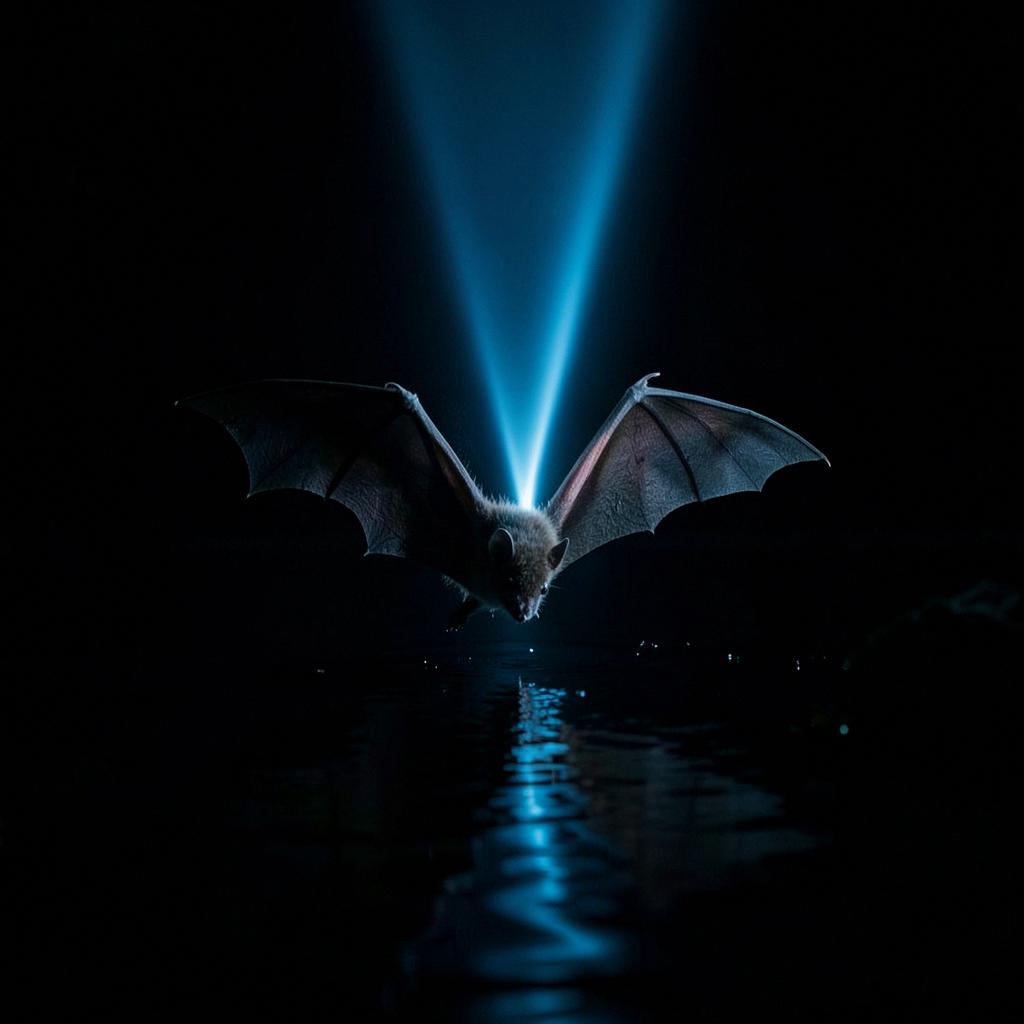
 Discussion