Check whether claims match experiments, exact reported results, and stated limitations.Know what the science actually supports before you trust the answer.
Press Enter ↵ to review paper
Explore by Goal
"The scientist is not a person who gives the right answers, he's one who asks the right questions."
- Claude Lévi-Strauss
Quick Answer
Copied
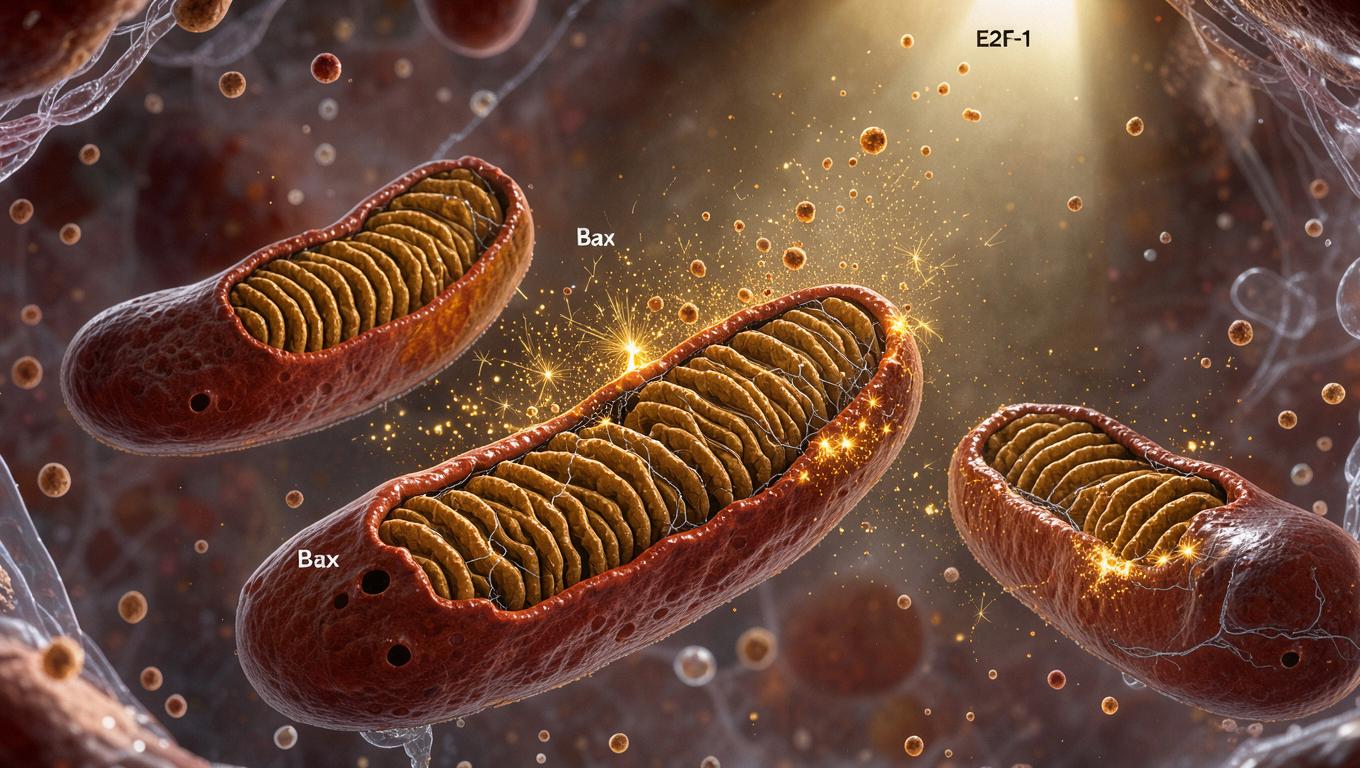
The paper plausibly shows that E2F-1 up-regulates PUMA transcriptionally (9.3-fold promoter activation; 10-fold mRNA at 16 h), triggering Bax mitochondrial translocation and caspase-9 activation (3.7-fold), with PUMA knockout conferring partial resistance (~15-18% higher viability) . Key weaknesses: no ChIP proof of direct E2F-1 promoter binding, in vitro-only, two cell lines, and incomplete causality of the PUMA-Bax link.
Long Answer
Core evidence chain
The paper builds a four-step pathway: E2F-1 → PUMA transcription → Bax mitochondrial translocation → caspase-9 activation. PUMA mRNA rose 2.6-, 5-, and 10-fold at 8, 12, and 16 h post Ad-E2F-1 infection (MOI 100) in SK-MEL-2 cells (mutant p53), with protein increases matching . A truncated E2F-1 lacking the transactivation domain failed to activate the PUMA promoter, supporting (but not proving) direct transcriptional regulation .
The genetic test is the strongest element: HCT116 PUMA-/- cells showed ~15% (trypan blue) and ~18% (MTT) higher viability than PUMA+/+ after 4 days at MOI 50, with equivalent (~70%) adenoviral transduction — but PUMA-/- cells still died, and residual caspase-9 activation (1.5-fold) persisted . PUMA's ability to activate Bax is mechanistically consistent with later work mapping Puma BH3 binding to Bax helix 1 .
What would strengthen or falsify the model
No direct chromatin binding: six putative GGCGGG sites were identified by sequence scanning only; ChIP-qPCR or EMSA showing E2F-1 occupancy at the PUMA promoter was not performed, so the 9.3-fold reporter activation could reflect indirect effects .
In vitro, two cell lines only: no melanoma xenograft or additional melanoma lines; the authors themselves caution results "may not be generalizable to all cancer cell types" .
Partial protection: ~15-18% viability difference is modest; PUMA is one mediator, not the essential one — consistent with later mouse data where PUMA loss accelerates Myc-driven lymphoma far less than p53 haploinsufficiency .
Small replicates: qPCR reported from two independent experiments; some data (HCT116 mRNA, MTT) cited as "not shown," limiting independent verification.
Confidence note: The pathway is directionally well-supported (reported observations + genetic knockout), but the directness of E2F-1→PUMA binding and clinical generalizability remain uncertain. A melanoma PUMA-null rescue experiment or ChIP would be decisive falsification tests.
Feedback:
Updated: October 27, 2026
BGPT Paper Review
Study Novelty
60%
Extends prior Hershko/Ginsberg findings (E2F1 up-regulates BH3-only proteins in NIH3T3) to melanoma with knockout genetic evidence; incremental rather than paradigm-shifting.
Scientific Quality
70%
Good controls (LacZ, truncated E2F-1, transduction-efficiency check) and a knockout test, but no ChIP, small replicate counts, some data 'not shown', and in vitro-only scope.
Study Generality
50%
Two cell lines, one mutant-p53 melanoma model; authors acknowledge non-generalizability; no in vivo validation.
Study Usefulness
70%
Clarifies a p53-independent E2F-1 apoptotic arm relevant to melanoma gene-therapy strategies; connects to later PUMA-Bax structural work.
Study Reproducibility
60%
Methods are detailed (MOIs, vectors, antibodies, constructs from named sources), but some quantitative results are 'data not shown' and replicates are small.
Retrieving and visualizing the PUMA promoter sequence to map the six reported E2F-1 binding motifs and their evolutionary conservation across mammals is being performed to assess site conservation.
Get emailed when your analysis is done!
We'll email you the results when your analysis is finished.
Hypothesis Graveyard
E2F-1 kills melanoma cells solely via p53 stabilization: falsified here because SK-MEL-2 has mutant p53 and no p73 induction, yet undergoes apoptosis.
PUMA promoter activation requires p53: contradicted by E2F-1-driven activation in mutant-p53 SK-MEL-2 cells and p53-null fibroblasts (Hershko 2004).

 Explore by Goal
 Quick Answer
 Long Answer
 Top Data Sources
 Ask a Follow-Up
 Key Insight
 Keep Exploring
 Analysis
 Hypothesis Graveyard
 Potential Experiments
 Discussion
