Check whether claims match experiments, exact reported results, and stated limitations.Know what the science actually supports before you trust the answer.
Press Enter ↵ to review paper
Explore by Goal
"A gene is a long sequence of coded letters, like computer information. Modern biology is becoming very much a branch of information technology."
- Richard Dawkins
Quick Explanation
Copied
Verdict: A well-powered, mechanistically decisive study establishing that eIF4E Ser209 phosphorylation is dispensable for normal mouse development but essential for eIF4E-driven tumorigenesis, acting via MNK1 to suppress apoptosis through translational upregulation of Mcl-1
Long Explanation
Mechanistic Decoding of eIF4E Oncogenic Action
This 2007 Genes & Development paper dissects how the translation initiation factor eIF4E drives tumorigenesis using the Eµ-Myc mouse lymphoma model with adoptive HSC transfer. The authors previously showed eIF4E is a potent oncogene in vivo; here they test which molecular functions are required .
Three decisive findings emerge:
Cap-dependent translation is required. W56A and W73F mutants fail to accelerate tumor onset, ruling out eIF4E's nuclear mRNA-export function as the oncogenic driver in this model.
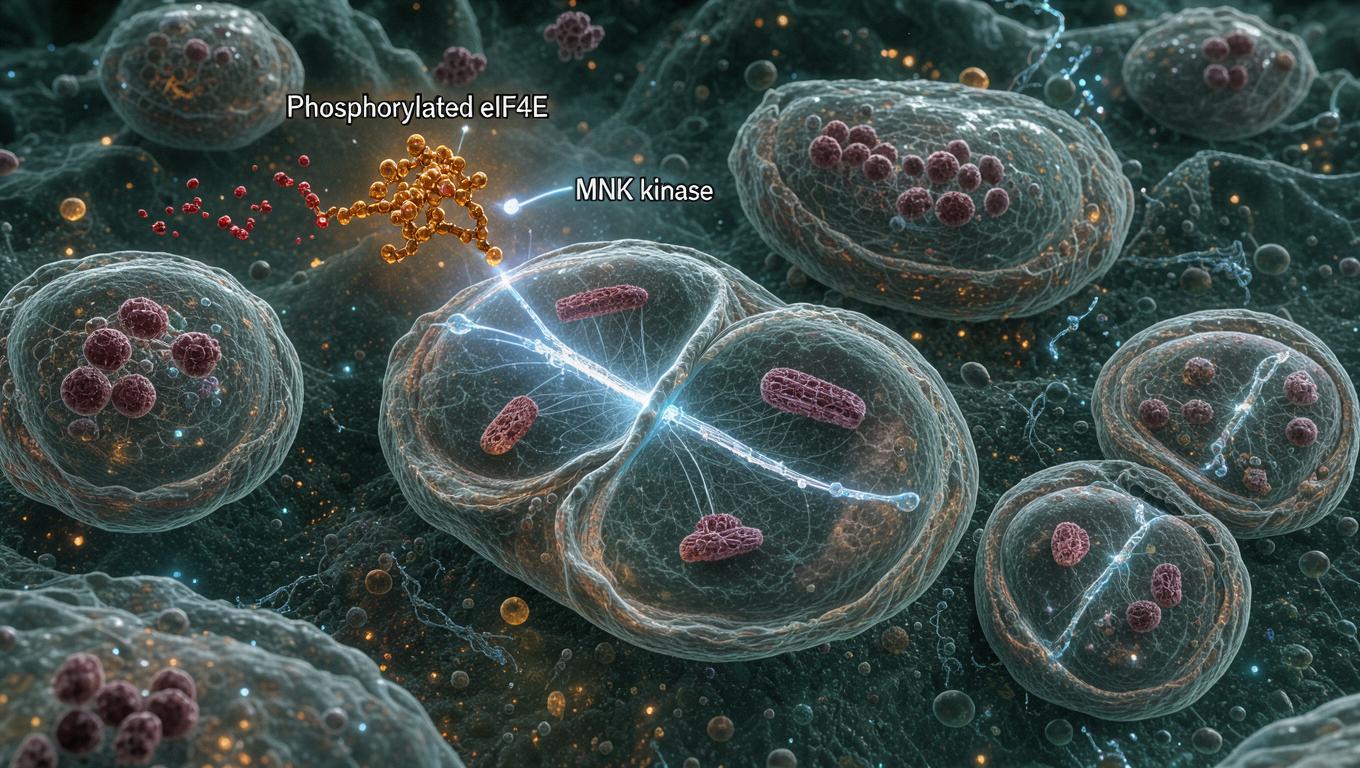
Ser209 phosphorylation is essential. The non-phosphorylatable S209A mutant is oncogenically inert (P = 0.24 vs control), while the phosphomimetic S209D phenocopies wild-type eIF4E (P < 0.0001). Constitutively active MNK1 (T332D) also accelerates lymphomagenesis, genetically placing MNK upstream.
Mcl-1 is a key effector. Phospho-eIF4E and active MNK1 elevate Mcl-1 protein via enhanced polysomal loading, and Mcl-1 alone accelerates lymphomagenesis. In 77 human DLBCL samples, all 13 phospho-eIF4E-positive cases were MCL-1-positive (Fisher's exact P = 0.02).
Critical strengths: In vivo causality with large n (eIF4E n=45; vector n=61); multiple independent allelic perturbations converging on one conclusion; human corroboration via TMAs; and a mechanistic model (translation → anti-apoptosis → tumorigenesis) supported by polysome fractionation and p53 LOH analysis. The therapeutic implication—MNK inhibition should be tolerable given normal development of Mnk1/2 DKO mice—has been borne out by later work showing MNK–eIF4E governs selective mRNA translation in metastasis and synaptic memory .
Limitations and blind spots: (1) S209D is a phosphomimetic, not true phosphorylation—it cannot capture dynamic kinase cycling. (2) W73F had reduced expression, confounding the transport-vs-translation interpretation the authors acknowledge. (3) Single lymphoma model limits generalizability. (4) The MNK→eIF4E→Mcl-1 axis may not be exhaustive; MNK kinases have additional substrates (eIF4G, hnRNP A1) not addressed. (5) The human TMA is correlative, not causal. (6) No effect-size quantification (median latency) is extractable from the text alone. (7) Some anti-apoptotic targets beyond Mcl-1 likely exist—the authors themselves concede MCL-1 may be regulated at additional levels.
Counterpoint worth noting: Later structural work revealed that eIF4G and 4E-BPs engage an extended lateral surface of eIF4E , suggesting Ser209 phosphorylation may allosterically tune these distal interfaces in ways the 2007 mutational approach could not resolve.
What would disconfirm the paper's conclusion? If a kinase-dead MNK knock-in mouse retained eIF4E-driven lymphomagenesis, or if S209A eIF4E knock-in mice showed normal tumorigenesis, the phosphorylation-essential model would collapse. This has not occurred to our knowledge.
Feedback:
Updated: October 27, 2026
BGPT Paper Review
Study Novelty
90%
In 2007, resolving eIF4E's oncogenic mechanism from nuclear-export vs cap-dependent-translation vs phosphorylation using in vivo allelic series was groundbreaking. MNK kinases lacked any biological phenotype prior to this; assigning them oncogenic roles was unexpected.
Scientific Quality
90%
Rigorous in vivo genetics with large n, multiple converging allelic perturbations, human TMA validation, and clear statistical reporting. Minor weakness: W73F expression reduction confound, phosphomimetic S209D does not recapitulate dynamic phosphorylation, and no effect-size quantification of tumor latency medians.
Study Generality
70%
Mechanistically general (translation→apoptosis suppression→tumorigenesis) but demonstrated in one lymphoma model; extrapolation to solid tumors requires further evidence, though later reviews confirm broad MNK-eIF4E relevance.
Study Usefulness
90%
Directly identified a therapeutic vulnerability (MNK-eIF4E-Mcl-1 axis) with a built-in therapeutic window (normal development of Mnk1/2 DKO mice); guided subsequent drug-discovery efforts for MNK inhibitors and eIF4E antagonists.
Study Reproducibility
70%
Detailed methods for retroviral transduction, adoptive transfer, immunohistochemistry, polysome fractionation, and flow cytometry are provided with reagent catalog numbers; no public data deposition or raw Kaplan-Meier curves shared.
Explanatory Depth
80%
Strong mechanistic logic connecting genotype → phosphorylation → translation of Mcl-1 → apoptosis suppression → tumor latency, with p53 LOH as an independent causal readout; however, the biochemical mechanism by which phospho-eIF4E selectively loads Mcl-1 mRNA onto polysomes is left unresolved.
We'll email you the results when your analysis is finished.
Hypothesis Graveyard
eIF4E's nuclear mRNA-export function drives tumorigenesis: falsified in this model because W73F (export-competent, translation-defective) fails to accelerate lymphoma, though nuclear roles (4E-SE-mediated export via LRPPRC) remain relevant in other contexts.
MNK kinases are biologically inert because Mnk1/2 DKO mice are viable: overturned by showing that these kinases become rate-limiting under oncogenic stress, not during normal development.

 Explore by Goal
 Quick Explanation
 Long Explanation
 Top Data Sources
 Ask a Follow-Up
 Key Insight
 Keep Exploring
 Hypothesis Graveyard
 Potential Experiments
 Discussion
