Analyze how experimental results and claims are presented, scoped, and limited in a paper.Know what the science actually supports before you trust the answer.
Press Enter ↵ to analyze
Explore by Goal
"Science is organized knowledge. Wisdom is organized life."
- Immanuel Kant
Quick Explanation
Copied
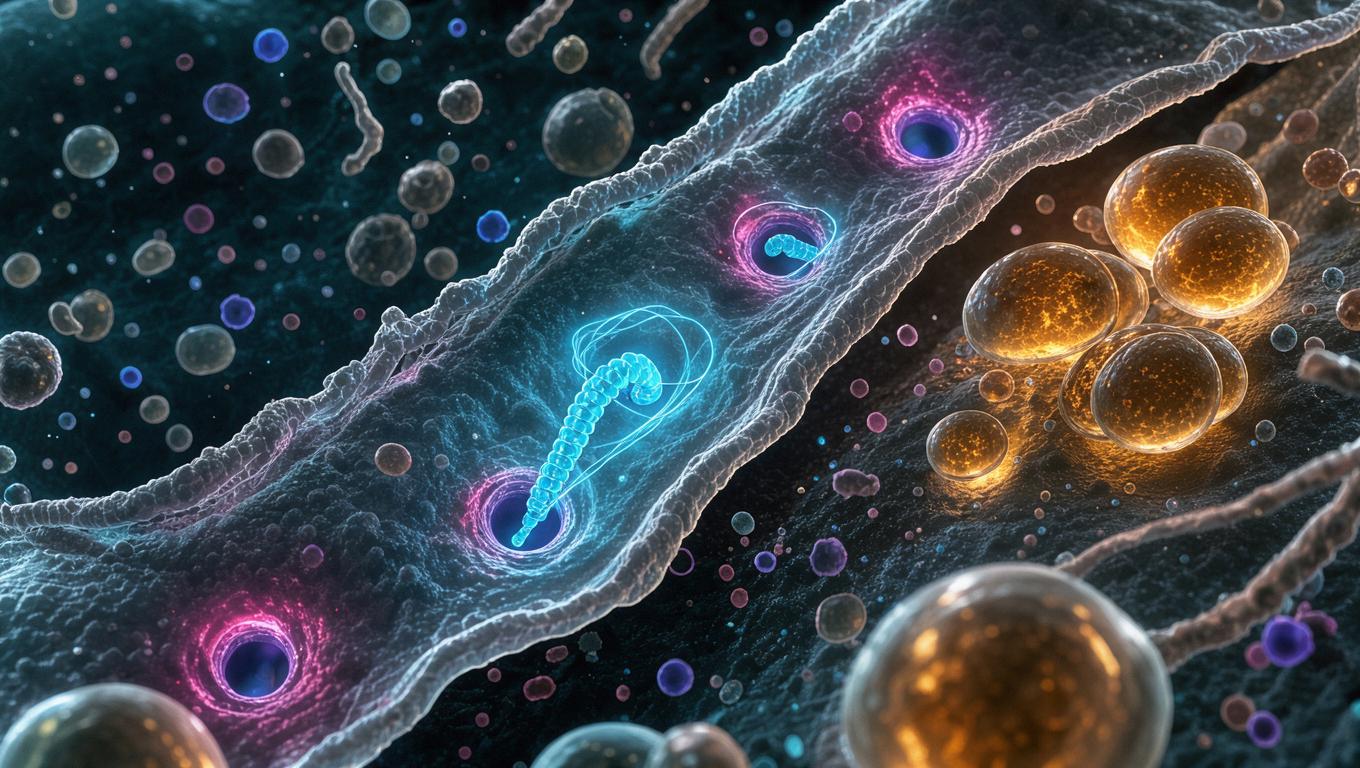
This preprint presents a rigorously validated, non-perturbing nanobody probe (VHH[Nic96]) that selectively labels newly synthesized Nic96-containing subcomplexes in living budding yeast, enabling the first direct live-cell pulse-labeling of NPC assembly and revealing NVJ-localized lipid droplets as nucleoporin storage sites
Long Explanation
Central Claim and Evidence
The paper solves a long-standing methodological problem: distinguishing newly assembling nuclear pore complexes (NPCs) from mature ones in living cells. The authors exploit a previously characterized nanobody, VHH-SAN12 (VHH[Nic96]), whose C-terminal Nic96 epitope is buried in mature NPCs . Three converging evidence lines support the core claim: (1) KARMA SILAC pulse-chase mass spectrometry shows Nic96, the CTN trimer (Nsp1/Nup49/Nup57), Pom152, and Nup192 are significantly more heavy-labeled in VHH[Nic96] purifications than in a VHH[Nup84] control that labels mature NPCs; (2) Pom34-ZZ pull-downs show VHH[Nic96] co-enriches with nups from all NPC structural elements, indicating eventual incorporation into complete pores; (3) Brl1-AID depletion, which stalls assembly, redirects VHH[Nic96]-mNG from the nuclear envelope to cytosolic foci. Structural superimposition with the cryo-EM inner spoke ring (PDB 8TJ5) plus a Nup157ΔC truncation experiment, which increased VHH[Nic96] incorporation, directly supports epitope shielding in mature NPCs .
What the Probe Reveals
Using the validated probe, the authors show foci kinetics consistent with continuous NPC synthesis: foci numbers rise then decline with cell-cycle dilution, foci intensity never exceeds endogenous Nic96-mNG levels (recruitment limited by Nic96, ~half of Nic96 copies VHH-bound), and diploid cells reach peak foci earlier than haploids, matching their doubled NPC load. Correlative light-electron microscopy places NVJ-proximal VHH[Nic96] foci on Pdr16/Ldo16-positive lipid droplets, often near NPCs; in nitrogen starvation and assembly-compromised mutants (nup53Δ, nup170ΔC, Brl1 depletion), the signal shifts toward these droplet-associated storage pools. In lipid-droplet-deficient quadruple mutants, VHH[Nic96] still incorporates into NPCs, establishing droplets as a non-obligate reservoir rather than a required intermediate .
Critical Assessment
Strengths: Multi-modal validation (SILAC-MS, super-resolution STED, CLEM/tomography, genetics) is unusually thorough; extensive non-perturbation controls include Nab2NLS import, Nup82-mCherry mislocalization screens across ~13 quality-control gene deletions, and replicative lifespan assays. Negative results (no lifespan or transport defects) are reported transparently. Sample sizes are large (n ≥ 140–215 cells per condition, ≥4 biological replicates for imaging; n=3–6 for MS). Statistics use appropriate negative-binomial GLMMs with residual diagnostics via DHARMa.
Limitations and blind spots: (1) Single-epitope sampling: the probe reports only Nic96-CTN trajectory; assembly of other subcomplexes (Y-complex, cytoplasmic filaments) is invisible. (2) PunctaFinder thresholds: the authors acknowledge undercounting foci to minimize false positives; absolute foci numbers are threshold-dependent, though relative comparisons are internally consistent. (3) Overexpression: galactose-pulsed VHH expression is supraphysiological; sub-stoichiometric incorporation suggests this, but subtle perturbations could escape detection. (4) Yeast-specificity: Nic96/Nup93 conservation makes human application plausible, but closed mitosis in yeast has no direct metazoan counterpart, and the two-mode (postmitotic vs interphase) assembly framework known from metazoa limits direct translation. (5) Data availability: deposition is promised but accession numbers are not yet provided, temporarily impeding reproducibility. (6) The lipid-droplet storage model is correlational—no direct physical interaction between Nic96 subcomplexes and droplet surfaces was shown, and the hypothesized Nic96 fatty-acid-binding domain remains untested.
Would this change the conclusions? Evidence that VHH[Nic96] binds mature NPCs at steady state, or that the Nup157ΔC epitope-void experiment confounds assembly rate with epitope accessibility, would undermine the selectivity claim. Direct biochemical demonstration of nup transfer between droplets and NPCs, or genetic rescue showing droplet storage is functionally meaningful for stress survival, would be needed to elevate the storage hypothesis beyond a plausible model.
Context
The tool fills a genuine gap: prior work established co-translational subcomplex assembly and KARMA-based maturation kinetics but lacked live-cell spatial resolution of intermediates. Combined with concurrent work showing Brl1/Brr6 membrane-fusion roles in NPC biogenesis , this probe now enables direct visualization of where stalling occurs. The NVJ/lipid-droplet findings connect NPC biogenesis to metabolic state, echoing prior reports that lipid droplets act as a physiological nucleoporin reservoir and that NVJ contacts mitigate assembly stress . Confidence in the tool-validation claims is high; confidence in the lipid-droplet storage/assembly-balance model is moderate pending mechanistic follow-up.
Feedback:
Updated: October 31, 2026
BGPT Paper Review
Study Novelty
90%
First live-cell pulse-labeling tool selective for NPC assembly intermediates rather than mature pores, built on a pre-existing structural-biology nanobody suite; the lipid-droplet storage observation at the NVJ is a genuinely new in vivo biological finding.
Scientific Quality
90%
Exceptional multi-modal validation (SILAC-KARMA, STED, CLEM, genetics, lifespan), large samples, appropriate GLMM statistics, and transparent reporting of thresholds and negative results. Minor weaknesses: promised data accessions absent, and the storage model remains correlational.
Study Generality
70%
Grounded in S. cerevisiae closed mitosis; Nic96/Nup93 conservation suggests translatability, but only one nup trajectory is probed and metazoan assembly modes differ, limiting scope.
Study Usefulness
90%
A validated, non-perturbing, spatiotemporal probe for NPC biogenesis that any yeast NPC lab can adopt immediately, enabling assembly-rate quantification and intermediate localization.
Study Reproducibility
80%
Detailed methods, strains, plasmids, and thresholds are provided; however, no public accession numbers for MS/imaging data yet, which would otherwise raise this score.
Explanatory Depth
80%
Mechanistic logic from epitope shielding through subcomplex incorporation is well supported; the lipid-droplet buffering/degradation model is plausible but currently correlational.
Cross-referencing the VHH[Nic96] interactome data with yeast nucleoporin databases to quantify which assembly-stage subcomplexes the probe captures versus mature NPC composition.
Get emailed when your analysis is done!
We'll email you the results when your analysis is finished.
Hypothesis Graveyard
Lipid droplets are obligate NPC assembly intermediates — falsified by the authors' own experiment: VHH[Nic96] incorporates into NPCs normally in are1/are2/dga1/lro1 quadruple mutants lacking droplets.
VHH[Nic96] labels NPCs directly by binding accessible Nic96 — falsified by Nup157ΔC epitope-void experiment and Brl1-depletion stalling, both consistent with burial in mature pores.

 Explore by Goal
 Quick Explanation
 Long Explanation
 Top Data Sources
 Ask a Follow-Up
 Key Insight
 Keep Exploring
 Analysis
 Hypothesis Graveyard
 Potential Experiments
 Discussion
