Analyze how experimental results and claims are presented, scoped, and limited in a paper.Know what the science actually supports before you trust the answer.
Press Enter ↵ to analyze
Explore by Goal
"A gene is a long sequence of coded letters, like computer information. Modern biology is becoming very much a branch of information technology."
- Richard Dawkins
Quick Explanation
Copied
This Nature Biotechnology study builds an antigen-driven toggle-switch model of memory/effector/exhausted T cell dynamics, fitting Kymriah CLL pharmacokinetic/tumor data to show that memory-cell turnover and effector cytotoxic potency—not cell frequency—drive clinical variance, and that pre-infusion transcriptomes predict response better than immunophenotyping across three indications. The mechanism-based model and cross-dataset transcriptome classifiers (median accuracies 71–90%) are strong, but parameters are non-identifiable, training data are digitized group means, and the entire author team is employed by Notch Therapeutics, a CAR-T company with direct commercial incentive.
Long Explanation
What the paper did and what it shows
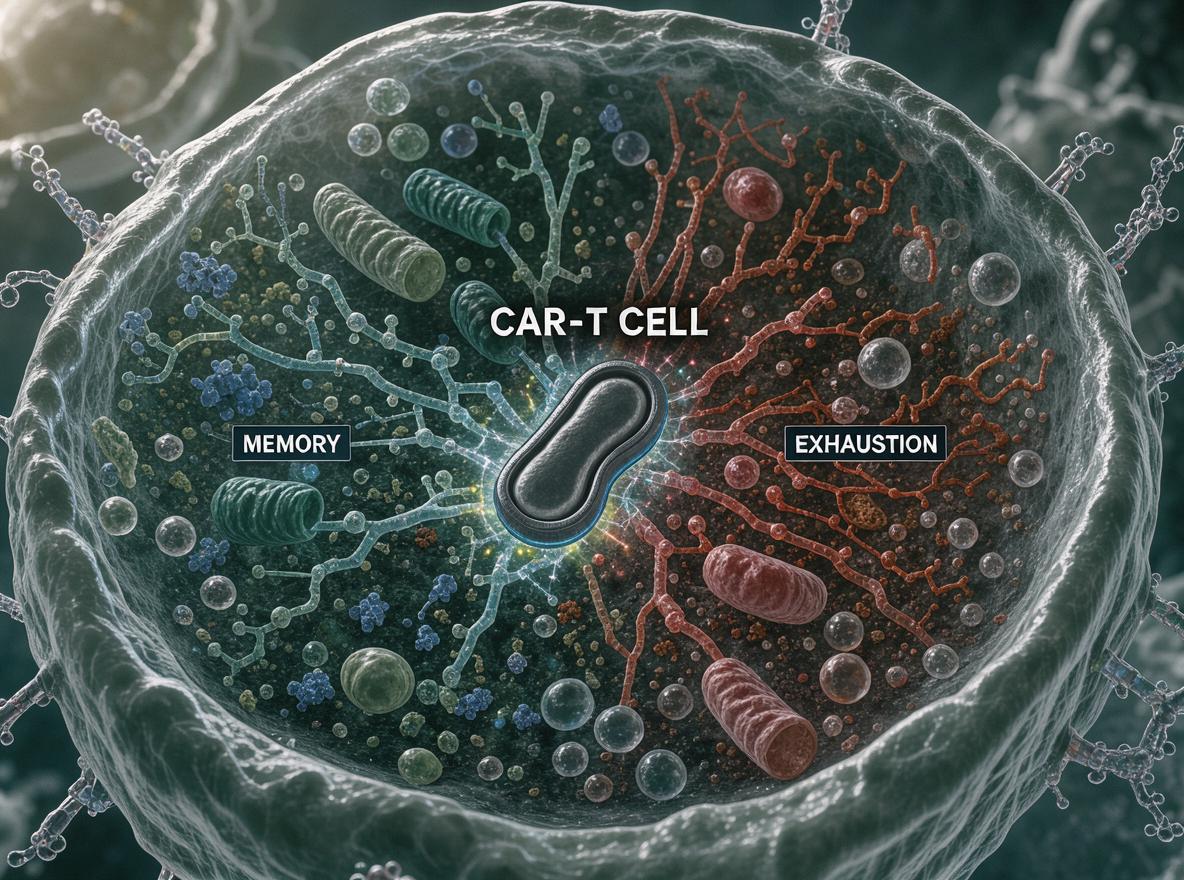
Kirouac et al. encoded an ordinary-differential-equation toggle-switch model in which tumor-antigen levels (Hill functions) coordinately regulate memory-cell self-renewal, effector proliferation/exhaustion, and memory regeneration. Fitting digitized mean pharmacokinetic/tumor curves from Fraietta et al. (Kymriah in CLL: CR n=8, PR n=5, NR n=25) via particle swarm optimization, principal-component analysis of the 36 parameter sets identified memory/effector turnover rates (μM, dM) and effector cytotoxic potency (TK50)—not memory-cell frequency—as the dominant axes separating CR from NR archetypes .
Pre-infusion product transcriptomes (28-signature ssGSEA logistic classifier, genetic-algorithm feature selection, 60:40 train:test, 2,500 iterations) predicted outcomes with reported median accuracies shown above, beating immunophenotype-based classifiers in every dataset (all P < 10-15 for the key comparisons). Single-cell reanalysis of Bai et al. (ALL) and Haradhvala et al. (LBCL) data confirmed CR products show memory-like, functional signatures while NR/RL products show CAR-T dysfunction signatures even within phenotypically identical memory/effector gates. Virtual populations (n=1,000) with randomized dose and tumor burden recapitulated the ~3-orders-of-magnitude AUC variance of registrational Kymriah data and predicted Cmax/B0 as a response covariate, later validated qualitatively against Yescarta data and Abecma dose-response phase 2 dynamics out to 1 year .
Critical appraisal: strengths and blind spots
Strengths: mechanism-based rather than purely empirical modeling; parameters trained on clinical PK/tumor data and independently cross-checked against transcriptomics; negative controls (random parameter populations, random gene-signature classifiers) are included; code is public on Zenodo and scRNA-seq data from GEO (GSE197215, GSE197268).
Blind spots the authors partly acknowledge but that deserve emphasis: (1) Model parameters are explicitly non-identifiable—12 PSO runs per population were averaged because single fits are not unique, so PC1 loadings (the paper's central mechanistic claim) rest on a degenerate parameter space. (2) Training data are digitized group means ± SD from published figures, not individual patient curves, which masks patient-level variance and can bias parameter inference. (3) The classifier was derived and validated on the same small datasets (CLL n=38; ALL n=12; LBCL n=32) with no fully held-out external cohort; 90% accuracy on a 60:40 split of 38 samples has wide uncertainty. (4) The 'product-intrinsic vs host-intrinsic' dichotomy is circular by the authors' own admission—product traits may simply reflect the patient's immune state. (5) Financial incentive bias: every author is an employee/shareholder of Notch Therapeutics, whose allogeneic platform strategy aligns with the paper's conclusion that durable efficacy requires moving beyond autologous products; this does not invalidate the analysis but warrants independent replication . (6) The scorecard's signatures were seeded from the first (CLL) dataset, making cross-dataset 'validation' partly training-dependent; the authors flag large gray bubbles and inconsistent directionality. (7) No longitudinal post-infusion phenotyping exists to test the predicted dose-dependent exhaustion/memory-regeneration dynamics—the key untested mechanistic prediction.
Context within current CAR-T modeling
The work complements later physiologically based PK models for solid tumors that similarly couple delivery, immune dynamics, and normalization strategies to optimize dosing , and its memory-function thesis is echoed by allogeneic TSCM-predominant BCMA CAR-T data where early-memory frequency and polyfunctionality correlate with tumor control in phase 1 myeloma (ORR 80–83% with intensified lymphodepletion vs 0% standard) .
Falsification paths: prospective validation of the 28-gene scorecard in an independent cohort; direct measurement of memory-cell proliferative turnover (e.g., Ki-67/deuterium labeling) correlated with Cmax; and longitudinal exhaustion phenotyping post-infusion. Until then, treat the mechanism as a well-constrained hypothesis, not established fact. Confidence in the central claims: moderate-to-high for the transcriptome-predictivity observation, moderate for the parameter-level mechanistic interpretation.
Author reviews:
Feedback:
Updated: November 01, 2026
BGPT Paper Review
Study Novelty
80%
Integrating a mechanism-based toggle-switch T cell model with clinical PK data and pre-infusion transcriptome classifiers was novel for 2023; individual components (empirical PK models, memory-phenotype predictors) were known, but the deconvolution of frequency vs function was new.
Scientific Quality
80%
Rigorous methods, negative controls, and public code; reduced by non-identifiable parameters, digitized group-mean training data, small validation cohorts, and the all-industry-author conflict of interest at a CAR-T company.
Study Generality
70%
Validated across two CD19 products and three indications plus BCMA Abecma, but extrapolation to solid tumors, allogeneic products, and non-CD19 targets remains untested by the paper itself.
Study Usefulness
80%
Provides an actionable framework for product optimization, dose personalization by tumor burden, and a transcriptomic scorecard usable in product characterization.
Study Reproducibility
70%
Code on Zenodo and GEO data deposited, but reliance on digitized published figures and non-identifiable PSO fits limits exact reproduction; no fully independent external cohort validation.
Explanatory Depth
80%
Mechanistic model links antigen burden, differentiation states, and clinical exposure quantitatively; however, lumped parameters (TK50, turnover rates) aggregate many unresolvable cellular processes, acknowledged by the authors.
Reanalyzing the deposited Bai and Haradhvala scRNA-seq datasets to reproduce the CAR-T dysfunction signature scoring and test transcriptome versus immunophenotype classifier accuracy across ALL and LBCL cohorts.
Get emailed when your analysis is done!
We'll email you the results when your analysis is finished.
Hypothesis Graveyard
Memory cell frequency alone explains response variance: falsified in-paper by simulations showing CR/PR/NR differences exceed what composition-only models can generate.
Purely empirical population PK models (BLA-style) suffice for product development: the paper shows they cannot simulate alternate designs, though their clinical fit is adequate.

 Explore by Goal
 Quick Explanation
 Long Explanation
 Top Data Sources
 Ask a Follow-Up
 Key Insight
 Keep Exploring
 Analysis
 Hypothesis Graveyard
 Potential Experiments
 Discussion
