Check each claim against its linked experiments, results, and falsification criteria.Know what the science actually supports before you trust the answer.
Press Enter ↵ to check claims
Explore by Goal
"Science is the great antidote to the poison of enthusiasm and superstition."
- Adam Smith
Quick Explanation
Copied
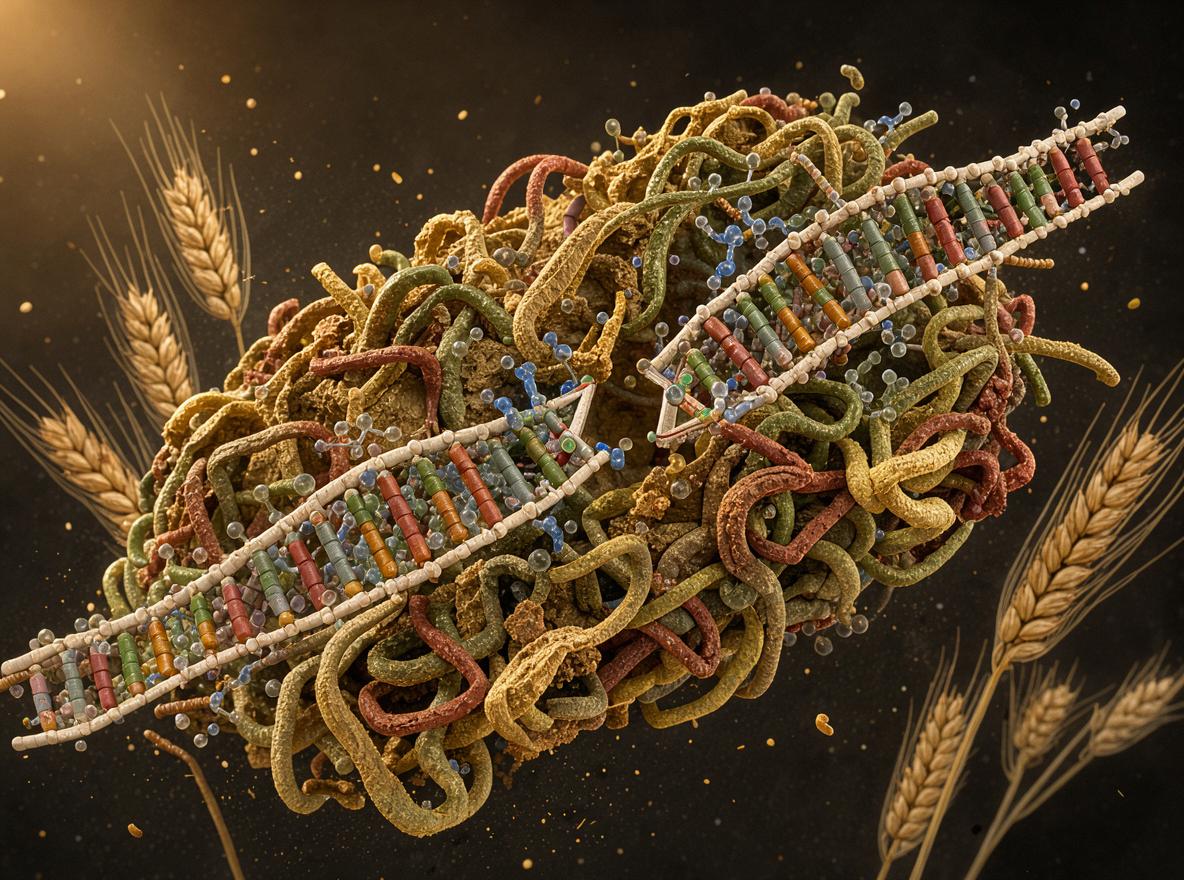
Richard, Burgess and Champoux show wheat germ type 1 topoisomerase cleaves duplex and single-stranded DNA at non-random sites, forms a covalent 3'-phosphotyrosyl bond leaving a 5'-OH, and shares many cleavage sites with the rat liver enzyme, establishing strong conservation of eukaryotic Top1 mechanism across kingdoms.
Long Explanation
Evidence Supporting the Central Claims
This 1984 comparative biochemistry study extends mammalian topoisomerase 1 mechanism to the plant kingdom using purified wheat germ (WG) and rat liver (RL) enzymes on defined SV40 and M13 DNA substrates.
1. Cleavage requires denaturation and is enzyme-specific. Duplex SV40 Form I DNA incubated with enzyme and stopped with SDS yielded ~0.51 nicks/molecule (RL) and ~0.58 (WG), versus ~0.19 without enzyme. Adding 0.5 M NaCl before SDS dropped nicking to ~0.21 for both enzymes, arguing against contaminating endonucleases since salt-dissociated protein should not abolish endonuclease cuts.
2. 3'-end covalent attachment. Breaks generate a free 5'-OH labelable by polynucleotide kinase. With 5'-end-labeled substrate, untreated samples migrated as smears (protein attached), while proteinase K treatment restored discrete bands of 1.8, 1.1, 0.77, 0.54/0.53 and 0.24 kb; 3'-labeled substrates gave discrete bands regardless. Alkali/high-salt/detergent stability of the complex indicates a covalent bond, consistent with the known mammalian enzyme-DNA linkage.
3. Non-random, conserved cleavage sites. Sequencing gels of an end-labeled 0.75 kb EcoRI/BamHI SV40 fragment show many sites (~1 every 10 bases on average, weak sites unevenly distributed) with substantial overlap between RL and WG enzymes but non-identical band intensities. Denatured DNA is cleaved under native conditions at both shared and unique sites, and temperature (24 vs 37°C) alters fragment patterns.
Critical Assessment
In vitro, high enzyme:DNA ratios (~35:1 to 10:1) were required empirically; the authors themselves note this may reflect activity loss on storage/dilution, so cleavage site frequencies may not reflect physiological targeting.
Denaturant-dependent detection traps the cleavable complex; the paper acknowledges three non-exclusive models (random binding, probabilistic cleavage, selective binding) and cannot distinguish them.
No replicates or error estimates are reported; single-gel autoradiographs support qualitative conclusions only. Single-stranded breakage patterns varied with temperature, and short-substrate behavior differed from M13, limiting generality.
The chromatin discussion (regulation at the level of chromatin access rather than sequence specificity alone) is speculative but prescient, anticipating topoisomerase poison biology later exploited in chemotherapy where drug-stabilized cleavable complexes kill tumor cells.
Verification and Context
The high-salt control cleverly excludes endonuclease contamination; the Maxam-Gilbert sequencing lanes provide internal size calibration. The claim that WG cleavage sites overlap RL sites is directly visible in Fig. 4 banding. What would change this conclusion: demonstration that cleavage is random under native physiological conditions, or that in vivo chromatin-bound Top1 shows a different site distribution, per the paper's own falsification framing.
Author Reviews:
Feedback:
Updated: November 05, 2026
BGPT Paper Review
Study Novelty
60%
Extends known mammalian Top1 mechanism to a plant enzyme; confirmatory comparative work in 1984, novel at the time for cross-kingdom conservation but incremental relative to prior rat liver and chicken erythrocyte studies it cites.
Scientific Quality
80%
Rigorous controls (high-salt exclusion of endonuclease, proteinase K shifts, polarity-specific end labels, Maxam-Gilbert calibration); limitations are single-run autoradiographs without replicates and non-physiological denaturing termination, acknowledged by the authors.
Study Generality
70%
Findings generalize Top1 mechanism across plant and animal kingdoms and inform chromatin regulation concepts, but are constrained to in vitro substrates (SV40, M13) with no in vivo validation.
Study Usefulness
80%
Established the eukaryotic Top1 3'-attachment polarity and site specificity paradigm later foundational for camptothecin/poison pharmacology and chromatin-access models of topoisomerase regulation.
Study Reproducibility
70%
Detailed buffer, substrate, and labeling conditions enable replication with standard 1980s-era biochemistry; however, enzyme storage lability and empirically tuned enzyme ratios introduce run-to-run variability the authors note.
Explanatory Depth
70%
Mechanistic interpretation (covalent 3'-phosphate linkage, Poisson nicking analysis, three competing site-specificity models) is thoughtful but lacks molecular structural detail; sequence-level bias analysis deferred to cited Edwards et al. work.
We'll email you the results when your analysis is finished.
Hypothesis Graveyard
Random binding followed by denaturant-trapped cuts everywhere: rejected because high-salt pretreatment abolishes breakage and discrete bands dominate, inconsistent with uniformly random cleavage.
Top1 site specificity as the primary determinant of chromatin hypersensitive sites: undermined by the authors' own estimate of one potential site per 10 bp, making sequence-level control insufficient to explain restricted in vivo access.

 Explore by Goal
 Quick Explanation
 Long Explanation
 Top Data Sources
 Ask a Follow-Up
 Key Insight
 Keep Exploring
 Hypothesis Graveyard
 Potential Experiments
 Discussion
