Check a paper's claims against linked experiments, exact results, stated scope, and limitations.Know what falsifiable science actually supports before you trust the answer.
Press Enter ↵ to search evidence
Explore by Goal
"The universe is not only queerer than we suppose, but queerer than we can suppose."
- J.B.S. Haldane
Quick Explanation
Copied
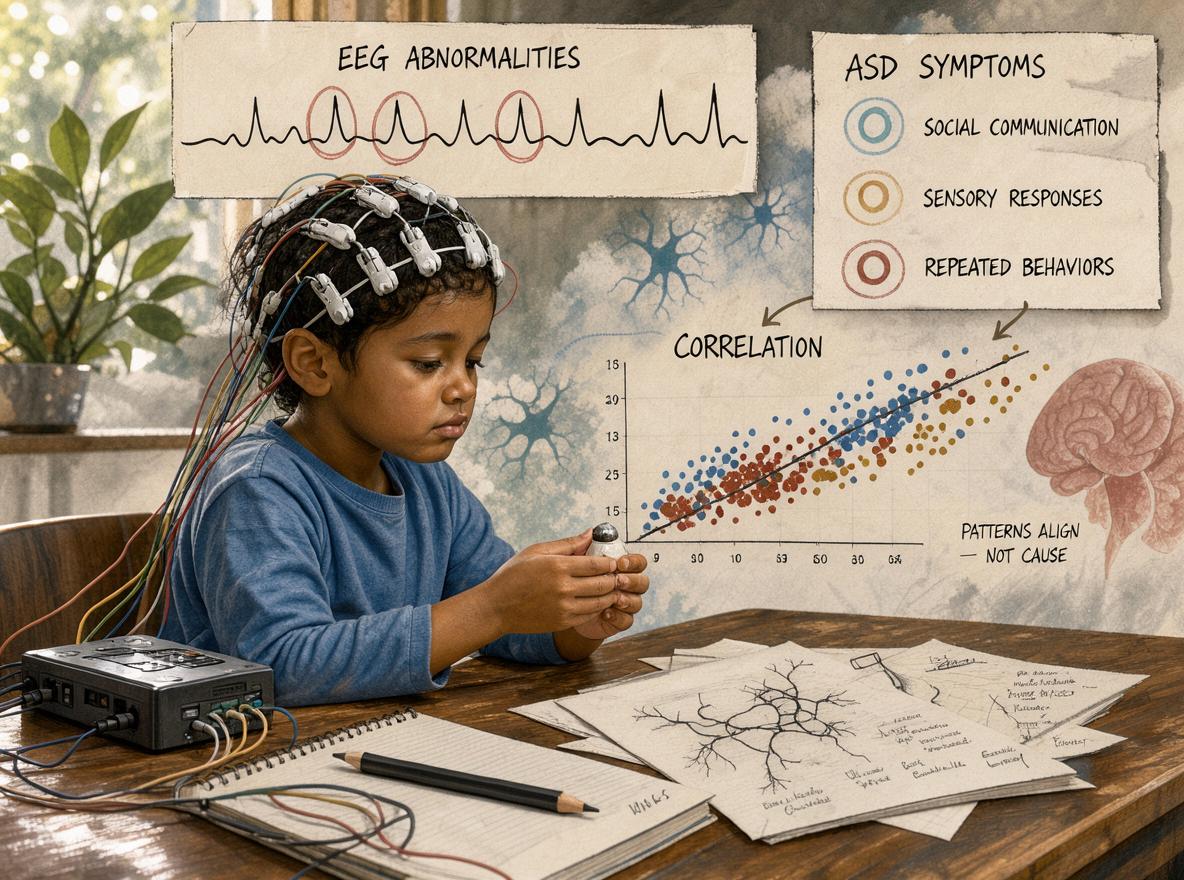
This single-clinic, single-author observational study of 1014 Japanese children with ASD reports 37% epilepsy and 85.8% epileptiform EEG discharges, concentrated frontally (65.6%) and in lower-IQ children, and speculatively links frontal spike foci to mirror-neuron dysfunction. Its large sample is valuable, but no control group, unblinded EEG reading, clinic-based selection, and treatment case studies confounded by concurrent ABA make the causal claim that anticonvulsants improve ASD symptoms unproven.
Long Explanation
What the Paper Reports
Yasuhara followed 1014 children with ASD (DSM-IV criteria; ages 3–20, 785 male/229 female) at one Osaka clinic for >3 years, with sleep EEG roughly every 6 months on a 32-channel digital system .
The reported frontal predominance (65.6% of spike foci; temporal, parietal, occipital, and multifocal each <10%) matches the earlier finding of Hashimoto et al. that paroxysmal discharges in young autistic patients cluster frontally, as cited by the author .
How It Fits the Wider EEG-in-ASD Evidence
The 85.8% discharge rate is far above the ~40% literature mean for epileptiform discharges in children with ASD without known epilepsy, and above Chez et al.'s 60% (889 cases) . This gap is partly explicable by the paper's unusually sensitive method — serial sleep EEG every 6 months with any single discharge counted as abnormal — a permissive definition that inflates rates relative to single-recording studies. Modern resting-state meta-analysis (41 studies, N=2701) instead finds modest gamma-power elevation (g=0.37) and reduced relative alpha power (g=−0.35) in ASD, with heavy heterogeneity, showing that today's field uses quantitative spectral biomarkers rather than binary spike counts .
Critical Weaknesses
No control group and single-clinic recruitment (selection/referral bias); single author, no independent blinded EEG readers .
Conflating correlation with causation: the IQ–epilepsy gradient is reported as an association; reverse causation (more severe encephalopathy drives both low IQ and epileptiform activity) is not tested. The mirror-neuron interpretation (Broca's area, cingulate, angular gyrus, STS spike foci) is post-hoc narrative built from four case reports — a HARKing-style leap the paper itself flags as awaiting future data.
Treatment cases are uninterpretable for efficacy: Case 2's DQ rise (62→88 on VPA) occurred alongside ABA and natural development, without blinding or controls; the author acknowledges a double-blind trial is still needed .
Reproducibility: no data-sharing, no statistical tests reported, no confidence intervals; spike-scoring criteria not operationalized.
Confidence note: Descriptive epidemiology (37% epilepsy, IQ gradient) is credible and consistent with independent cohort data; the mirror-neuron localization and treatment-improvement claims are speculative. Disproof would require blinded, controlled trials showing anticonvulsants do not improve ASD outcomes and multi-reader studies not reproducing the frontal predominance.
Feedback:
Updated: November 21, 2026
BGPT Paper Review
Study Novelty
50%
Confirms known ASD-epilepsy comorbidity and frontal predominance reported previously (Hashimoto 2001, Chez 2006, Danielsson 2005); the mirror-neuron spike-localization framing was relatively novel in 2010 but speculative.
Scientific Quality
40%
Large sample is an asset, but no control group, single unblinded author/reader, permissive 'any discharge = abnormal' criterion, no statistics/CIs, post-hoc case-based causal claims, and acknowledged need for blinded trials cap quality.
Study Generality
50%
Findings on epilepsy-IQ association generalize modestly; clinic-specific EEG rates and mirror-neuron localization are population- and method-dependent, limiting broad applicability.
Study Usefulness
50%
Supports clinical vigilance for epileptiform activity in ASD (especially low-IQ children), but treatment recommendations rest on uncontrolled case reports.
Study Reproducibility
30%
No shared data, no statistical testing, vague spike-scoring criteria, and single-site single-observer EEG reading prevent independent reproduction.
Explanatory Depth
30%
Mechanistic mirror-neuron narrative is associative narrative built on four cases; no electrophysiological quantification, genetics, or longitudinal causal modeling.
We'll email you the results when your analysis is finished.
Hypothesis Graveyard
Mirror-neuron dysfunction caused by focal frontal spikes: weakened because mirror-neuron theory of ASD itself has been heavily challenged and spike foci in cingulate/STS were seen in only single uncontrolled cases.

 Explore by Goal
 Quick Explanation
 Long Explanation
 Top Data Sources
 Ask a Follow-Up
 Key Insight
 Keep Exploring
 Hypothesis Graveyard
 Potential Experiments
 Discussion
