Analyze how experimental results and claims are presented, scoped, and limited in a paper.Know what the science actually supports before you trust the answer.
Press Enter ↵ to analyze
Explore by Goal
"We are just an advanced breed of monkeys on a minor planet of a very average star. But we can understand the Universe. That makes us something very special."
- Stephen Hawking
Quick Explanation
Copied
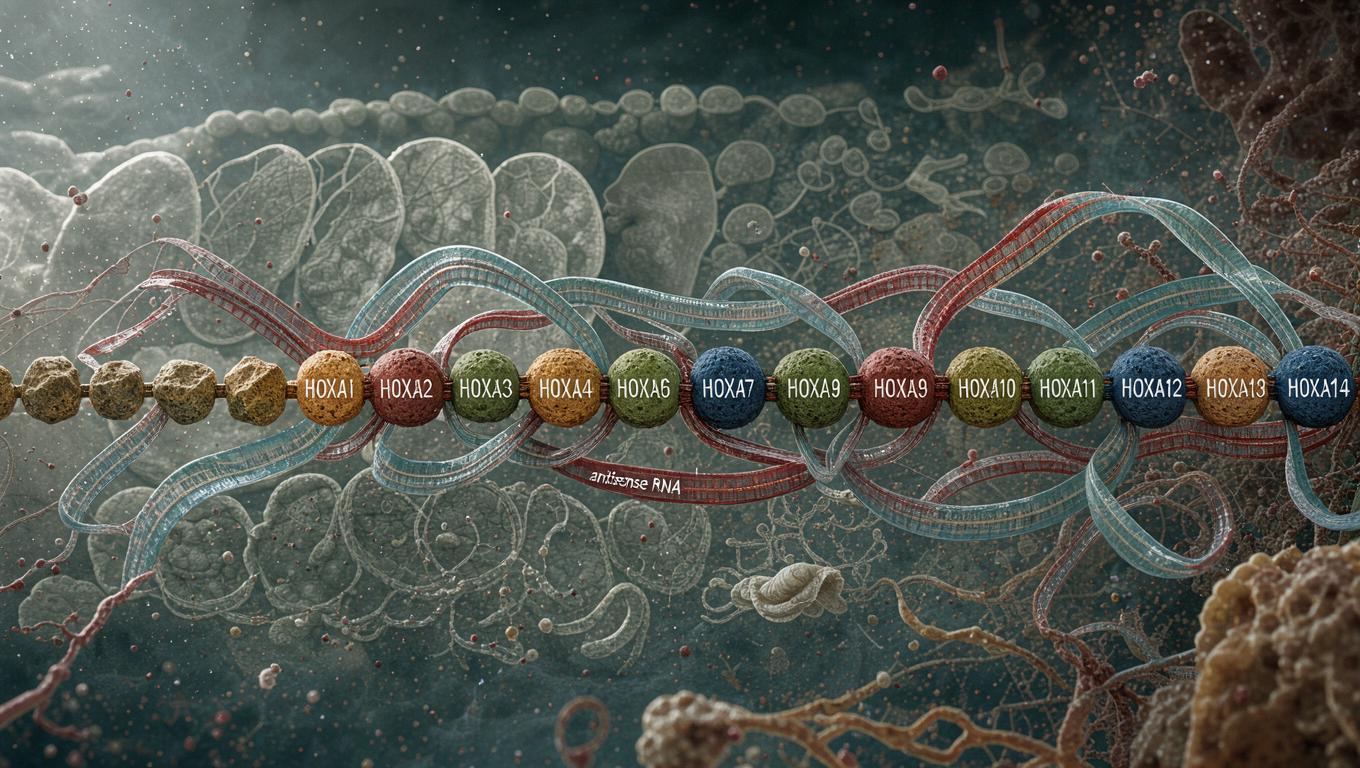
This 2007 BBRC study by Sasaki et al. identifies intergenic antisense ncRNAs in the human HOXA cluster that are positionally conserved in mouse and co-expressed with flanking HOXA mRNAs across tissues, tumors, and nine cancer cell lines, including a 265 bp ultra-conserved structured region in HIT18844 . The evidence is correlational (RT-qPCR only, no functional perturbation), so the causal claim that ncRNA expression is "prerequisite" for HOXA regulation remains untested.
Long Explanation
What the paper actually established
Sasaki et al. manually inspected the HOXA locus via UCSC Genome Browser and identified seven intergenic antisense ncRNAs (HIT06113, HIT92376, HIT12844, HIT94153, HIT16800, HIT91045, HIT18844), each with a putative mouse counterpart at an equivalent cluster position, transcribed opposite to HOXA mRNAs . RT-qPCR across 10 human tissues showed ncRNA expression patterns mirroring flanking HOXA mRNAs and following the colinearity rule (thymus: HOXA1–A4 stream; lung shifted distal; uterus/prostate dominated by distal genes) . Coordination persisted in tumors and nine cancer cell lines (HeLa, HEK293, Jurkat, HL60, K562, MCF-7, HEPG2, T24, PC3); late HOXA genes were aberrantly activated in HeLa with both ncRNA partners co-elevated, and T24/PC3 patterns were reciprocal .
The only absolute quantification reported is this ratio, indicating ncRNA abundance is several-fold lower than flanking mRNA—interpreted by the authors as lower ncRNA stability or promoter strength differences .
The ultra-conserved region
HIT18844 contains a 265 bp ultra-conserved stretch 1.8 kb upstream of HOXA13 (1568 bases from its 5′ end), with 65–99% identity among eight mammals, >87% identity over a 47 bp core in chicken/zebrafish/fugu, and RNAz SVM RNA-class probability P = 1.000 for a conserved secondary structure; mouse ESTs suggest alternative splicing removes the region via conserved GT-AG sites . Note the authors' own caveat: HIT18844 is likely an internally primed truncated cDNA (24-bp genomic poly(A) stretch downstream).
Critical assessment
What is solid: the annotated inventory, positional orthology, and co-expression correlations (three experimental replicates for tissue data; two for cell lines). What is overclaimed: the abstract asserts ncRNA expression is "prerequisite" for HOXA regulation, but no knockdown, perturbation, or chromatin experiment was performed; the mechanistic framing relies on external work (transcriptional interference in yeast/Drosophila; Sessa et al.'s Polycomp/ncRNA model, which the authors cite as concurrent). Blindspots: primer sequences undisclosed ("available upon request"), limiting reproducibility; tumor specimen numbers are small and heterogeneous (patient-to-patient variability acknowledged for kidney and uterine tumors, and authors themselves call for matched normal/malignant pairs); SYBR Green RT-qPCR without disclosed normalization details; correlation could equally arise from shared chromatin activation driving both strands rather than ncRNA function. Notably, later antisense-lncRNA work at the cluster (e.g., HOXA-AS2 acting as a miRNA sponge in glioblastoma) shows HOXA antisense transcripts do have autonomous functions, but through mechanisms quite different from the cis-regulatory model proposed here . What would falsify the core claim: CRISPR deletion of HIT18844/HIT91045 without altering adjacent HOXA expression or chromatin state, or loss of collinear HOXA activation upon promoter-specific ncRNA ablation.
Verdict
A careful, descriptive discovery paper whose strongest contribution is the annotated human–mouse ncRNA orthology map and the ultra-conserved structural motif in HIT18844. The central regulatory claim was, at publication, a reasonable hypothesis stated beyond its correlative evidence; follow-up functional work (which this paper correctly prioritizes) was needed, and partially materialized through later HOXA antisense lncRNA studies. Confidence: moderate—claims are well-documented but causality remains open.
Feedback:
Updated: October 30, 2026
BGPT Paper Review
Study Novelty
70%
For 2007, systematic identification of positionally conserved antisense ncRNAs across an entire HOX cluster was early and influential; the concurrent Sessa et al. finding reduces exclusivity of the core observation.
Scientific Quality
70%
Careful annotation and replicated qPCR across tissues and nine cell lines, but purely correlative: no knockdown or chromatin assays support the 'prerequisite' claim; primers undisclosed; small heterogeneous tumor samples; HIT18844 likely internally primed per authors' own note.
Study Generality
70%
Colinear ncRNA-mRNA coordination at a HOX cluster speaks broadly to cluster regulation, ncRNA biology, and cancer, though evidence is limited to one cluster and two species.
Study Usefulness
70%
Provided an annotated ncRNA inventory, accession numbers, and a testable regulatory model that framed subsequent HOXA antisense lncRNA research, but no direct practical application follows from this correlative work.
Study Reproducibility
60%
Accession numbers and software are given, but primer sequences were withheld ('available upon request'), normalization details are sparse, and raw CP values were not tabulated in the text.
Explanatory Depth
60%
The paper describes patterns thoroughly and proposes two mechanisms (transcriptional interference vs Polycomb-counteracting ncRNAs) without discriminating between them; mechanistic depth is borrowed from cited external studies.
We'll email you the results when your analysis is finished.
Hypothesis Graveyard
Transcriptional interference (yeast SER3-style) as the dominant mechanism at HOXA: inconsistent with ncRNAs being antisense to actively transcribed genes and with co-activation rather than mutual exclusion.
ncRNAs being merely degradation noise from convergent promoters: undermined by the ultra-conserved structured region (RNAz P=1.000) and conserved GT-AG splicing patterns, though the internally primed HIT18844 cDNA keeps a partial noise explanation alive.

 Explore by Goal
 Quick Explanation
 Long Explanation
 Top Data Sources
 Ask a Follow-Up
 Key Insight
 Keep Exploring
 Hypothesis Graveyard
 Potential Experiments
 Discussion
