Check a paper's claims against linked experiments, exact results, stated scope, and limitations.Know what falsifiable science actually supports before you trust the answer.
Press Enter ↵ to search evidence
Explore by Goal
"The first principle is that you must not fool yourself — and you are the easiest person to fool."
- Richard Feynman
Quick Explanation
Copied
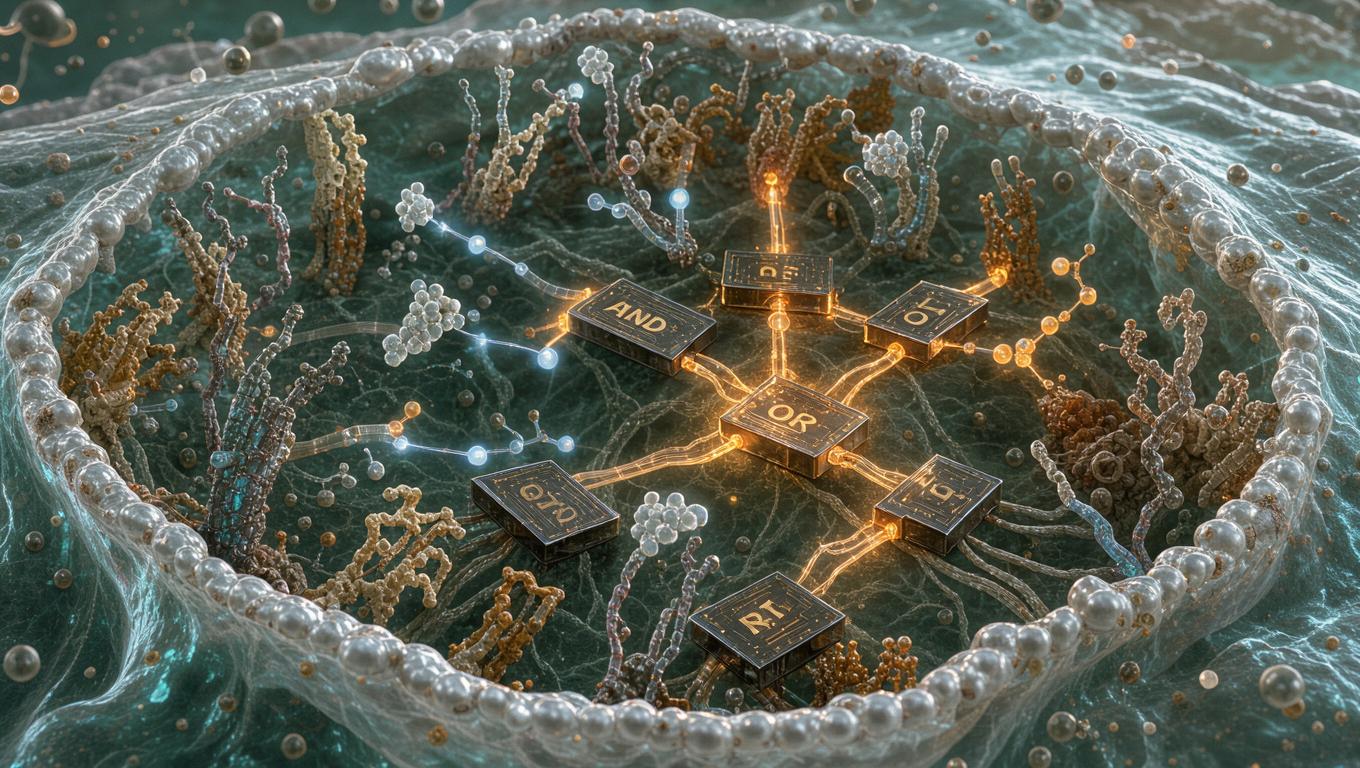
This Nature Chemical Biology study successfully converted three of four natural human cytokine receptor families (VEGFR, IL-10R, and partially TNFR) into orthogonal MESA biosensors that sense soluble ligands independently of native signaling, enabling IL-10-driven CAR expression and VEGF/IL-10 OR and AND logic gates in cell lines . Claims are rigorously supported in immortalized cells but remain untested in primary T cells or in vivo.
Long Explanation
What the study achieved
Edelstein et al. paired natural cytokine receptor ectodomains (NatE) with the split-TEV protease MESA intracellular architecture, testing four receptor families: VEGFR1/2, IL-10Rα/β, TNFR1/2, and TGFβR1/2. Three of four yielded ligand-inducible sensors — VEGF (best: VEGFR2 NTEVp + VEGFR1 CTEVp with the 190K CTEVp mutant), IL-10 (best: IL-10Rβ NTEVp + IL-10Rα CTEVp), and minimally inducible TNF — while TGFβ never signaled, attributed mainly to low expression . This extends, rather than replaces, prior chimeric-receptor work — Baeumler et al. had already shown VEGFR ectodomain-based TF release, and IL-6/IL-12 domain shuffling demonstrated synthetic cytokine receptor modularity — but the systematic cross-family comparison, exogenous-ligand validation, and logic-gate integration are new contributions . A preprint version was posted in March 2024 before the 2025 journal publication .
Reported performance (key numbers)
Reported detection thresholds differ substantially by deployment: HEK293FT cells detected IL-10 down to 16 ng/ml (saturating ~250 ng/ml), Jurkat T cells to 32 ng/ml, and sorted high-expressor Jurkats to 2 ng/ml :
BGPT inference: the ~16-fold threshold spread across contexts shows that apparent sensitivity is expression-state dependent — a critical variable for any therapeutic deployment, and one the authors themselves flag via lost cooperativity (Hill nH 1.9 → 0.58) after sorting.
Low expression dominated; no variant rescued signaling
Critical assessment
Strengths: systematic design-space survey (signal sequence, TMD/JMD, split-TEVp mutants, integration strategy), transparent reporting of failed conversions, absolute reporter quantification (MEPTR calibration), and three biological replicates with corrected statistics .
Blindspots and limits the authors partially acknowledge: all work is in HEK293FT, HEK293FT-LP, Jurkat, and SKOV3 lines (n=3 replicates) with no primary cells, animal models, or human data; immunogenicity of non-native constructs is explicitly untested; possible crosstalk with the endogenous receptors from which ectodomains are derived remains unresolved; and natural-TF outputs (cJun, BATF, Tbet) produced only modest, construct-dependent induction in Jurkats . What is not discussed: no competition experiments against native receptor signaling, no longitudinal stability beyond silencing subclones, and no dose-response data under physiologic (sub-ng/ml to low-ng/ml) IL-10 or VEGF concentrations typical of human plasma, so clinical relevance of the thresholds is unestablished.
Falsification path: the central mechanistic claim — that ligand-induced ectodomain conformational change reconstitutes split TEVp — would be weakened if matched chains failed to respond under receptor-expression-controlled conditions, or if cross-reactive chain pairing produced ligand-independent output in primary cells.
Feedback:
Updated: November 24, 2026
BGPT Paper Review
Study Novelty
80%
Systematic conversion of natural ectodomains into orthogonal synthetic biosensors across four receptor families is new; the MESA mechanism, prior VEGFR-based TF release, and synthetic cytokine receptor shuffling were already established.
Scientific Quality
80%
Rigorous design-space survey, corrected statistics, and transparent failure reporting; deductions include reliance on immortalized lines only, modest natural-TF output, unquantified cross-reactivity in some chain pairings, and garbled figure-annotation extraction.
Study Generality
80%
Design principles (heteroassociative compatibility, TMD choice, autocrine-first screening) are framed to generalize to other receptors, though derived from only four families in two cell contexts.
Study Usefulness
80%
Directly enables soluble-TME-cue sensing with customizable outputs for engineered cell therapies; practical impact gated on primary-cell and in vivo validation.
Study Reproducibility
80%
Detailed methods, plasmid maps, DNA doses, source data, and Addgene deposition enable reproduction; some outcome-critical tuning details reside in extensive supplementary notes.
Mapping reported conversion outcomes, fold inductions, and detection thresholds across the four cytokine receptor families to identify which ectodomain design variables predict functional NatE MESA signaling.
Get emailed when your analysis is done!
We'll email you the results when your analysis is finished.
Hypothesis Graveyard
That signal-sequence optimization could rescue noninducible conversions — tested exhaustively across variants and falsified; only TMD/JMD geometry changes modulated inducibility.

 Explore by Goal
 Quick Explanation
 Long Explanation
 Top Data Sources
 Ask a Follow-Up
 Key Insight
 Keep Exploring
 Analysis
 Hypothesis Graveyard
 Potential Experiments
 Discussion
