Check a paper's claims against linked experiments, exact results, stated scope, and limitations.Know what falsifiable science actually supports before you trust the answer.
Press Enter ↵ to search evidence
Explore by Goal
"The cosmos is within us. We are made of star-stuff. We are a way for the universe to know itself."
- Carl Sagan
Quick Explanation
Copied
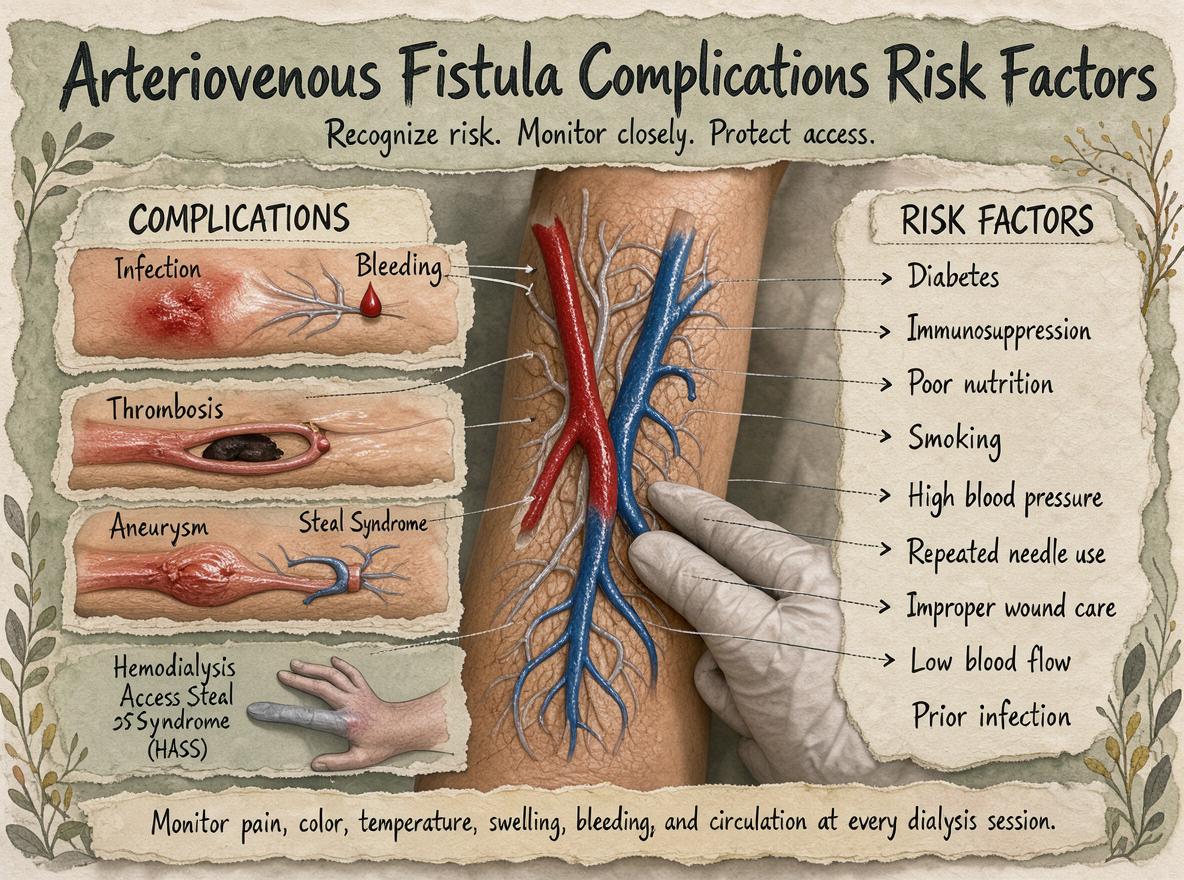
This systematic review of 61 cohorts (11,374 fistulas) reported median AVF complication rates of 0.03–0.24 events per 1000 patient-days, with thrombosis highest and venous hypertension lowest; infections frequently exceeded KDOQI guideline targets, especially with buttonhole cannulation (0.17 vs 0.001 per 1000 patient-days for rope ladder). Marked heterogeneity, inconsistent definitions, and high risk of bias precluded meta-analysis, so rates are descriptive benchmarks rather than precise estimates.
Long Explanation
Key Evidence
Al-Jaishi et al. screened 2292 citations and included 43 studies (61 unique cohorts; n=11,374 fistulas; 19 countries; published 2001–2014) with prospectively captured data on ≥100 fistulas. Median event rates per 1000 patient-days ranged from 0.03 (venous hypertension, single cohort only) to 0.24 (thrombosis). Infections exceeded the KDOQI/CSN target (0.027 per 1000 patient-days) in 23 of 30 cohorts, and buttonhole cannulation showed a markedly higher infection median (0.17) than rope ladder (0.001) .
Critical Appraisal
Strengths: PRISMA-compliant, prespecified PROSPERO protocol (CRD42014010444), blinded dual reviewer screening, SVS/NAVAC-based outcome definitions, and honest refusal to pool heterogeneous data. Weaknesses: definitions were unreported in a substantial fraction of studies (e.g., 13/18 thrombosis studies, 7/23 infection studies); 38/39 observational studies carried moderate/high risk of bias in at least one domain (3/4 RCTs); English-only restriction; venous hypertension rested on a single 350-fistula cohort; and the buttonhole-vs-rope-ladder contrast derived from only two studies each (302 vs 527 fistulas). The constant-hazard assumption used to convert follow-up into patient-days may distort rates where events cluster early, as the authors acknowledge for Ravani et al. .
Blind Spots and Falsification
Surgeon experience, cannulation skill, vessel characteristics, and timing of first needle use were largely unreported, so drivers of the wide rate variability remain unknown—limits the authors themselves emphasize. Non-maturation (~23% primary failure) was excluded by design into a companion review. The core conclusion would be falsified if a standardized, prospectively defined multinational registry using uniform definitions yielded convergent rates with tight intervals, permitting valid pooling .
Feedback:
Updated: November 21, 2026
BGPT Paper Review
Study Novelty
70%
First systematic review restricted to contemporary (2000–2014) AVF complication rates expressed as event rates, complementing earlier patency-focused and narrative reviews that mixed studies dating to the 1970s.
Scientific Quality
70%
Rigorous PRISMA/PROSPERO methods with blinded dual screening and explicit risk-of-bias assessment, but the evidence base itself was heterogeneous, definitions often unreported, and no meta-analysis was possible; medians only.
Study Generality
60%
Broadly relevant to nephrology and vascular access care across 19 countries, but confined to hemodialysis AVF populations and five primary complications; no pediatric or home-dialysis stratification.
Study Usefulness
80%
Directly supports patient-centered consent discussions and guideline benchmarking; the finding that infection rates exceed KDOQI targets—especially with buttonhole cannulation—is immediately actionable for dialysis units.
Study Reproducibility
70%
Registered prespecified protocol, transparent search/inclusion criteria, and supplemental tables per cohort; no public raw data repository, and patient-day conversions rest on an unverifiable constant-hazard assumption.
Explanatory Depth
40%
Descriptive synthesis with narrative mechanistic discussion of aneurysm and steal; quantitative risk-factor modeling was precluded by under-reporting, so heterogeneity drivers remain unidentified.
We'll email you the results when your analysis is finished.
Hypothesis Graveyard
'Fistulas are uniformly safer than grafts and catheters' — the review shows steal risk rises with upper-arm fistulas and infection rates exceed guideline targets, refuting a blanket safety narrative.
'Access-flow surveillance reduces thrombosis' — cohorts with Qa surveillance showed a higher median thrombosis rate (0.33), suggesting confounding by indication rather than a monitoring effect.

 Explore by Goal
 Quick Explanation
 Long Explanation
 Top Data Sources
 Ask a Follow-Up
 Key Insight
 Keep Exploring
 Hypothesis Graveyard
 Potential Experiments
 Discussion
