Check each claim against its experiments, reported results, scope, and stated limitations.Know what the science actually supports before you trust the answer.
Press Enter ↵ to start review
Explore by Goal
"Science is not about why, it's about why not."
- Portal 2
Quick Explanation
Copied
In this CRD composting study, bio-inoculants (FAA, FPJ, IMO, Trichoderma) did not significantly change total nitrogen (p=0.0812) but did affect total phosphorus (p=0.0192) and potassium (p<0.0001), with lower P/K in inoculated composts interpreted as microbial immobilization rather than nutrient gain . The claim is plausible but under-supported by missing replication and treatment means.
Long Explanation
What the Study Reports
Debosura et al. composted 120 kg of fruit and vegetable waste from Zamboanga City in 20-L bins (6 kg waste per bin), applying Fish Amino Acid (FAA), Fermented Plant Juice (FPJ), Indigenous Microorganisms (IMO), or Trichoderma at 100 mL/kg reapplied every 3 days, versus a no-catalyst control, over three months. One-way ANOVA found TN not significant (p=0.0812) but TP (p=0.0192) and TK (p=0.0000) significant .
The reported TN values were highest in IMO (3.36%) and FAA (3.34%), with all inoculated treatments above control; P and K were generally highest in control, and lowest TK in Trichoderma-treated compost .
Interpretation and Supporting Literature
The authors' immobilization hypothesis—microbes assimilating P/K into biomass during rapid growth—is consistent with a meta-analysis showing microbial inoculation alters nutrient turnover during composting , and with work showing Trichoderma-based amendments accelerate decomposition . Their most valuable point—challenging mass loss alone as a compost quality metric—aligns with this literature .
Critical Blind Spots
Replicate number and treatment means not reported — no SDs, SEs, or post-hoc tests accompany the ANOVA p-values; the "p = 0.0000" reporting is statistically improper and suggests possible rounding or testing issues (BGPT inference).
Ambient backyard composting introduces uncontrolled temperature, moisture, and turning variability that can dominate nutrient outcomes, and confounds cannot be separated from inoculant effects.
No microbial community, enzyme, or maturity data — the immobilization mechanism is asserted, not measured; no mass-loss data are actually shown despite the critique of mass-loss metrics (BGPT inference).
A nutrient concentration paradox — TN is a concentration relative to remaining mass; higher TN with lower P/K could simply reflect faster mass loss concentrating nitrogen, which the paper does not disentangle (BGPT inference).
Endpoint-only sampling limits any claim about "dynamics," which requires time series.
Conclusion: The central claim (inoculants shift nutrient transformation, not total content) is plausible and literature-consistent, but this study's missing replication details, missing means, and single-site backyard conditions leave it as a low-power exploratory observation. What would change it: a replicated trial reporting full means with post-hoc comparisons, time-series nutrient and microbial measurements, and mass-balance accounting would confirm or refute the immobilization mechanism.
Feedback:
Updated: September 18, 2026
BGPT Paper Review
Study Novelty
20%
Comparing organic inoculants on compost NPK is well-trodden; the only modestly new element is testing Filipino indigenous preparations (FAA, FPJ, IMO) against Trichoderma on fruit/vegetable waste.
Scientific Quality
30%
Missing replicate counts, no SDs or post-hoc tests, improper 'p = 0.0000' reporting, uncontrolled backyard conditions, endpoint-only sampling, and no mechanistic measurements despite causal interpretations are major red flags.
Study Generality
30%
Findings apply to a single waste stream, location, and season; no demonstration of generality across substrates or climates.
Study Usefulness
40%
Modestly useful for local composting practice and as a hypothesis generator on nutrient immobilization, but too weakly reported to guide decisions.
Study Reproducibility
20%
Replicate number, randomization, inoculant sourcing/composition, and full treatment means are unreported, preventing independent reproduction.
Explanatory Depth
30%
Immobilization is invoked as a mechanism but no microbial, enzymatic, or mass-balance evidence supports it; explanations remain speculative.
We'll email you the results when your analysis is finished.
Hypothesis Graveyard
Bio-inoculants add meaningful nitrogen to compost — implausible because the applied volumes (30 mL/L dilution) carry negligible N relative to 3%+ compost TN; concentration changes must arise from transformation or mass loss.

 Explore by Goal
 Quick Explanation
 Long Explanation
 Top Data Sources
 Ask a Follow-Up
 Key Insight
 Keep Exploring
 Hypothesis Graveyard
 Potential Experiments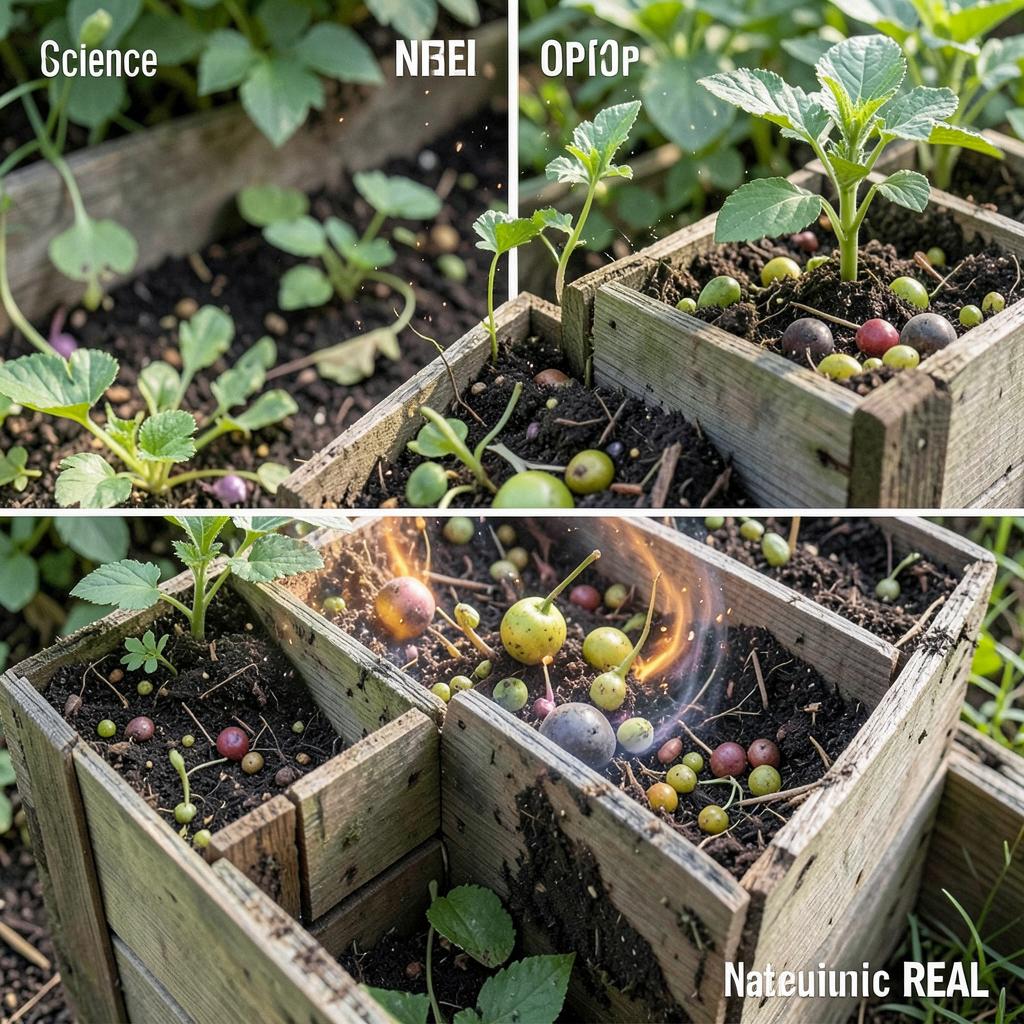
 Discussion