Check each claim against its experiments, reported results, scope, and stated limitations.Know what the science actually supports before you trust the answer.
Press Enter ↵ to start review
Explore by Goal
"Science is the acceptance of what works and the rejection of what does not. That needs more courage than we might think."
- Jacob Bronowski
Quick Explanation
Copied
Mini-review verdict
The paper is a mechanism-focused synthesis arguing that human sexual dimorphism is shaped not only by gonadal hormones, but also by X-chromosome inactivation (XCI), age-related mosaic sex-chromosome loss, sex-specific epigenetic regulation of SHOX, and non-classical androgen pathways (backdoor DHT and 11-oxygenated androgens). Key quantitative anchors include mLOY ~40% at ~70 years and mLOX ~12%, plus an estimate that Xi vs Y contributions explain ~22.6% of sex differences in height.
Long Explanation
Paper Review (Mechanistic Synthesis)
“Chromosomal and hormonal factors involved in human sexual dimorphism”
DOI: 10.1507/endocrj.EJ25-0379
1) Visual map: claimed causal chain
This diagram reflects the review’s emphasis on XCI, mosaic sex-chromosome loss, sex-specific SHOX regulation, and non-classical androgen pathways, all summarized as contributors to dimorphism and downstream disease differences.
2) Key quantitative anchors (from the review text)
Note: these are reported summary statistics cited by the review, not newly computed in this analysis.
The review ties these quantities to proposed biological mechanisms: mosaic losses are linked to different health outcomes (with stronger associations emphasized for mLOY), and SHOX epigenetic regulation is tied to gendered height differences.
Claim A — XCI (XIST/Xist) can affect female health independently of sex hormones
The review highlights evidence that XIST/Xist ribonucleoprotein complexes can be immunogenic, increasing risk of autoimmune disorders in females even when sex-hormone effects are controlled for (as described in the cited work).
Skeptical check: the review itself is narrative; causality in humans hinges on the exact experimental designs and how strongly hormone confounding is excluded.
Claim B — Incomplete XCI spread into PAR1 yields sex-specific SHOX methylation/expression in cartilage
The review argues that SHOX shows higher expression in male cartilage and specific male-dominant methylation in SHOX upstream region/exon 6a with female-dominant methylation in intron 2, and that these methylation patterns correlate positively with expression.
Skeptical check: the review notes that other genetic factors could also contribute and offers alternative possibilities (e.g., other growth regulators, Xist impacts on autosomes). That admission is a good sign of epistemic humility, but it also highlights that SHOX is not proven as the sole cause of height dimorphism.
Claim C — Mosaic loss of X vs Y shows different frequencies and different clinical associations
The review states mLOY is common (~40% in males around age 70) while mLOX is less frequent (~12% in females), and that mLOY is linked to a wider set of adverse outcomes (early death, cancer, Alzheimer’s disease), while mLOX is implicated in fewer features (e.g., atrial fibrillation).
Skeptical check: associations in peripheral blood can be downstream of many processes (cell selection, environment, measurement artifacts). Even the review’s mention that mechanisms differ (distinct genetic risk variants) is consistent with not assuming a single causal pathway.
Claim D — Humans use additional androgen pathways: backdoor DHT and non-aromatizable 11-oxygenated androgens
The review describes an alternative backdoor route to dihydrotestosterone that bypasses testosterone intermediacy, and it introduces 11-oxygenated C19 steroids (e.g., 11-keto testosterone and 11-keto DHT) as non-aromatizable androgens, with roles suggested in virilization of fetal females in adrenal overproduction contexts.
Skeptical check: for “healthy population” dimorphism contributions, the review itself says physiological roles in healthy males/females remain unclear and need further study, which is important for calibrating confidence.
4) Methodological critique (as a mini-review)
Strengths
Mechanism coverage is wide and explicitly includes non-hormonal sex-chromosome effects (XCI, mosaic loss) rather than reducing dimorphism to gonadal hormones alone.
It reports quantitative anchors (mLOY/mLOX prevalence; Xi vs Y height contribution) that help readers avoid purely qualitative claims.
Limitations / blind spots
Narrative mini-review limits: no systematic review methodology, so coverage depends on author selection and interpretation; potential “citation bias” and uneven evidence strength across topics remain possible.
Cross-tissue generalization: XCI dynamics and incomplete spread (PAR1) can vary across tissues and individuals; applying findings from cartilage or model contexts to broader phenotypes can be overextended without direct multi-tissue replication.
Causality vs association for mosaic loss: mLOY/mLOX are measured in peripheral blood; links to disease may reflect systemic aging, inflammation, or cell selection rather than direct causal drivers of each phenotype.
Healthy-population steroid physiology: the review states physiological roles of 11-oxygenated steroids in healthy males/females are not yet known, which reduces confidence when extrapolating from disease/virilization contexts to normal dimorphism.
5) What would most likely disprove / revise the review’s emphasis?
The review’s strongest mechanistic emphasis is that sex-chromosome biology (XCI, mosaic loss) and specific androgen alternatives add explanatory power beyond classical hormones. The most direct falsifiers would be:
SHOX epigenetics not mapping to expression: e.g., showing that sex-skewed SHOX methylation/expression in cartilage does not hold across independent cohorts or that methylation changes do not correlate with SHOX expression after controlling for cell composition and developmental stage.
No measurable hormone-independent XCI immune effects: e.g., if immunogenic XIST mechanisms do not translate to human autoimmune risk independent of sex hormones under rigorous confounding control.
Non-classical androgen pathways failing to contribute under normal physiology: e.g., if 11-oxygenated steroids are not causally linked to dimorphism-related traits in healthy cohorts.
Next: Author-specific deep dives (BGPT links)
Feedback:
Updated: April 29, 2026
BGPT Paper Review
Study Novelty
60%
As a mini-review, its novelty is mainly in integration of several relatively current mechanism themes (XCI immunogenicity; mosaic sex-chromosome loss; SHOX epigenetic regulation in PAR1; backdoor/11-oxygenated androgens) rather than presenting new experimental results.
Scientific Quality
70%
Strength: coherent mechanistic framing and use of multiple quantitative anchors. Skeptical limits: narrative mini-review format (no systematic inclusion/exclusion), reliance on cross-tissue extrapolation, and explicit uncertainty about physiological roles of 11-oxygenated steroids in healthy populations; causality remains largely dependent on cited studies rather than new work.
Study Generality
70%
The framework is general to human sexual dimorphism biology (chromosome dosage/epigenetics/hormones), but some emphasis is trait-specific (height) or context-specific (mosaic loss measured in blood; non-classical androgens clarified first in disease/virilization contexts).
Study Usefulness
70%
Useful as a mechanistic map and hypothesis generator for what non-gonadal mechanisms might explain sex differences and disease susceptibility; less useful for making precise causal effect sizes across all traits because it does not perform meta-analytic quantification across the whole dimorphism phenotype space.
Study Reproducibility
60%
Reproducibility is moderate for what reviews can do: it is not a methods-heavy study, and it provides a synthesis rather than datasets/analysis code. However, the review’s claims depend on cited studies and the ability to retrieve those primary sources, which the text does not systematically list as structured evidence beyond its reference list.
Explanatory Depth
70%
Mechanistically deep in the selected areas (XCI/XIST mechanisms, SHOX PAR1 epigenetics, alternative androgen pathways). Depth is limited where the review itself flags remaining unknowns (e.g., brain sex differences and healthy-population roles of 11-oxygenated steroids).
It will compile reported numeric anchors from the review (mLOY/mLOX prevalence; height fraction), then generate evidence-ranked charts mapping each anchor to its cited primary mechanism and study type.
Get emailed when your analysis is done!
We'll email you the results when your analysis is finished.
Hypothesis Graveyard
The hypothesis that sex differences in female autoimmune prevalence are explained primarily by sex hormones alone would be weakened by Xist-driven, hormone-independent mechanisms emphasized by the review’s cited evidence.
A simplistic model that mosaic sex-chromosome loss is only a passive biomarker of aging (with no contribution to sex-biased disease trajectories) would be undermined if mLOY/mLOX genetic drivers show pathway-level specificity and consistent temporal ordering across tissues.

 Explore by Goal
 Quick Explanation
 Long Explanation
 Top Data Sources
 Ask a Follow-Up
 Key Insight
 Keep Exploring
 Analysis
  Hypothesis Graveyard
 Potential Experiments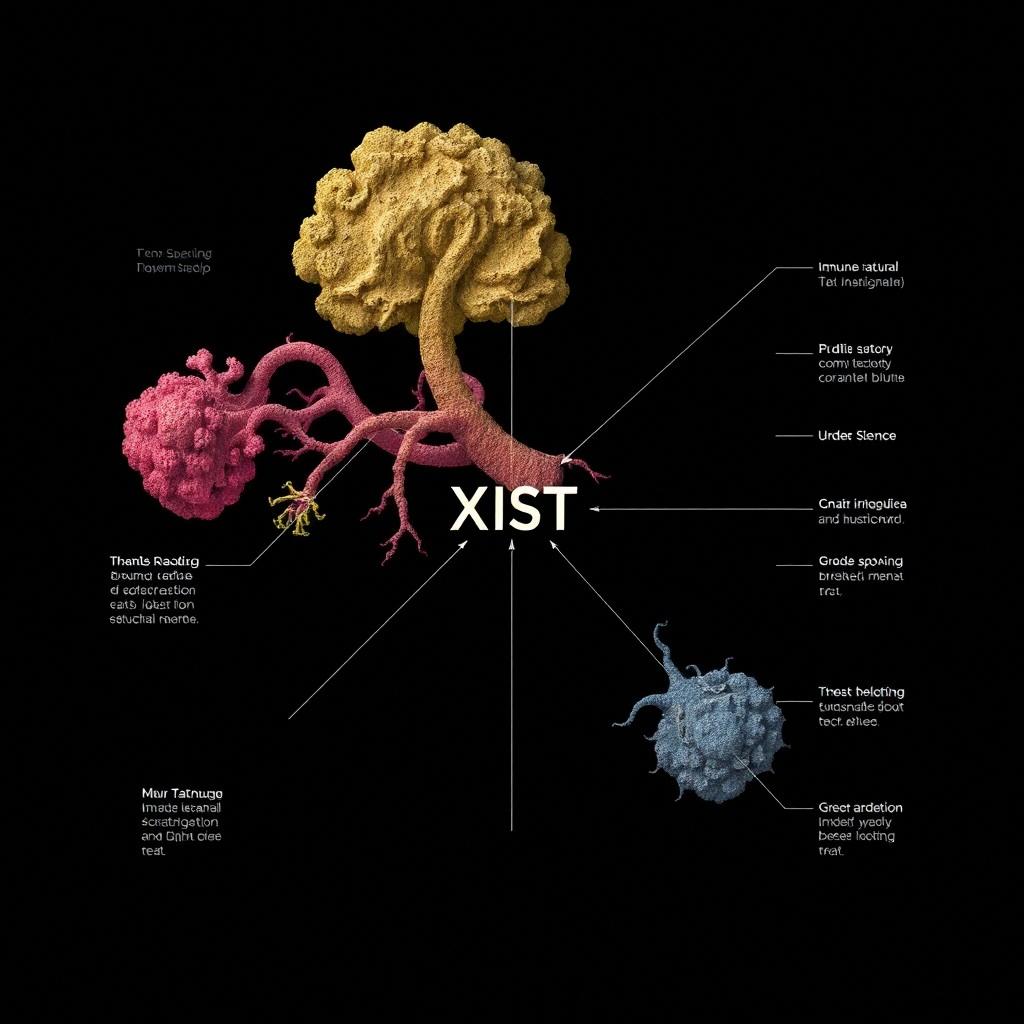
 Discussion