Go beyond summaries to locate specific, verifiable claims and sources within research.Know what falsifiable science actually supports before you trust the answer.
Press Enter ↵ to search paper
Explore by Goal
"The beauty of a living thing is not the atoms that go into it, but the way those atoms are put together."
- Carl Sagan
Quick Explanation
Copied
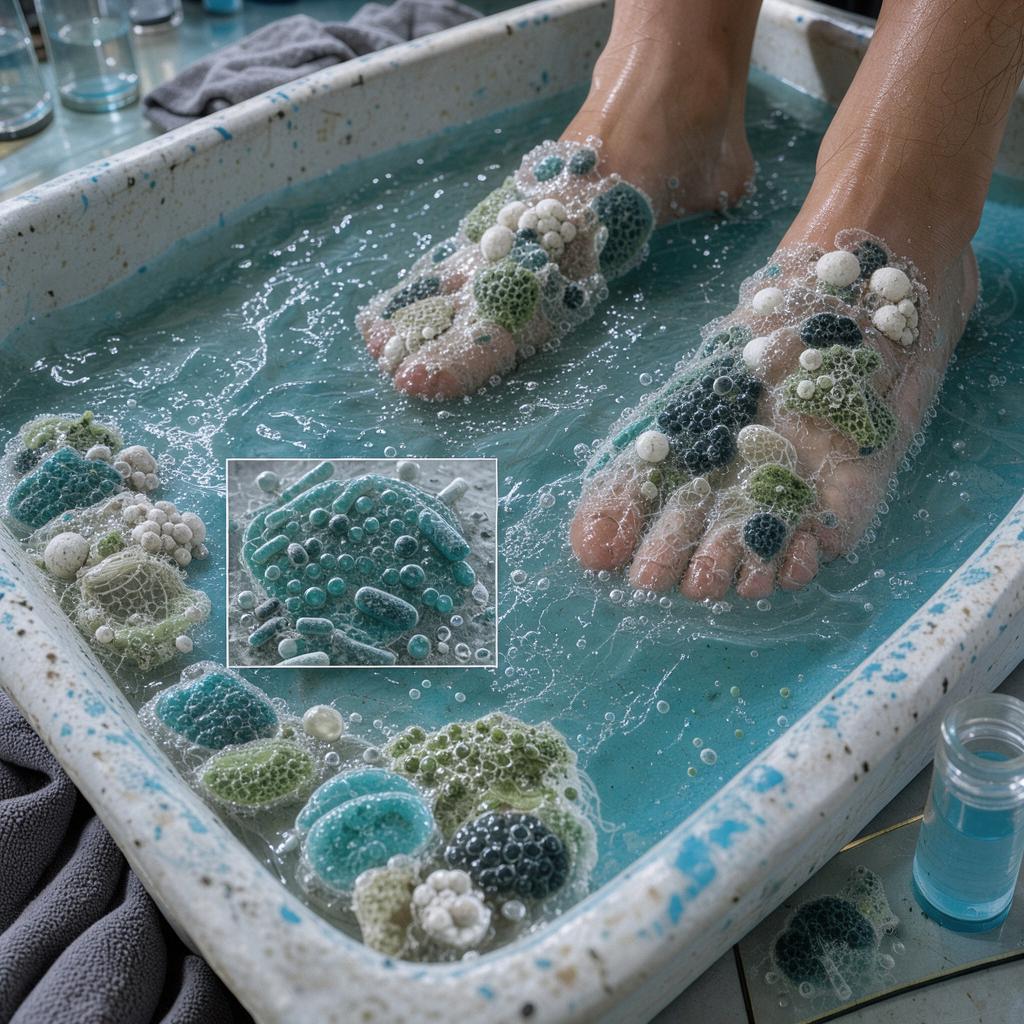
A survey of 12 hypochlorite footbaths in four Norwegian dairies found cultivable bacteria in 9/12, including S. aureus and K. pneumoniae; all isolates were killed by in-use chlorine (500 µg/ml) in suspension tests, but surface-attached cells were significantly more resistant (P=0.007), supporting the authors' conclusion that footbaths can become contamination reservoirs without hygienic monitoring
Long Explanation
Core Findings
Langsrud, Seifert, and Møretrø (Norwegian Food Research Institute) surveyed 12 footbaths across four cheese factories using hypochlorite at manufacturer-recommended levels (500–1,000 µg/ml active chlorine), changed daily or every second day. Bacteria were recovered from 9 of 12 footbaths, more often from post-drainage swabs than from the disinfectant solution itself, implicating surface-associated reservoirs. The flora differed sharply between dairies: Pseudomonas spp. dominated dairy A, Acinetobacter spp. dairy D, Bacillus and Staphylococcus (including S. aureus) dairy C, while dairy B yielded a mixed flora including Enterococcus faecalis and Klebsiella pneumoniae
Susceptibility paradox. No isolate was resistant to the recommended in-use concentration in suspension tests (>5 log reduction at 500 µg/ml). At 1/10 concentration (50 µg/ml), attached cells averaged ~1.8 log more reduction-resistant than suspended cells (P=0.007), yet correlation between suspension and surface results was near zero (r=−0.067) — a key practical finding that suspension assays poorly predict surface survival
Critical Appraisal
Authors acknowledged: active chlorine concentration in used disinfectant was not measured — the central limitation, since organic-load neutralization remains the simplest alternative explanation for survival in visually clean but unverified baths.
Not fully addressed: only 22 morphologically distinct isolates from a single sampling point per footbath; unculturable and non-dominant flora invisible; sporeformers excluded from susceptibility testing; n=4 dairies limits generalizability.
Lab model gap: coupon experiments (18 h in tryptic soy broth, no multispecies biofilm, no footbath mat material) could not reproduce the in-field survival of Pseudomonas and Acinetobacter — the authors honestly state this. The biofilm-protection hypothesis is therefore inference, not demonstrated mechanism.
Unmeasured confounders: footbath age, mat/foam porosity (dairy D used foam rubber), traffic load, and contact history were not quantified.
What Would Change the Conclusion
Direct measurement of residual free chlorine in used baths correlating with microbial recovery would confirm the organic-neutralization pathway; conversely, if chlorine remains at in-use levels while bacteria persist in solution, true physiological resistance is implicated. Cultivation-independent sequencing would test whether the 22 cultured isolates represent the real community.
Confidence: observations are well-documented and reproducible methods are described, but the mechanistic interpretation of survival remains uncertain and the survey is small.
Feedback:
Updated: November 25, 2026
BGPT Paper Review
Study Novelty
70%
First published characterization of microbial flora specifically in hypochlorite footbaths; builds on the authors' prior Serratia/tenside work, so novelty is incremental-to-notable within a narrow niche.
Scientific Quality
80%
Clear methods (16S rDNA identification, replicated susceptibility tests, neutralizer-validated), honest about unmeasured chlorine and inability of lab models to explain field survival. Weaknesses: small n, no residual chlorine measurement, no replicate sampling design details.
Study Generality
60%
Findings are dairy/footbath-specific but the surface-vs-suspension testing principle and biofilm-reservoir concept generalize to food-industry hygiene broadly.
Study Usefulness
80%
Directly actionable for food-factory hygiene programs: footbaths require routine monitoring; suspension disinfectant tests poorly predict surface efficacy — a practically important methodological warning.
Study Reproducibility
70%
Methods (primers, media, concentrations, exposure times, statistics) are described in detail; no strain accession numbers or raw data deposited, and field sampling is inherently variable.
Analyzing the 22 footbath isolates' dairy/species distribution and 16S similarity values to quantify inter-dairy diversity and identify species occurring only once for targeted surveillance priority.
Get emailed when your analysis is done!
We'll email you the results when your analysis is finished.
Hypothesis Graveyard
Acquired genotypic chlorine resistance as the survival explanation — rejected by the authors' own control testing: footbath isolates showed no higher intrinsic resistance than culture-collection strains of the same genera.
Organic-load neutralization as a complete explanation — weakened because baths were visually clean, disinfected frequently, and dairy B's solution contained no viable cells while swabs did.

 Explore by Goal
 Quick Explanation
 Long Explanation
 Top Data Sources
 Ask a Follow-Up
 Key Insight
 Keep Exploring
 Analysis
 Hypothesis Graveyard
 Potential Experiments
 Discussion
