Analyze how experimental results and claims are presented, scoped, and limited in a paper.Know what the science actually supports before you trust the answer.
Press Enter ↵ to analyze
Explore by Goal
"The scientific man does not aim at an immediate result. He does not expect that his advanced ideas will be readily taken up. His work is like that of the planter - for the future. His duty is to lay the foundation for those who are to come, and point the way."
- Nikola Tesla
Quick Explanation
Copied
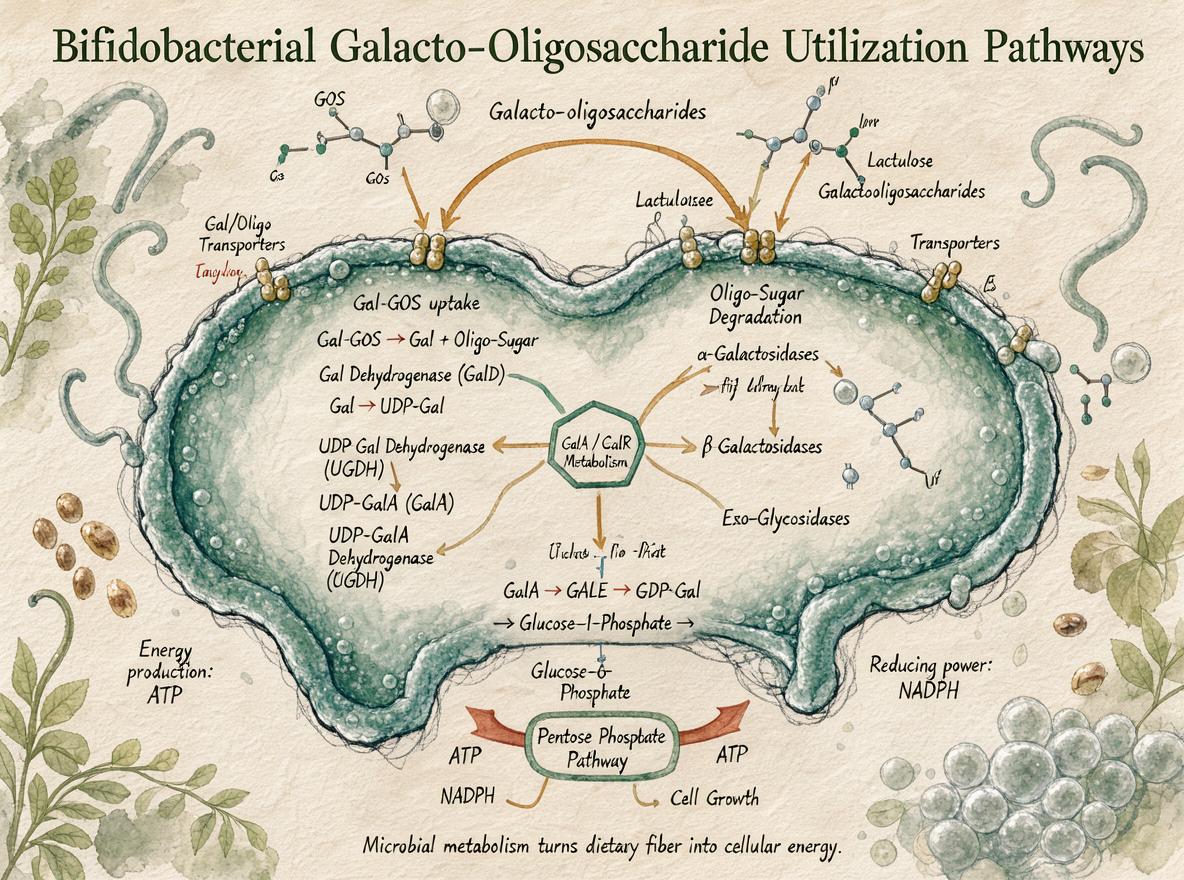
This 2015 Microbiology study identifies a co-induced BbrY_0420/BbrY_0422 locus in B. breve Yakult that specifically transports and hydrolyzes the GOS component 4′-galactosyllactose, with SPR confirming binding only to 4′-GL and 4-GB and enzymatic activity restricted to the same substrates. The work is methodologically solid but limited by single-strain, in vitro design and a clear industry conflict of interest.
Long Explanation
Core Findings
Using custom microarrays and RT-qPCR, the authors show that B. breve Yakult strongly upregulates BbrY_0420 (an ABC solute-binding protein) and BbrY_0422 (a GH42 β-galactosidase) during growth on 4′-galactosyllactose (4′-GL) compared with lactose. RT-qPCR confirmed 19±11-fold and 4.0±0.6-fold upregulation respectively, with large standard deviation on BbrY_0420 reflecting substantial biological variability across replicates.
Substrate Specificity
Surface plasmon resonance confirmed that recombinant BbrY_0420 binds 4′-GL (Kd ≈ 1.0×10⁻⁵ M) and 4-galactobiose (Kd ≈ 2.37×10⁻⁸ M), but not the structural isomers 3′-GL, 6′-GL, or lactose. Correspondingly, BbrY_0422 efficiently hydrolyzed only 4′-GL and 4-GB among tested substrates, cleaving the Galβ1→4Gal bond. This tight match between transporter specificity and enzymatic capability supports the authors' conclusion that these adjacent genes form a co-regulated 4′-GL/4-GB utilization locus, likely regulated by the nearby LacI-family protein BbrY_0423.
Critical Appraisal
The mechanistic linkage between SBP binding and β-galactosidase specificity is elegant and well-supported at the protein level. However, several limitations reduce confidence in broad generalizability: no gene knockout or knockdown experiments were performed to directly demonstrate functional necessity in vivo; the study is restricted to a single B. breve strain under in vitro conditions; the physiological relevance of higher 4-GB affinity (suggesting 4-GB as the primary in situ substrate) remains speculative without gut-environment validation. Additionally, the SPR Kd for 4′-GL carries typographical ambiguity in the published text, warranting caution.
Broader Context
The BLAST survey shows BbrY_0420 homologues are common across B. breve, B. longum, B. catenulatum, B. pseudocatenulatum, and B. dentium, while BbrY_0422 homologues are even more widely distributed. This suggests the locus reflects a broader bifidobacterial strategy for GOS metabolism, relevant to synbiotic design where prebiotic specificity and probiotic strain capability must match. Related work on bifidobacterial carbohydrate transporters and human milk oligosaccharide utilization supports this broader ecological framing.
Conflict of interest: All authors are Yakult Central Institute employees; the study was internally funded. This creates potential commercial bias toward favorable characterization of a proprietary prebiotic substrate (OLIGOMATE 55N, Yakult).
Feedback:
Updated: October 30, 2026
BGPT Paper Review
Study Novelty
60%
The identification of a co-induced SBP/GH42 pair with matched specificity is an incremental advance building on prior transcriptomic work by O'Connell Motherway et al. (2011) and homologous β-galactosidase characterization by Viborg and Katayama (2014).
Scientific Quality
70%
Methodologically rigorous within scope (SPR, recombinant enzymes, RT-qPCR with proper normalization), but no knockout validation, single strain focus, a typographical ambiguity in the reported Kd, and a strong industry conflict of interest slightly reduce confidence in broader claims.
Study Generality
50%
Findings apply primarily to 4′-GL and 4-GB utilization in B. breve Yakult; extension to broader bifidobacterial GOS metabolism requires additional strain and isomer coverage the authors explicitly acknowledge as future work.
Study Usefulness
70%
Directly informs synbiotic design by defining which prebiotic structures match probiotic strain capabilities; also provides molecular targets for strain selection and metabolic engineering.
Study Reproducibility
70%
Detailed methods, primer sequences, and accession numbers (LC015362, LC015363) are provided; however, lack of raw microarray data deposition and no knockout validation slightly reduce reproducibility confidence.
Explanatory Depth
70%
The paper provides a mechanistic explanation linking SBP substrate recognition to non-reducing terminal Galβ1→4Gal structure and corresponding β-galactosidase cleavage specificity, but stops short of structural (X-ray/NMR) confirmation of the binding interface.
We'll email you the results when your analysis is finished.
Hypothesis Graveyard
That GOS prebiotics function primarily by directly feeding bifidobacteria through dedicated HMO-like transporters: this paper and prior work show that substrate specificity is narrower and more isomer-dependent than a generic 'GOS utilization' model would predict.
That all bifidobacterial GH42 enzymes share similar substrate profiles: Viborg and Katayama (2014) demonstrated three distinct GH42 enzymes in B. longum subsp. infantis with divergent specificity, disproving a unified GH42 function model.

 Explore by Goal
 Quick Explanation
 Long Explanation
 Top Data Sources
 Ask a Follow-Up
 Key Insight
 Keep Exploring
 Hypothesis Graveyard
 Potential Experiments
 Discussion
