Check whether claims match experiments, exact reported results, and stated limitations.Know what the science actually supports before you trust the answer.
Press Enter ↵ to review paper
Explore by Goal
"In biology, nothing is clear, everything is too complicated, everything is a mess, and just when you think you understand something, you peel off a layer and find deeper complications beneath. Nature is anything but simple."
- Richard Preston
Quick Explanation
Copied
Funayama & Ishikawa's 2007 Chromosoma review is a rigorous, well-timed synthesis establishing SAHFs as condensed chromosome territories that stably repress E2F target genes during senescence; it remains valuable context but predates SASP, 3D-genome, and in-vivo lineage-tracing advances.
Long Explanation
Core Thesis and Evidence Quality
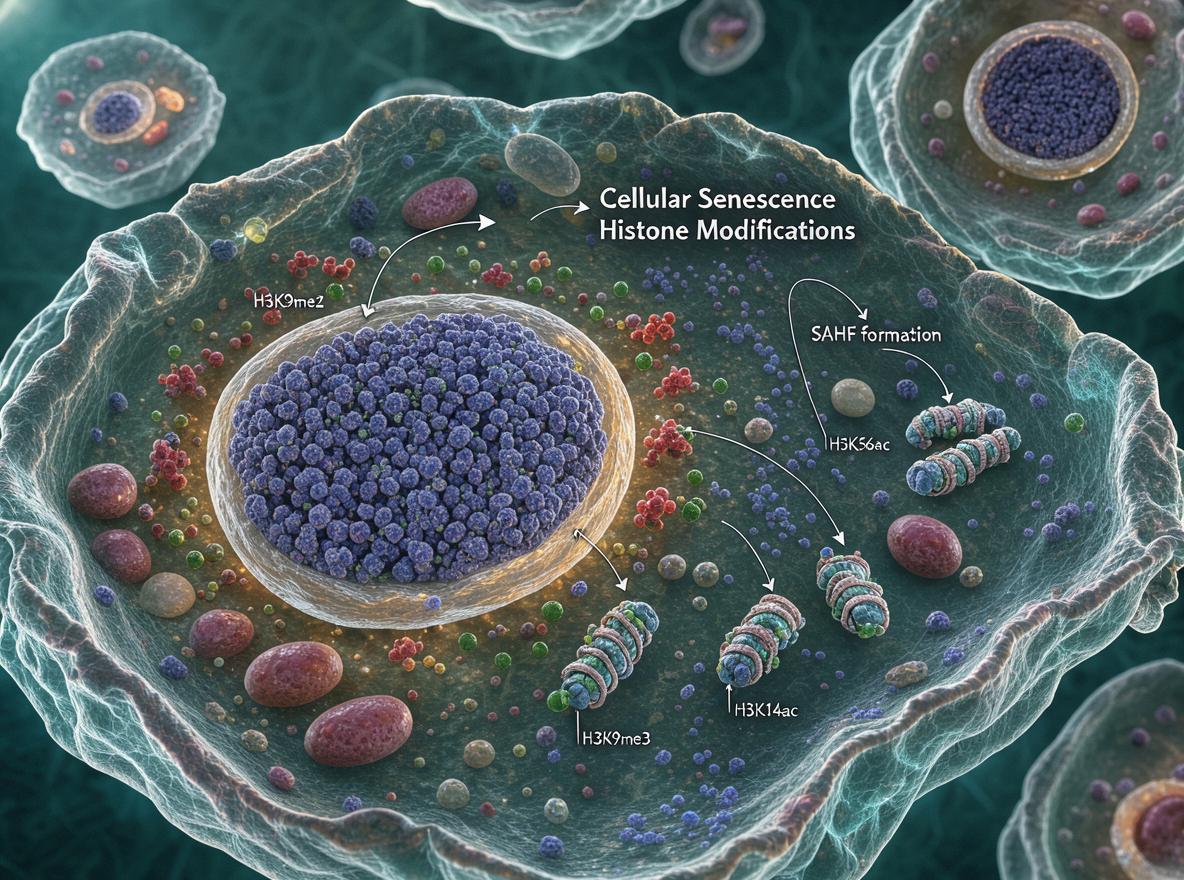
Funayama and Ishikawa review how chromatin restructuring enforces the irreversibility of cellular senescence, centering on senescence-associated heterochromatic foci (SAHFs). Two mechanisms of stable arrest are synthesized: a mitogen/ROS–PKCδ-dependent M-phase barrier blocking cytokinesis (via reduced WARTS expression), and SAHF-mediated heterochromatinization of E2F target gene promoters, confirmed by ChIP and refractory even to E2F-1 overexpression .
The review's strongest contribution is structural: integrating chromosome painting, single-centromere-per-SAHF counts, and ICD positioning to argue each SAHF is an entire condensed chromosome territory—not merely clustered E2F loci. It also honestly documents a key controversy: SAHFs co-localize with H3K9me/HP1, yet total H3K9me is unchanged during RasG12V senescence and dominant-negative HP1β does not block SAHF formation, undermining a simple classical heterochromatin model . The surprising H1→HMGA linker-DNA substitution—HMGA being pro-oncogenic yet required for SAHF—is a genuinely counterintuitive highlight .
Complementary evidence from cited work: human embryonic lung fibroblasts show global H3/H4 hypoacetylation, rising H4K20me3, and declining HDAC activity (1140 → 375 OD/h/mL above) across replicative and oxidative-stress senescence . However, a critical blind spot the review partially anticipates: SAHF biology is species-specific. Mouse fibroblasts largely fail to form robust SAHFs or recruit HIRA to PML bodies, so murine in-vivo SAHF evidence (e.g., K-Ras lung adenomas showing HP1γ signals) may not reflect the human mechanism at full fidelity .
Limitations and What Has Since Changed
As a narrative review, citation selection is non-systematic; quantitative data (e.g., >80% SAHF-positive cells, SAHF size vs inactive-X) come from small in-vitro fibroblast panels. Later work shows SAHF is only one layer: Lamin B1 depletion in senescent IMR90 cells remodels H3K4me3/H3K27me3 into large 'mesa/canyon' domains genome-wide , and the SASP—absent from this review's framework—contextualizes senescence as non-cell-autonomous. Falsification of the review's core claim would require showing SAHF-deficient senescent cells retain full irreversible arrest and equivalent tumor suppression, which later human-mouse comparisons make partially plausible. Confidence in the review's mechanistic claims: moderate-to-strong for culture models, weaker for in-vivo generality.
Feedback:
Updated: October 27, 2026
BGPT Paper Review
Study Novelty
70%
For 2007, the SAHF-as-chromosome-territory model and the H1→HMGA substitution were genuinely new syntheses; the review consolidates a field rather than founding one, and several components (SAHF genetics, Asf1a/HIRA) were only 2-4 years old.
Scientific Quality
80%
Well-structured, transparently reports internal controversies (H3K9me/HP1 conflict, p53's disputed role in SAHF). Weaknesses: narrative (non-systematic) selection, reliance on unpublished results cited as personal data, and no quantitative meta-analysis; in-vivo evidence is correlative histology.
Study Generality
70%
Spans tumor suppression, signaling (p38/p53/Rb), chromatin protein exchange, and nuclear architecture, but is anchored in fibroblast culture models and one senescence subtype; SASP and tissue-level effects are absent.
Study Usefulness
70%
Useful mechanistic map for chromatin-biologists and a citation hub for SAHF; therapeutic framing is speculative. Largely superseded by later 3D-genome and SASP literature but still citable for SAHF structural claims.
Study Reproducibility
50%
As a review it generates no primary data; reproducibility depends on the cited primary studies, some flagged as unpublished, limiting independent verification of several claims (e.g., H1 loss kinetics).
Explanatory Depth
70%
Deep on molecular components and causal pathway logic (two-barrier model, HMGA/H1/H3.3 mechanisms), but several steps remain explicitly unresolved by the authors themselves (e.g., whether H3.3 incorporation is causal, how HMGA condenses chromatin).
We'll email you the results when your analysis is finished.
Hypothesis Graveyard
Simple classical-heterochromatin model of SAHF (H3K9me + HP1 spread driving compaction) — weakened by unchanged total H3K9me during >80% SAHF-positive senescence and dominant-negative HP1β non-effect.
SAHF as purely clustered E2F loci — falsified by chromosome-painting showing each SAHF corresponds to a whole chromosome territory.

 Explore by Goal
 Quick Explanation
 Long Explanation
 Top Data Sources
 Ask a Follow-Up
 Key Insight
 Keep Exploring
 Hypothesis Graveyard
 Potential Experiments
 Discussion
