Ask questions across claims linked to experiments, exact results, limitations, and sources.Know what falsifiable science actually supports before you trust the answer.
Press Enter ↵ to search evidence
Explore by Goal
"Biology gives you a brain. Life turns it into a mind."
- Jeffrey Eugenides
Quick Explanation
Copied
This 2023 narrative review in Allergologia et Immunopathologia links COVID-19 to cardiac arrhythmias via hypoxia, cytokine storm, myocarditis, electrolyte disorders, and proarrhythmic drugs, but relies on heterogeneous case series without formal meta-analysis, so incidence estimates remain uncertain.
Long Explanation
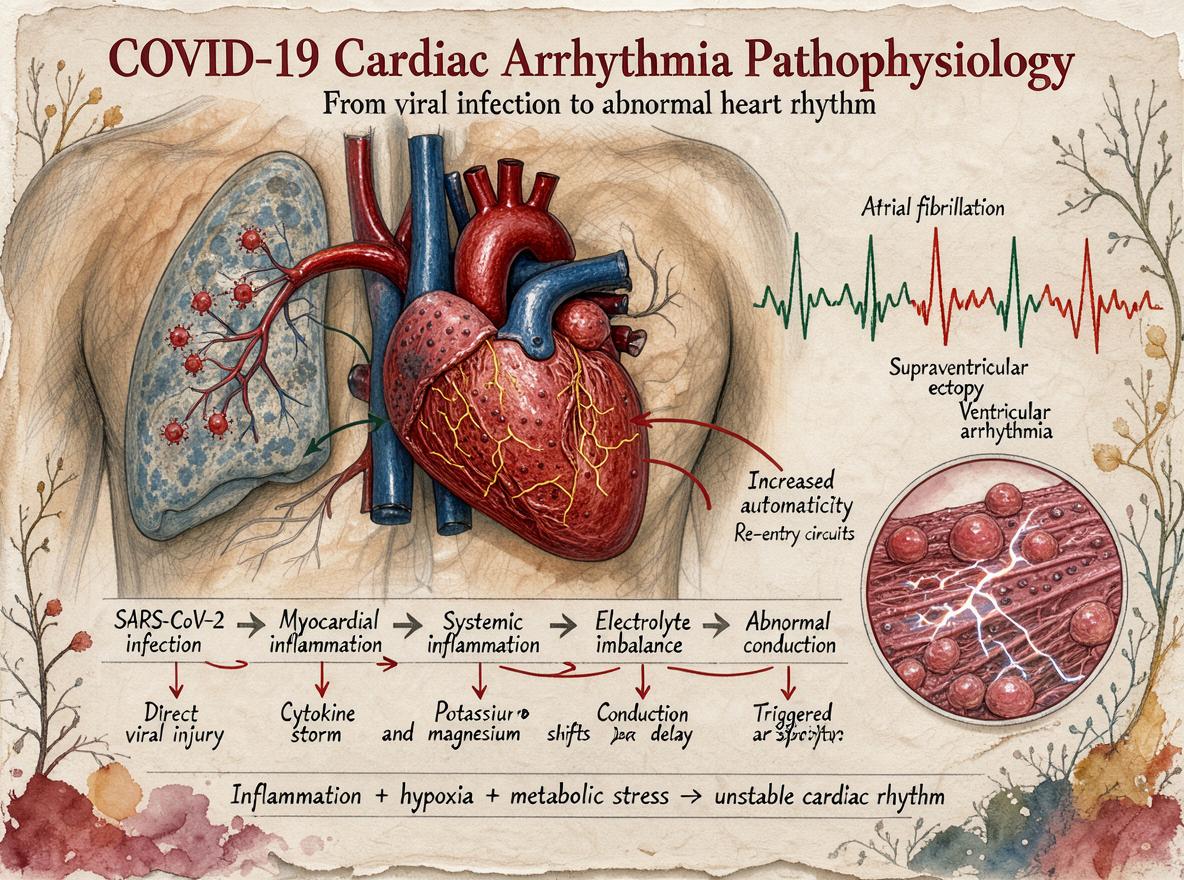
Cardiac arrhythmia and immune response in COVID-19 patients (Wang et al., 2023) is a narrative review synthesizing the incidence, types, and proposed mechanisms of COVID-19-associated arrhythmias .
Key quantitative claims from the review
The review aggregates figures from cited case series: overall arrhythmia 6-17% (44% in ICU), atrial fibrillation in 15-30% of patients, ventricular tachycardia/fibrillation in 5.9% of 187 hospitalized patients, 71.9% tachycardia independent of fever/hypotension in 121 patients, palpitations in 7.3% of 137 patients, electrolyte disorders in 7.2%, and cardiac-injury-associated mortality of 59.6% vs 8.9% without injury .
Note: midpoint values are shown for the 6-17% and 15-30% ranges; these are author-reported figures from varied study designs, populations, and monitoring intensity and are not directly comparable.
Mechanistic synthesis
The review proposes a multifactorial framework: hypoxia-induced intracellular calcium overload via sodium-hydrogen exchanger dysregulation, connexin-43 dephosphorylation reducing electrical coupling, cytokine-mediated channel dysfunction (IL-6, TNF-α, IL-1 prolonging ventricular action potentials and inhibiting CYP450, increasing QT-drug bioavailability), ACE2-mediated angiotensin II accumulation causing adverse remodeling, right-heart stress from pulmonary embolism/ARDS, and QT-prolonging treatments (hydroxychloroquine, azithromycin, lopinavir/ritonavir) .
Critical assessment
No systematic methodology: no search strategy, inclusion criteria, or formal meta-analysis; incidence estimates derive from heterogeneous case series with inconsistent arrhythmia definitions .
Confounding: hospitalized/ICU patients differ from stable outpatients; the review itself notes low arrhythmia prevalence in clinically stable patients, but treatment-era confounds (hydroxychloroquine use has since declined) limit current relevance.
Mechanistic claims are largely inferential: cytokine-channel interactions are drawn from rheumatoid arthritis literature, not direct COVID-19 cardiac electrophysiology data.
Self-citation density: several references cite the authors' own prior work, which warrants scrutiny for citation bias.
Falsification: prospective monitoring studies showing arrhythmia rates fully explained by pre-existing disease, drugs, or electrolytes would undercut the causal framing.
Verdict: a readable, mechanistically broad but methodologically weak synthesis; useful as a teaching overview, not as quantitative evidence.
Feedback:
Updated: November 18, 2026
BGPT Paper Review
Study Novelty
50%
Arrhythmia mechanisms in COVID-19 were extensively reviewed by 2020-2022 high-impact papers (e.g., Circ Arrhythm Electrophysiol, JACC EP); this 2023 narrative review adds no new data or novel synthesis framework.
Scientific Quality
50%
Narrative review with no stated search strategy or meta-analysis; figures are drawn from heterogeneous case series of varying design and era; partial self-citation density and copyediting artifacts (e.g., truncated sentences, garbled author block) reduce polish, though the mechanistic scope is broad and the declared absence of funding/COI is a modest positive.
Study Generality
60%
Covers a clinically broad topic spanning tachy- and bradyarrhythmias across mechanisms, but conclusions are anchored to early-pandemic (2020) treatments and case series, limiting generalizability to contemporary practice.
Study Usefulness
60%
Useful as a consolidated teaching overview of hypothesized mechanisms (hypoxia, cytokines, ACE2, drug QT effects), but the quantitative claims should not be cited as precise incidence estimates without the primary sources.
Study Reproducibility
30%
Narrative reviews without a documented search strategy, screening flow, or data extraction method cannot be reproduced; no protocol or registry was reported.
Explanatory Depth
60%
Detailed mechanistic chain from hypoxia to calcium overload and cytokine-channel effects is commendably specific, but mechanisms are inferred largely from non-COVID literature (e.g., rheumatoid arthritis) rather than direct SARS-CoV-2 electrophysiology studies.
We'll email you the results when your analysis is finished.
Hypothesis Graveyard
Hydroxychloroquine-driven QT risk as a major contributor to COVID-19 arrhythmia incidence: this treatment is no longer standard of care, so it cannot explain current arrhythmia rates.

 Explore by Goal
 Quick Explanation
 Long Explanation
 Top Data Sources
 Ask a Follow-Up
 Key Insight
 Keep Exploring
 Hypothesis Graveyard
 Potential Experiments
 Discussion
