Analyze how experimental results and claims are presented, scoped, and limited in a paper.Know what the science actually supports before you trust the answer.
Press Enter ↵ to analyze
Explore by Goal
"For me, it is far better to grasp the Universe as it really is than to persist in delusion, however satisfying and reassuring."
- Carl Sagan
Quick Explanation
Copied
This 2012 Pediatric Dermatology brief report documents a single 3-year-old with scabies presenting as itchy annular patches, diagnosed by biopsy showing a mite egg after 2.5 years of failed treatments, and cured with two permethrin applications (). Its main value is diagnostic vigilance for annular lesions, not evidence on treatment efficacy.
Long Explanation
What the paper reports
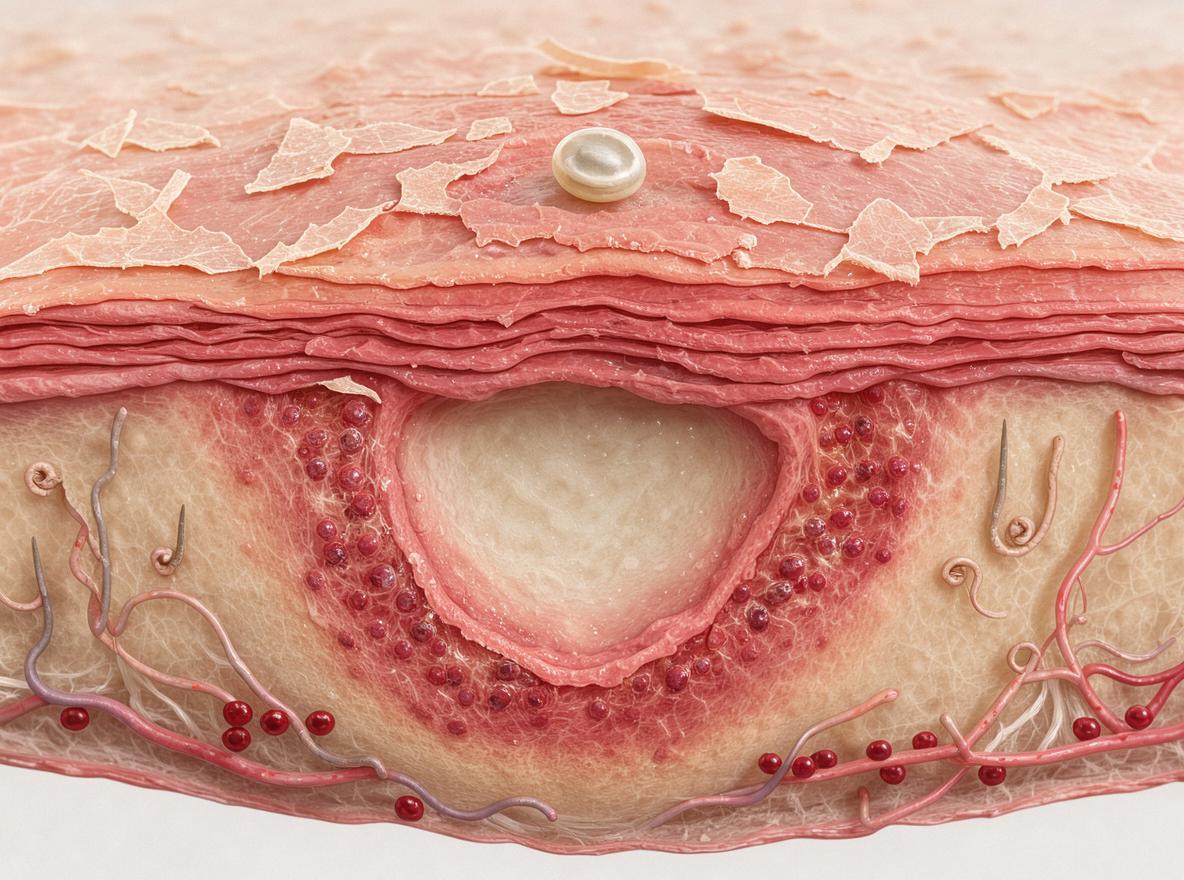
A brief report from Hospital Universitario La Paz (Madrid) describes a 3-year-old girl with itchy, scaly, well-defined annular patches on the left medial knee, lower back, and upper thighs, progressing from pink macules first noted at 6 months of age. Over 2.5 years she received systemic and topical steroids, antihistamines, antifungals, antibiotics, and vitamins without improvement. Cultures, KOH, Gram stain, IgE, and a slit-skin smear for leprosy were negative; a skin biopsy showing a scabies mite egg in the epidermis established the diagnosis (). Permethrin 5% cream applied twice, two weeks apart, produced complete remission at one month.
Critical appraisal
Diagnostic circularity risk: the annular morphology is atypical for scabies, and the causal link between the mite egg and the annular lesions rests on histology plus response to therapy, not on demonstration of live mites or burrows at the patch sites ().
Missing details: no dermoscopy findings, no family/contact history reported, no long-term recurrence data, and no systematic exclusion of annular dermatoses (e.g., tinea was excluded by KOH, but granuloma annulare or annular psoriasis pathways are not fully addressed in the excerpt).
Context on the delay: diagnostic uncertainty is common in scabies; a retrospective Australian cohort found 72.7% of inpatients prescribed scabicides had no documented diagnostic criteria (), and international guidelines emphasize microscopy/dermoscopy confirmation precisely to avoid such delays ().
Treatment claim scope: cure after two permethrin applications is expected in typical scabies (~90% efficacy in reviews) (), so the outcome supports but does not uniquely validate the diagnosis. Internal inconsistency: the case text says treatment was repeated two weeks apart while the discussion says one week later.
Bottom line and what would change it
The case is a credible, single-observer reminder that scabies can masquerade as annular dermatitis in young children and deserves inclusion when annular pruritic patches resist conventional therapy. Confidence is limited: n=1, no control, and possible publication bias favoring unusual presentations. Findings would change if biopsy-proven annular scabies failed permethrin or if larger series showed annular patches are unrelated to mite infestation.
Feedback:
Updated: November 02, 2026
BGPT Paper Review
Study Novelty
60%
Annular patch morphology is a genuinely uncommon scabies presentation; case reports of atypical scabies forms exist, but this specific phenotype adds a useful pattern to the differential for pediatric annular lesions.
Scientific Quality
60%
Appropriate workup for the era (KOH, cultures, leprosy smear, biopsy) and clear outcome, but n=1, internal inconsistency on the repeat-treatment interval (1 vs 2 weeks), no dermoscopy, no family/contact history, and no follow-up for recurrence.
Study Generality
40%
A single pediatric case with a rare phenotype; it widens the differential for annular pruritic patches but adds little generalizable knowledge beyond pattern recognition.
Study Usefulness
50%
Practically useful as a diagnostic vigilance cue for clinicians managing chronic annular patches in children who fail steroids and antifungals; limited by absence of dermoscopy or recurrence data.
Study Reproducibility
40%
Methods (biopsy, microscopy, permethrin regimen) are described, but single-case data, no imaging of microscopic findings beyond description, and inconsistent dosing interval hinder independent replication or comparison.
Explanatory Depth
40%
Mechanistic explanation is thin: the paper does not explain why the mite produced annular morphology, nor report dermoscopic burrows; it relies on biopsy confirmation and therapeutic response.
We'll email you the results when your analysis is finished.
Hypothesis Graveyard
The patches were a steroid-modified (tinea incognito-like) eczematous reaction unrelated to the mite egg: unlikely because the biopsy directly demonstrated mite egg in the epidermis and multiple prior steroid courses failed.
The annular patches were granuloma annulare with incidental scabies: no report of palisading granulomatous histology, and lesions resolved with permethrin alone, not with the systemic steroids previously given.

 Explore by Goal
 Quick Explanation
 Long Explanation
 Top Data Sources
 Ask a Follow-Up
 Key Insight
 Keep Exploring
 Hypothesis Graveyard
 Potential Experiments
 Discussion
