Check whether claims match experiments, exact reported results, and stated limitations.Know what the science actually supports before you trust the answer.
Press Enter ↵ to review paper
Explore by Goal
"The most important scientific revolutions all include, as their only common feature, the dethronement of human arrogance from one pedestal after another of previous convictions about our centrality in the cosmos."
- Stephen Jay Gould
Quick Explanation
Copied
De Pascual-Teresa & Sanchez-Ballesta's 2008 review is a broad, well-organized synthesis spanning plant biochemistry, agronomy, food processing, bioavailability, and disease prevention of anthocyanins, but its health claims rest heavily on in vitro and rodent evidence with acknowledged analytical limitations ().
Long Explanation
Evidence Base and Core Content
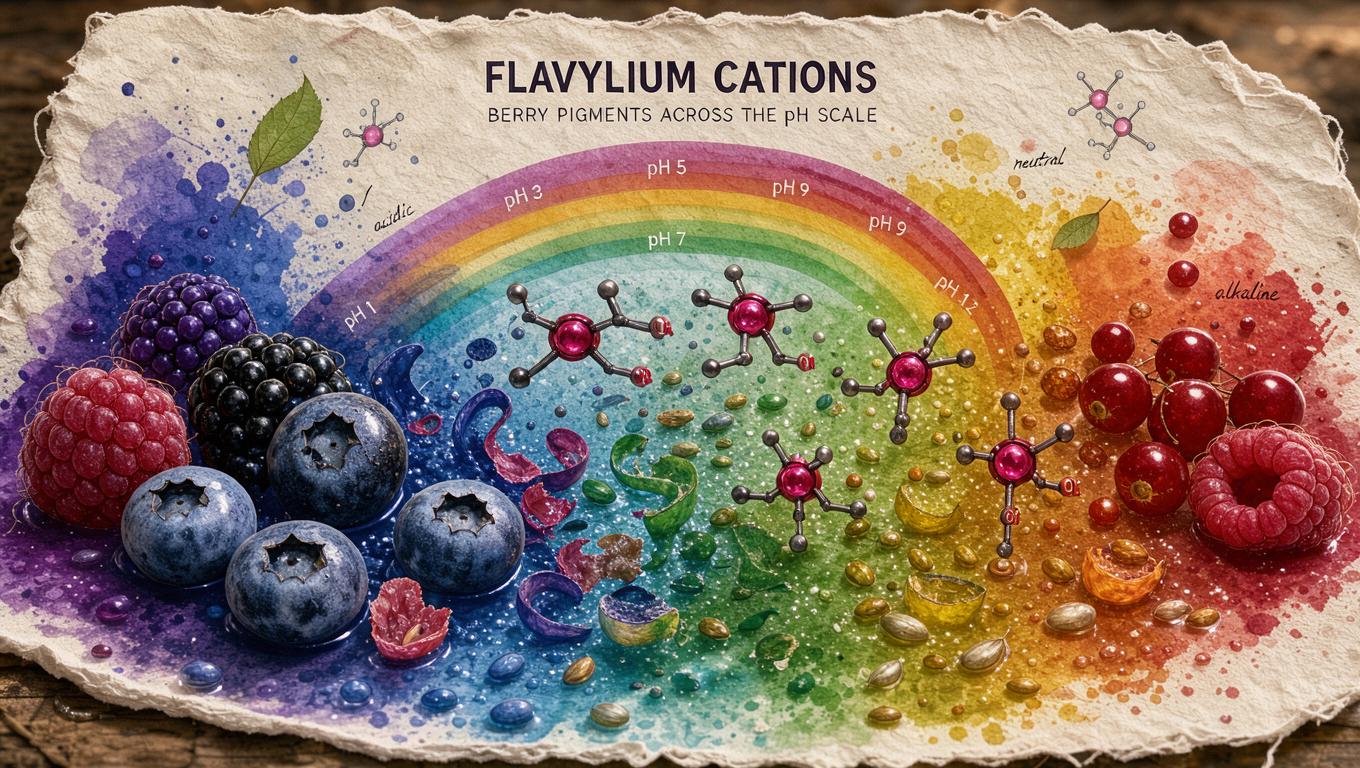
The review integrates 198 references across five domains: (1) anthocyanin chemistry (six common anthocyanidins, pH-dependent equilibrium of flavylium cation, quinonoidal base, carbinol pseudobase and chalcone forms), (2) plant content and agronomic/genetic manipulation, (3) postharvest and processing effects, (4) intake, bioavailability and metabolism, and (5) biological activity spanning cardiovascular, anticancer, antidiabetic, ocular, antimicrobial and neuroprotective effects (). Reported food concentrations span three orders of magnitude, from 1.7 mg/100 g in Red Delicious apple to 1,642 mg/100 g in purple corn.
Figure: reported anthocyanin ranges from the review's Table 1, log scale. Ranges reflect cultivar, environment and method variability the authors explicitly emphasize.
Critical Strengths and Blindspots
Strengths: The paper is unusually candid about analytical fragility — anthocyanins' pH-dependent speciation and instability may explain anomalously low bioavailability estimates (urinary recovery 0.004–0.2% of intake, up to 5% in one study) (). The authors also flag confounding: most bioactivity studies used fruit/wine extracts, so other phenolics may fully or partially account for effects — a commendable epistemic caveat rare in 2007-era nutraceutical reviews.
Blindspots: (a) The cardiovascular and anticancer sections are dominated by cell-culture and rodent data; the review cites no randomized human intervention outcome trials. (b) Intake estimates vary 60-fold (Kuhnau's 180–215 mg/day vs Chun's 3 mg/day) with no reconciliation beyond population differences — this inconsistency undermines epidemiological anchoring. (c) Anthocyanin quantification methods differ across the cited studies (pH-differential vs HPLC), introducing cross-study measurement bias the paper does not systematically address. (d) The wine section is silent on alcohol-related harms of the primary anthocyanin vehicle. (e) No conflict-of-interest statement appears despite wine- and berry-industry relevance. Later primary literature has partially addressed these gaps: the microbiota-degylcosylation pathway the review flags as unidentified was subsequently confirmed, and bHLH/MYB/WD40 regulation it mentions has since been evolutionarily re-characterized in grasses with an independent ncaMYB/BZ2 module (). Processing-loss data it reviewed (70% canning loss, 40–70% jam losses) remain consistent with later kinetic studies on blackberry blanching (first-order degradation, k = 0.017–0.052 min-1 at 80–100°C) ().
Verdict with Confidence Assessment
The review earns its status as a foundational reference: accurate chemistry, comprehensive agronomy/processing coverage, and honest acknowledgment that "most studies have been done by using fruit extract or wine and thus other substances may be totally or partially responsible" for observed bioactivities. Confidence in its chemical and agronomic content is high; confidence in its extrapolated health-promotion framing is moderate at best given the preponderance of in vitro evidence. What would revise this verdict: well-powered randomized human outcome trials showing no cardiovascular or cancer benefit of isolated anthocyanins, or conversely, metabolite-identified microbiota-mediated effects robust to extract controls.
Author Reviews:
Feedback:
Updated: October 28, 2026
BGPT Paper Review
Study Novelty
50%
A 2007 literature synthesis; at publication it consolidated a fast-growing field rather than introducing new methods or findings. Its integrated agronomy-to-health framing was useful but not groundbreaking.
Scientific Quality
70%
Comprehensive, well-referenced (198 refs), and commendably candid about analytical and confounding limitations. Weaknesses: no COI statement, no systematic search methodology, unreconciled 60-fold intake discrepancy, and reliance on heterogeneous measurement methods without bias adjustment.
Study Generality
90%
Spans plant biology, agronomy, food technology, and human health — broadly applicable across multiple subdisciplines and relevant to any anthocyanin-bearing crop or food system.
Study Usefulness
80%
Highly useful as a foundation reference and a roadmap for functional-food design; its identified gaps (microbiota metabolites, long-term exposure) correctly predicted the field's next decade of research directions.
Study Reproducibility
40%
Reviews are inherently not reproducible as experiments; no systematic review methodology (search strategy, inclusion criteria, PRISMA) is reported, so the synthesis cannot be independently replicated deterministically.
Explanatory Depth
70%
Strong mechanistic depth on chemistry (pH equilibria, acylation effects) and biosynthetic genetics (CHS through FGT, MBW regulators), but shallower on health mechanisms — largely descriptive cataloguing of in vitro effects without integrated dose-response or metabolite-level mechanistic models.
Comparing reported anthocyanin content ranges across foods and degradation kinetics across processing studies to quantify which processing factors and structural modifications most affect retention.
Get emailed when your analysis is done!
We'll email you the results when your analysis is finished.
Hypothesis Graveyard
'Anthocyanins act mainly as plasma antioxidants after systemic absorption' — undermined by the review's own low recovery data and later confirmation that phenolic-acid degradation products from colonic microflora, not intact glycosides, dominate circulating metabolite pools.

 Explore by Goal
 Quick Explanation
 Long Explanation
 Top Data Sources
 Ask a Follow-Up
 Key Insight
 Keep Exploring
 Analysis
 Hypothesis Graveyard
 Potential Experiments
 Discussion
