Check a paper's claims against linked experiments, exact results, stated scope, and limitations.Know what falsifiable science actually supports before you trust the answer.
Press Enter ↵ to search evidence
Explore by Goal
"The important thing in science is not so much to obtain new facts as to discover new ways of thinking about them."
- William Lawrence Bragg
Quick Explanation
Copied
Kızılin's two sandstone figurines, stratigraphically anchored in Geological Level IIa (cal. ~13,782 BC), are credibly argued to be Anatolia's oldest known stone human figurines, one a probable female head and one a conjoined-twin form . The find is significant, but the superlative claim rests on associated-layer dating (not direct dating), a N=2 sample, and an unexcavated cave interior, so confidence is contextual rather than absolute.
Long Explanation
What the paper reports
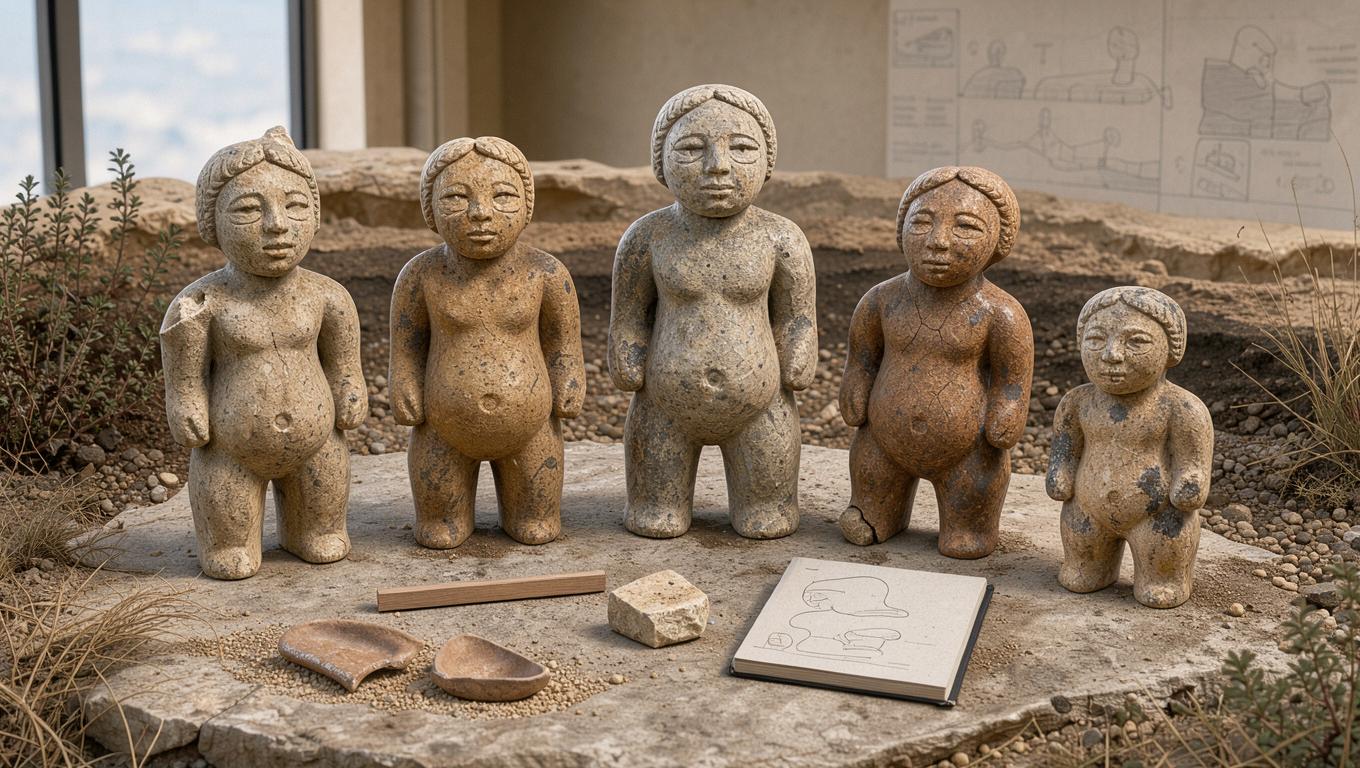
Metin Kartal and Öz (Ankara University) present two sandstone human figurines excavated from the terrace of Kızılin, an Epi-palaeolithic site near Antalya, in Geological Level IIa (light-red sediments rich in geometric microliths). Kızılin 1, from H15, is a broken head (width 4.06 cm, thickness 3.87 cm; estimated original height ≤10 cm) carved by incision and abrasion, with concave lens-shaped eye depressions, an implied nose, and V/U incisions on the back of the head interpreted as possible hair or headgear. Kızılin 2, from H17, is complete (6.30 × 3.30 × 3.25 cm) and split lengthwise by deep grooves into two heads and two torsos, which the authors interpret as conjoined twins .
Dating: strong stratigraphy, indirect chronology
The terrace sequence is anchored by 40+ AMS radiocarbon dates on mollusc shells (bones lacked collagen), spanning cal. 19,455–13,621 BC; both figurines are assigned an age of ~13,782 BC (2σ mean) by their JS-IIa position, and Kızılin 1 was found beneath a large rock, which the authors argue secures its in situ Epi-palaeolithic origin . The shell-based dates reported in Table 1 clearly separate JS-IIa from the older JS-IIb:
Note that TÜBİTAK-2125 (JS-IIb, cal. 15,082–15,398) overlaps the JS-IIa range — a small inversion the authors do not discuss; shell dates can also be affected by reservoir effects, which are not addressed in the text .
Interpretation: where evidence ends and analogy begins
Three author claims differ sharply in evidential strength. Robust: the figurines are pre-Neolithic stone human representations in secure JS-IIa contexts, predating Çatalhöyük's twin figurines (Temple VI) and pushing conjoined-twin imagery back ~7,000 years in Anatolia. Plausible but analogical: Kızılin 1 as a "female head" rests on the observation that European figurines with similar hair/headgear incisions (ca. 25,000–20,000 BC) are almost all female; the paper itself concedes no sex indicators exist on the object and that a European origin cannot be asserted. Speculative: the mixed "European + Near Eastern" stylistic attribution, which the authors explicitly leave unresolved . The conjoined-twin reading of Kızılin 2 is internally coherent (front and back grooves create distinct head profiles), but alternative readings — e.g., deliberate bisection for other symbolic or functional purposes — are not tested.
Blind spots and what would change the conclusion
The cave interior remains unexcavated (active soil flow, no electricity), so terrace and cave deposits cannot yet be correlated — the "oldest known" status is provisional on the ~850–900 m² terrace sample from only six seasons.
No direct dating of the figurines themselves (e.g., OSL on burial sediment or surface-exposure methods) is reported; chronology is entirely inferential from layer association.
Reservoir-effect uncertainty on mollusc-shell dates and the TÜBİTAK-2125 inversion are unexamined.
Regional sampling bias: absence of older figurines elsewhere in Anatolia may reflect excavation coverage, not true absence — a discovery elsewhere in a securely dated older context would immediately falsify the superlative title.
Confidence: the find's significance and Epi-palaeolithic attribution are well supported (reported stratigraphy, multiple AMS dates); the "oldest in Anatolia" label is conditionally sound given current knowledge; gender and stylistic-affinity claims are weakly supported and should be treated as hypotheses, as the authors largely acknowledge.
Feedback:
Updated: November 08, 2026
BGPT Paper Review
Study Novelty
80%
First report of Epi-palaeolithic stone human figurines in Anatolia, including the earliest known conjoined-twin imagery, substantially antedating Çatalhöyük examples; the descriptive core is new, though built on an established regional research program.
Scientific Quality
60%
Solid primary reporting with stratigraphic and AMS support, but the chronology is indirect (layer association, shell dates), a small date inversion and possible reservoir effects are undiscussed, and key interpretive claims (female head, twin representation) rest on analogy without falsification tests. Figures support the descriptions well.
Study Generality
30%
A highly site- and object-specific report; it enriches regional prehistory but offers limited generalizable theory about Palaeolithic symbolism or figurine function.
Study Usefulness
60%
Valuable for Anatolian prehistory specialists and for anyone tracking the origins of figurative representation; the documented dimensions, layer positions, and date table make it a citable primary record, but practical applicability beyond archaeology is low.
Study Reproducibility
40%
Measurements, findspots (H15, H17), and Table 1 dates are reported, but only two objects exist, raw radiocarbon lab data and calibration details are not fully published, and reinterpretation depends on unpublished excavation archives.
Explanatory Depth
30%
Descriptive depth is good (technology, dimensions, decoration), but mechanistic explanation is shallow: why these forms were made, their function, or the twin imagery's meaning is left speculative, and compositional or technological provenance analyses are absent.
We'll email you the results when your analysis is finished.
Hypothesis Graveyard
'The figurines are Neolithic intrusions into Epi-palaeolithic layers' — weakened by the reported in situ position of Kızılin 1 beneath a large rock within JS-IIa and the consistent microlith typology, though only direct dating of the objects would fully falsify it.
'Kızılin 1 is certainly female' — the paper's own analogical reasoning cannot be decisive; with no sex indicators on the object, the female label remains unfalsifiable as stated and should be downgraded to a suggestion.

 Explore by Goal
 Quick Explanation
 Long Explanation
 Top Data Sources
 Ask a Follow-Up
 Key Insight
 Keep Exploring
 Hypothesis Graveyard
 Potential Experiments
 Discussion
