Analyze how experimental results and claims are presented, scoped, and limited in a paper.Know what the science actually supports before you trust the answer.
Press Enter ↵ to analyze
Explore by Goal
"The molecules of life are like letters of the alphabet. You can't tell what a word says by knowing the number of letters in it."
- Matt Ridley
Long Explanation
Copied
What the paper is — and is not
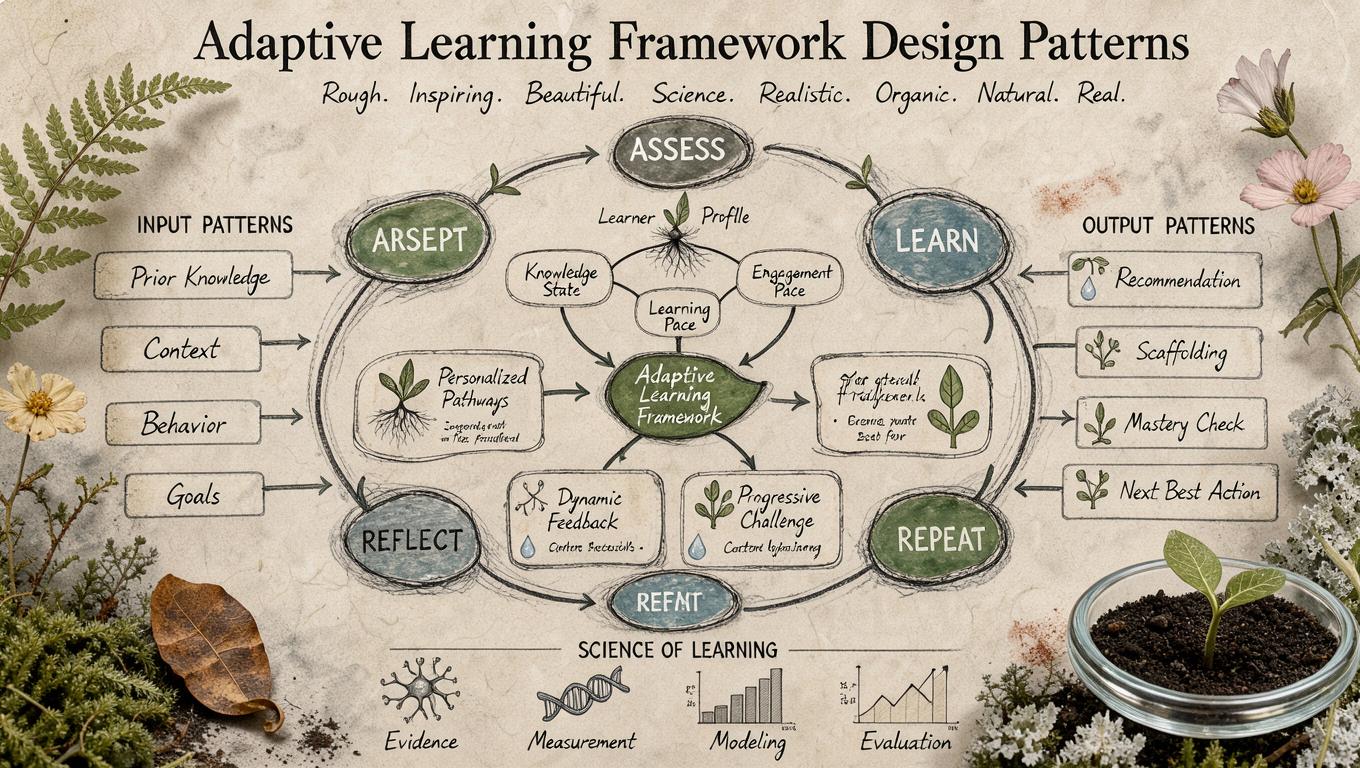
Amabibi (2026) proposes a conceptual framework for educational product innovation: three infrastructure layers (digital products/platforms, AI, social distribution) integrated with a seven-stage design cycle, from defining the learning need through measure-learn-iterate. The author is transparent that this is a conceptual synthesis, not an empirical test — implementation examples come from the author's own "Edify Hub" ecosystem and are explicitly "illustrative cases rather than an empirical evaluation" .
Evidence base and blind spots
The synthesis rests on a small, purposively selected set of reviews rather than a systematic search — no protocol, database search string, or inter-rater screening was used, which the author concedes limits replicability. The cited literature is genuinely relevant: AI-in-education mapping , AI formative assessment , and UNESCO guidance on human-centred generative AI . However, broader empirical work on whether such ecosystems actually improve learning (e.g., effect sizes in real deployments ) is not engaged. A further structural concern: the framework originates in the author's own 2026 monograph and is "validated" against it — a self-referential loop .
Verdict and what would change it
As a practitioner-oriented heuristic, the framework is coherent and usefully resists "technology for technology's sake." As science, it generates hypotheses but tests none. Confidence: moderate that the characterization is fair; the honest falsification test would be a comparative study showing the seven-stage framework yields no better learner outcomes or implementation coherence than simpler approaches .
Feedback:
Updated: November 02, 2026
BGPT Paper Review
Study Novelty
40%
The three-layer/seven-stage integration is a reasonable repackaging of well-established ideas (adaptive learning, digital ecosystems, formative feedback loops) rather than a new construct; framing social distribution as a learning-ecosystem entry layer is the mildly fresh element.
Scientific Quality
30%
Conceptual-only work with a non-systematic, purposive literature selection; the core 'validation' is self-referential (author's own monograph and products). Transparent about limitations, but no independent evidence, protocol, or data.
Study Generality
20%
Tightly scoped to one practitioner context (the author's Edify Hub ecosystem); claims general applicability but derives from a single self-documented case.
Study Usefulness
50%
Moderately useful as a design checklist for educators and ed-tech entrepreneurs; explicitly positions AI as augmentation and ties social channels to learning outcomes rather than visibility.
Study Reproducibility
30%
No search protocol, corpus, inter-rater checks, or datasets; a reader could not reproduce the synthesis. The framework itself is describable, but its derivation is not.
Explanatory Depth
30%
Descriptive architecture without mechanisms: why these seven stages, what trade-offs exist between layers, or how feedback signals should be weighted is unspecified.
We'll email you the results when your analysis is finished.
Hypothesis Graveyard
'Comprehensive frameworks outperform technology-specific approaches by default' — unsupported; the paper provides no comparison, and production-scale evidence (e.g., Umíme) shows context effects can invert simple metric expectations.

 Explore by Goal
 Long Explanation

 Top Data Sources
 Ask a Follow-Up
 Key Insight
 Keep Exploring
 Hypothesis Graveyard
 Potential Experiments
 Discussion
