Ask questions across claims linked to experiments, exact results, limitations, and sources.Know what falsifiable science actually supports before you trust the answer.
Press Enter ↵ to search evidence
Explore by Goal
"Science is organized knowledge. Wisdom is organized life."
- Immanuel Kant
Quick Explanation
Copied
This 2012 review by Salas and Andrés provides a rigorous, experimentally grounded synthesis of ASFV assembly, established largely through the authors' own inducible-recombinant system: ER-derived inner envelope, p17/p54-dependent membrane precursor formation, polyprotein-driven core assembly, and pE120R-dependent egress . Its functional gene-by-gene framework still guides current antiviral and vaccine work targeting p72, S273R, and assembly intermediates.
Long Explanation
Core contributions: a protein-by-protein assembly model
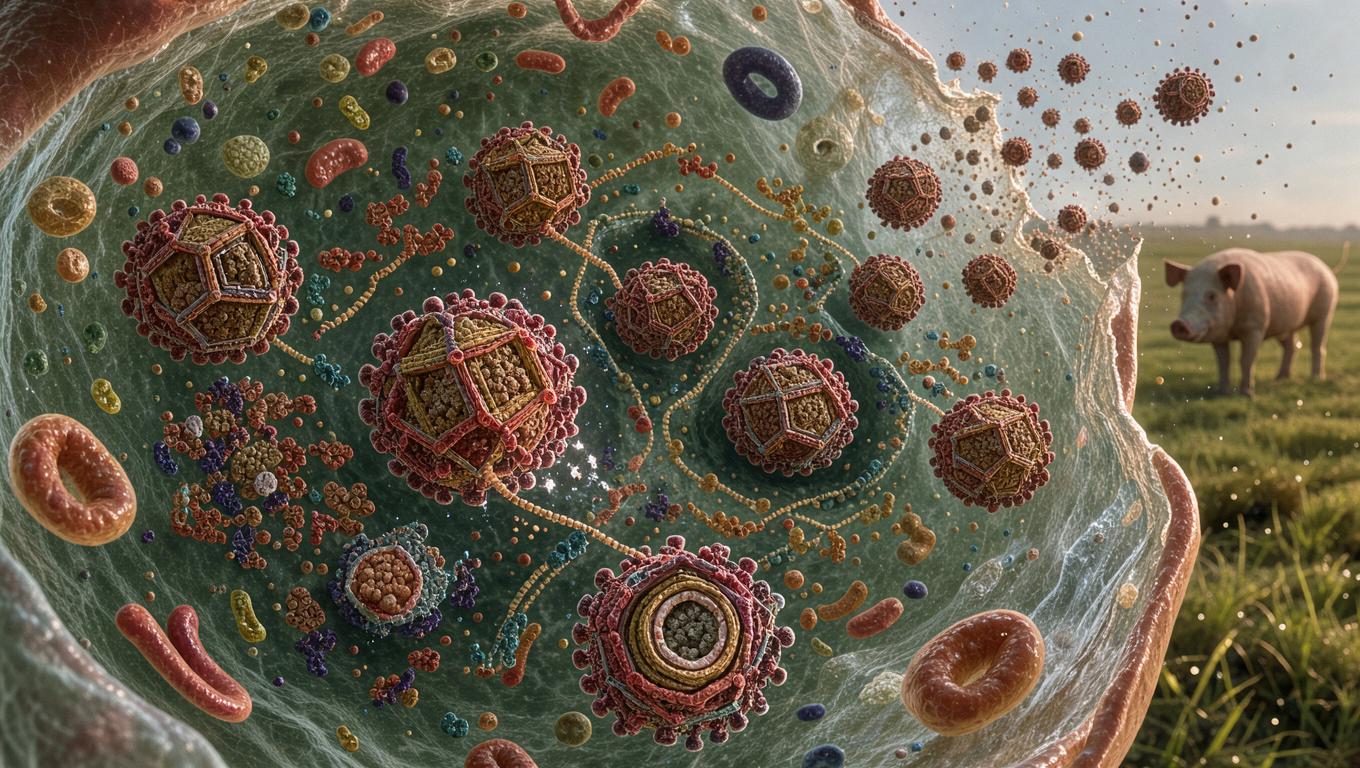
Salas and Andrés synthesize the Madrid group's work on ASFV strain BA71V into a coherent morphogenetic sequence: viral factories near the MTOC recruit ER cisternae; inner-envelope protein p54 is required for membrane precursor recruitment ; p17 gates progression to icosahedral intermediates; p72 with chaperone pB602L and vertex protein pB438L builds the capsid (repression of B438L yields 1-μm tubules instead of icosahedra); polyproteins pp220/pp62 plus protease S273R assemble the core shell, constituting 32% of virion mass ; and pE120R drives microtubule/kinesin-mediated transport to the plasma membrane . Each claim is anchored to IPTG-inducible recombinants — a clean, falsifiable design where every knocked-down protein yields a distinct ultrastructural arrest phenotype (Fig. 4 phenotypes).
The mass-composition figure shows why assembly matters pharmacologically: p72 alone is ~one-third of virion protein mass, and polyprotein products add another third, concentrating huge surface area for inhibitor targeting.
Critical assessment and unresolved claims
The review is honest about what remains unknown, which strengthens its credibility. Key open questions it flags: (1) the mechanism converting ER cisternae into a single-bilayer inner envelope remains unresolved — collapsed-cisterna vs. membrane-rupture models are both left open, paralleling the poxvirus debate ; (2) whether newly discovered helicoidal membrane structures are a main route or an alternative pathway is uncertain; (3) DNA encapsidation is "poorly understood," with only B354L proposed as a packaging ATPase homolog. Only 9 of 19 known structural protein genes had assigned functions at the time — a candid accounting of knowledge gaps.
A blind spot the review does not fully address: all mechanistic conclusions rest on the BA71V Vero-cell-adapted lab strain, not virulent pig macrophage isolates, so morphogenesis may differ in the natural host cell. The functional role of p54-induced ER collapse (OSER formation via N-terminal disulfide bonds, Windsor et al. 2012) is reported but its relevance in actual infection is left as an open hypothesis.
Legacy: how the morphogenetic map guides current science
The review's framework remains load-bearing. Recent work builds directly on it: the 2024 Nature Communications cryo-EM capsid structure and related assembly studies cite this review . S273R deletion now underpins a replication-restricted vaccine candidate (AQSΔS273R) with aberrant off-center cores and partial protection in pigs — a direct translational test of the review's protease-dependence claim . Antiviral screens target the assembly machinery the review mapped: EGCG binds p72 and p1192R with IC50 5.2–8.3 μM , and siRNA against VP72 (the p72 gene) reduces titers up to 4 log10 in Vero cells . The companion review on replication and genomics complements this morphogenesis account .
What would change the model's conclusions: cryo-EM or live-cell evidence showing inner-envelope precursors derive from a compartment other than ER, demonstration that helicoidal intermediates are dispensable dead-ends, or identification of a packaging-independent DNA encapsidation route — any of these would require revision of specific stages rather than the overall sequential framework.
Feedback:
Updated: November 17, 2026
BGPT Paper Review
Study Novelty
60%
A review consolidating the Madrid group's own prior primary findings (1997–2010) into a unified model; synthetically novel in integrating p54, p17, pB438L, and helicoidal intermediates into one sequence, but not presenting new data.
Scientific Quality
80%
Claims are consistently tied to inducible-recombinant phenotypes with clear EM evidence and honest acknowledgment of unresolved mechanisms. Limitations: relies on one lab strain (BA71V) and cell type; some key claims (pB438L vertex localization) rest on indirect evidence due to antibody unavailability; no attempt at quantitative assembly kinetics.
Study Generality
70%
The NCLDV-wide framing (p72/D13 homology, shared capsid jelly-roll domain) and the polyprotein-processing paradigm give it relevance beyond ASFV, though the details remain virus-specific.
Study Usefulness
80%
Directly guided antiviral targeting (p72, S273R) and attenuated-vaccine design (S273R deletion), and remains the standard assembly reference cited by 2024–2026 structural and virology work.
Study Reproducibility
70%
Underlying primary studies used well-defined inducible recombinants in BA71V with documented EM and immunocytochemical methods; however, phenotypes require BSL facilities, and some findings (e.g., p24 recruitment, helicoidal intermediates) await independent replication.
Explanatory Depth
80%
Deep mechanistic reasoning at the protein-function level (topology of p54, myristoylation of pp220, chaperone paradox of pB602L) with explicit alternative models; limited only by unresolved envelope biogenesis and DNA packaging mechanisms.
Building a network graph linking each ASFV morphogenesis protein to its assembly-stage phenotype from the review's inducible-recombinant data, enabling systematic comparison with the 2024 capsid structure and vaccine deletion targets.
Get emailed when your analysis is done!
We'll email you the results when your analysis is finished.
Hypothesis Graveyard
The 'ASFV is fully wrapped by ER cisternae (two-membrane envelope)' model (Rouiller 1998) — largely superseded: Hawes 2008 cryo-EM showed the mature inner envelope is a single bilayer, so the two-membrane claim applies only to assembly intermediates if at all.
Pronucleoid pre-formation followed by encapsidation at a single vertex (Brookes 1996/1998) — not confirmed by other studies; genome incorporation appears to depend on prior core-shell assembly instead.

 Explore by Goal
 Quick Explanation
 Long Explanation
 Top Data Sources
 Ask a Follow-Up
 Key Insight
 Keep Exploring
 Analysis
 Hypothesis Graveyard
 Potential Experiments
 Discussion
