Check whether claims match experiments, exact reported results, and stated limitations.Know what the science actually supports before you trust the answer.
Press Enter ↵ to review paper
Explore by Goal
"Imagination is more important than knowledge. Knowledge is limited. Imagination encircles the world."
- Albert Einstein
Quick Explanation
Copied
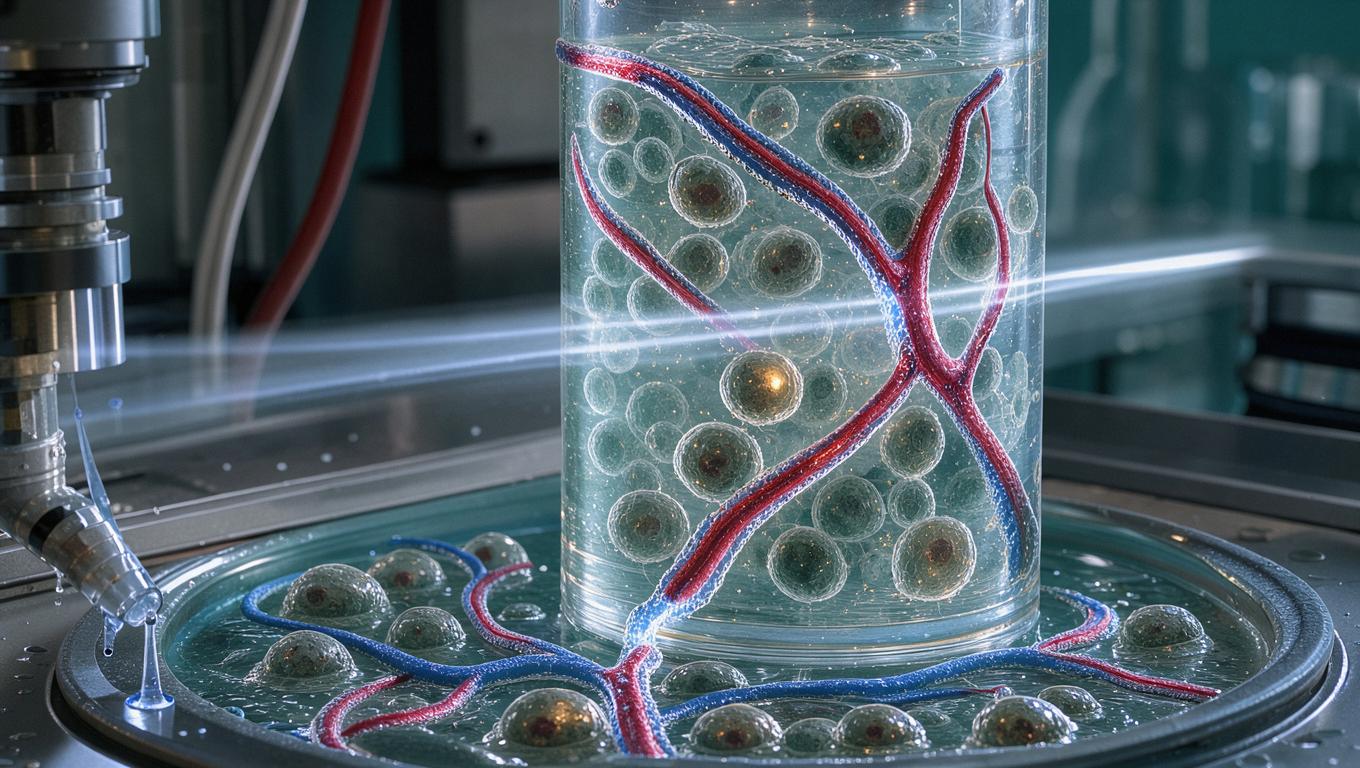
GRACE integrates light-sheet tomography, computer vision, and parametric modelling to make volumetric 3D printers context-aware, achieving adaptive vascular-like channels around embedded features with functional gains (proinsulin secretion 3.2 vs 2.0 vs 1.4 ×10⁵ RLU for GRACE, random, and bulk controls) and shadow-corrected print fidelity (r.m.s. error 0.50→0.18 µm).
Long Explanation
What GRACE does and how well the evidence supports it
Florczak et al. (Nature, 3 Sept 2025) report GRACE — Generative, Adaptive, Context-Aware 3D Printing — a closed-loop workflow where a light-sheet module scans the printing vat, converts polar image stacks into a Cartesian 3D point cloud, isolates features via DBSCAN clustering, and passes coordinates to Rhino3D/Grasshopper parametric models that generate bespoke geometries printed tomographically in GelMA + LAP resins. Scanning, feature isolation, model generation and printing complete in ~4 min per spectral channel, and ICP-based auto-alignment of sequential prints completes in <15 s .
Three quantitative pillars support the central claim. First, shadow correction: for a ball-in-cage occlusion test, OSMO-optimized prints reduced surface r.m.s. error from 0.50 ± 0.09 to 0.18 ± 0.05 µm and raised sphericity from 0.830 ± 0.060 to 0.965 ± 0.006 (n=3, P=0.0071 and P=0.0137). For the pillar phantom (n=12), the Bhattacharyya coefficient dropped 0.39→0.15 and the Jaccard index rose 0.70→0.945. Second, functional bioprinting: adaptive vessel-like networks around iβ-cell-laden toruses (300 µm offset, ~180 ± 10 mm² fixed surface area) secreted more proinsulin after 24 h dynamic culture (3.2 ± 0.3 ×10⁵ RLU) than random-channel (2.0 ± 0.4) or bulk (1.4 ± 0.1) controls (ANOVA, n=6, F=55.74) . Third, multitissue assembly: an auto-aligned osteochondral femur-cartilage construct (MSC 5.0×10⁶ ml⁻¹, ACPC 1.0×10⁷ ml⁻¹) retained compartmentalized cells for 4 weeks with histologically confirmed cartilage and mineralized matrix deposition (n=3 histology) .
Note the sphericity units are misprinted as “µm” in the source (a dimensionless quantity) — a minor editorial flaw worth flagging .
Limitations, blind spots, and conflicts
Resolution ceiling: the light-sheet system resolves 14.47 µm in the image plane, so single-cell detection is out of reach; only particles/organoids ≥~150 µm were targeted .
Small samples: shadow-correction accuracy uses n=3 per group; some histology claims rest on n=3. Only the pillar occlusion phantom used n=12. Replication across independent printers is unverified.
Dependence on fluorescence: feature mapping requires stained/fluorescent features; non-fluorescent imaging (optical tomography, holography) is proposed but not demonstrated here.
Shadow correction decays with occlusion complexity, does not mitigate bubbles, and is recommended to be preceded by in silico printability checks — the authors self-report this honestly.
Conflicts of interest: Florczak and Levato hold a provisional patent (PCT/NL2024/050642) on the workflow, and Levato advises Readily3D SA (maker of the vials/printer) — commercial incentive warrants independent replication .
Code is only available on request, weakening reproducibility despite the open Zenodo source data (zenodo.org/records/16024214).
Confidence: the headline functional claim (adaptive vessels improve mass transport) rests on one cell line (iβ-cells) and one 24-h readout; the mechanism — shorter diffusion distances — is plausible but inferred, not directly measured (e.g., no oxygen or glucose-gradient data). The dimensional-accuracy claims are well controlled and the strongest evidence in the paper.
What would falsify or change the conclusion
Printing without feature adaptation matching or beating GRACE fidelity, shadow correction failing to improve r.m.s./sphericity on independent hardware, or ICP alignment failing on noisy point clouds would undercut the central claims. Broader generality depends on demonstrating the concept in non-fluorescent imaging and human-tissue-scale volumes, both left to future work .
Author-specific reviews
Feedback:
Updated: October 27, 2026
BGPT Paper Review
Study Novelty
80%
Turning a passive printer into a closed-loop, perception-action system (scan → segment → generative model → print) is a genuine conceptual shift for volumetric printing; individual components (light sheets, OSMO, DBSCAN, ICP) are established, but their integration into context-aware autonomous fabrication is new.
Scientific Quality
90%
Rigorous Nature-level work with appropriate controls (random-channel and bulk), reported statistics, and honest self-reported limitations. Flaws: small n in key fidelity experiments, sphericity unit typo, and code not openly released.
Study Generality
80%
Demonstrated across multiple modalities (tomographic, embedded extrusion, FLight) and applications (bioprinting, mechanics, occlusion correction), though validation remains confined to GelMA hydrogels and millimetre-scale volumes.
Study Usefulness
90%
Directly addresses the vascularization bottleneck in biofabrication with a practical, fast (~4 min) automated workflow; immediately useful for tissue-model design and overprinting applications.
Study Reproducibility
60%
Custom hardware, manually tuned exposure/gain, request-only code access, and proprietary software (Rhino3D/Grasshopper) impede reproduction, despite open Zenodo source data and detailed supplementary methods.
Explanatory Depth
80%
Mechanistic accounts (diffusion-distance argument for improved proinsulin, Monte Carlo-optimized occlusion phantoms) are credible but partly inferred; the imaging/printing physics is well characterized.
We'll email you the results when your analysis is finished.
Hypothesis Graveyard
'Volumetric printing cannot overprint opaque objects accurately' — falsified here via profilometric light-sheet mapping plus OSMO optimization, which reduced r.m.s. error 64%.
'Manual repositioning suffices for sequential prints' — undermined by the <15 s ICP alignment achieving repeatability that manual placement demonstrably cannot at this scale.

 Explore by Goal
 Quick Explanation
 Long Explanation
 Top Data Sources
 Ask a Follow-Up
 Key Insight
 Keep Exploring
 Hypothesis Graveyard
 Potential Experiments
 Discussion
