Check a paper's claims against linked experiments, exact results, stated scope, and limitations.Know what falsifiable science actually supports before you trust the answer.
Press Enter ↵ to search evidence
Explore by Goal
"The scientist is not a person who gives the right answers, he's one who asks the right questions."
- Claude Lévi-Strauss
Quick Explanation
Copied
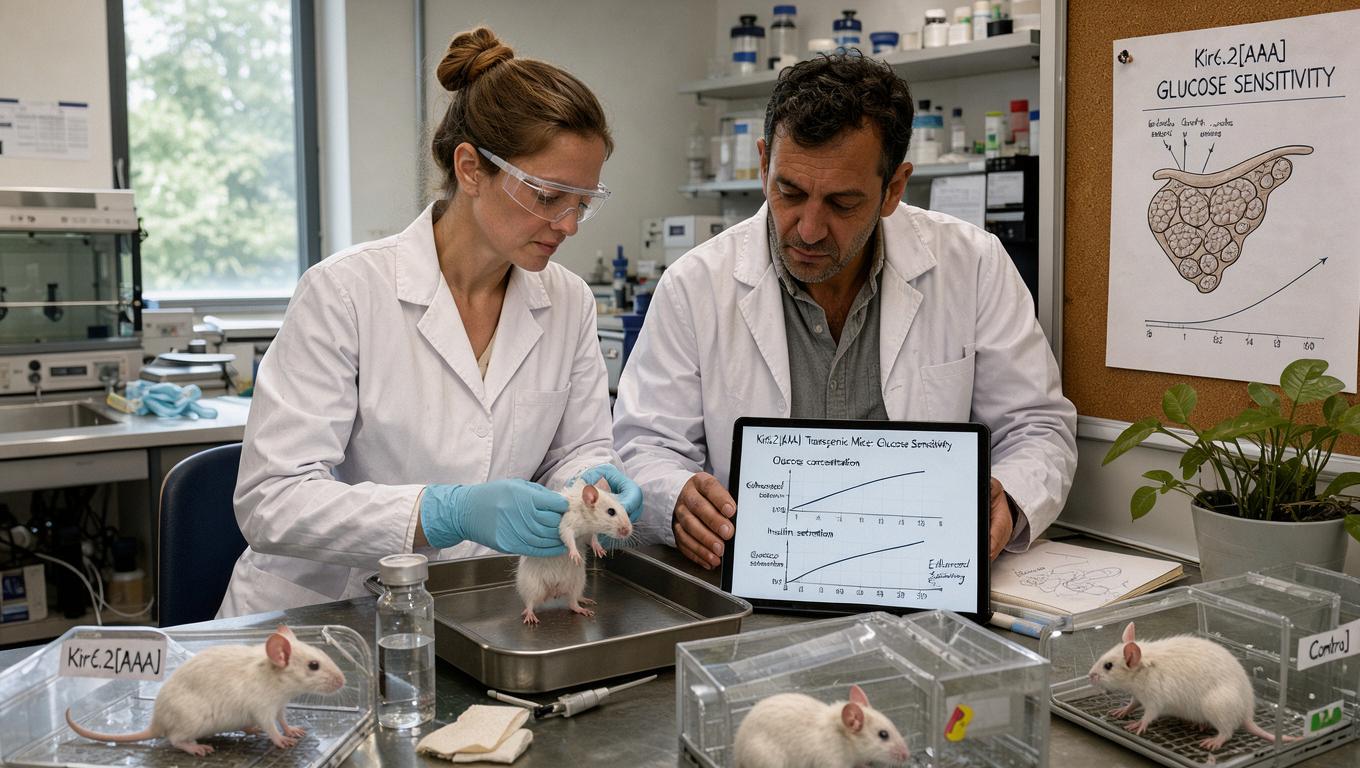
This computational modeling paper convincingly explains why Kir6.2[AAA] mosaic islets retain near-normal glucose sensitivity: Ca2+-driven upregulation of the open KATP fraction plus strong gap-junctional coupling compensate a 3-fold conductance loss with only a ~2–3 mM leftward dose-response shift . Key predictions remain experimentally unvalidated, particularly Ca2+ diffusion through gap junctions as required for mosaic synchrony.
Long Explanation
Mechanism of Compensation: What the Model Shows
The paper (Tsaneva-Atanasova & Sherman, Biophysical Journal 2009) addresses a paradox: Kir6.2[AAA] transgenic islets lose functional KATP channels in ~70% of beta-cells, yet the glucose dose-response curve shifts only ~2–3 mM . Using a phantom bursting model where Ca2+ raises the ADP/ATP ratio and thus the KATP open fraction (a), the authors show a threefold conductance reduction (gKATP 30,000 → 10,000 pS) is offset by a nearly threefold rise in open fraction, keeping active KATP conductance near ~250 pS—the range needed to terminate bursts. Bifurcation analysis explains the geometric basis: the a-nullcline is nearly horizontal, so a small r shift (0.2 → 0.1885 mM) restores the same plateau fraction.
Reported (all from model predictions, not new experiments): bursting is predicted possible down to gKATP ≈ 1,200 pS (limited by the ~20% maximal open-fraction observed in 0 glucose), an 84–96% tolerance of conductance loss .
Coupling in Mosaic Islets
In 216-cell (6×6×6) simulations with two-thirds of cells lacking KATP channels entirely, physiologically measured electrical coupling alone synchronizes Ca2+ responses but produces oscillator death of voltage spikes; Ca2+ diffusion through gap junctions is needed to equalize Ca2+ across WT and mutant cells, and 4× stronger electrical coupling restores spiking. The authors frame this as three falsifiable predictions, including that AAA islets either have upregulated coupling or lose spiking .
Critical Assessment and Blind Spots
Strengths: Mechanistic, parsimonious, yields testable predictions; results are robust to a 10-fold change in sigmoid slope (shift only doubles); code was publicly released.
Limitations: (1) All validation is against previously published data—no new experiments test Prediction 2 (Ca2+ diffusion requirement) or Prediction 3; the Ca2+ gap-junction permeability was chosen freely since it is unknown. (2) The model is agnostic on whether Ca2+ raises ADP/ATP via ATP consumption or production, so metabolic grounding is phenomenological. (3) Mosaicism is assumed random/uniform; real spatial distributions could alter coupling demands. (4) An alternative explanation exists: Ca2+ oscillations persist even in islets with zero KATP channels, attributed to an unidentified alternative metabolically sensitive K+ channel—analogous to the diazoxide/somatostatin-sensitive IKPHHI channel documented in human KATP-deficient beta-cells . The authors acknowledge this but argue it is not required for partial loss. (5) Uniform (non-mosaic) heterozygous loss is handled more easily by the model, so the mosaic case is where the coupling assumptions carry the most weight. (6) Islet size scaling means the 6×6×6 results may not extrapolate; a 12×12×12 check is mentioned but not shown.
What would falsify the model: demonstrating Ca2+ equalization in mosaic islets without gap-junctional Ca2+ permeability, or finding that the open-fraction upregulation does not occur. Measuring KATP open probability in WT vs AAA beta-cells (Prediction 1) is the cheapest decisive test and, to BGPT's knowledge, remains unperformed.
Feedback:
Updated: November 25, 2026
BGPT Paper Review
Study Novelty
70%
First quantitative mechanistic account of mosaic KATP compensation in islets; builds on existing Bertram-Sherman model rather than new framework, but the mosaic-coupling prediction is novel.
Scientific Quality
80%
Rigorous bifurcation analysis and robustness checks (slope, gKATP magnitude, islet size). Weaknesses: purely computational, no new experimental validation within the paper, Ca2+ permeability parameter chosen freely, random mosaic assumption unverified.
Study Generality
70%
Insights on spare-channel compensation and heterogeneous coupling generalize to other KATP loss-of-function contexts (heterozygous SUR1/Kir6.2, pharmacological blockade), but remain beta-cell-specific.
Study Usefulness
80%
Provides falsifiable predictions and a framework for interpreting KATP channelopathy phenotypes; code availability aids reuse; relevant to neonatal diabetes and hyperinsulinism research.
Study Reproducibility
80%
Full parameter table, equations, and publicly released simulation code (XPPAUT/AUTO2000/Fortran at the authors' site) support reproduction; only gap-junction Ca2+ permeability is under-specified.
Explanatory Depth
90%
Bifurcation analysis gives genuine mechanistic/geometric understanding of why compensation is cheap (near-horizontal nullcline), not just curve-fitting.
Reimplementing the paper's reduced bursting model ODEs in Python to reproduce WT vs AAA KATP compensation and dose-response shift, then parameter-sweeping gKATP and coupling strength to map the predicted compensation boundary.
Get emailed when your analysis is done!
We'll email you the results when your analysis is finished.
Hypothesis Graveyard
Alternative-channel explanation (unidentified metabolically sensitive K+ channel accounts for AAA compensation): plausible but not favored here because Ca2+ oscillations in fully KATP-null islets may use a different mechanism than mosaic partial loss, and no candidate channel has been identified.
Pure electrical coupling synchrony: falsified within the model—physiological electrical coupling alone cannot equalize Ca2+ or restore spikes in mosaic islets.

 Explore by Goal
 Quick Explanation
 Long Explanation
 Top Data Sources
 Ask a Follow-Up
 Key Insight
 Keep Exploring
 Analysis
 Hypothesis Graveyard
 Potential Experiments
 Discussion
