Check whether claims match experiments, exact reported results, and stated limitations.Know what the science actually supports before you trust the answer.
Press Enter ↵ to review paper
Explore by Goal
"If the brain were so simple we could understand it, we would be so simple we couldn't."
- Lyall Watson
Quick Explanation
Copied
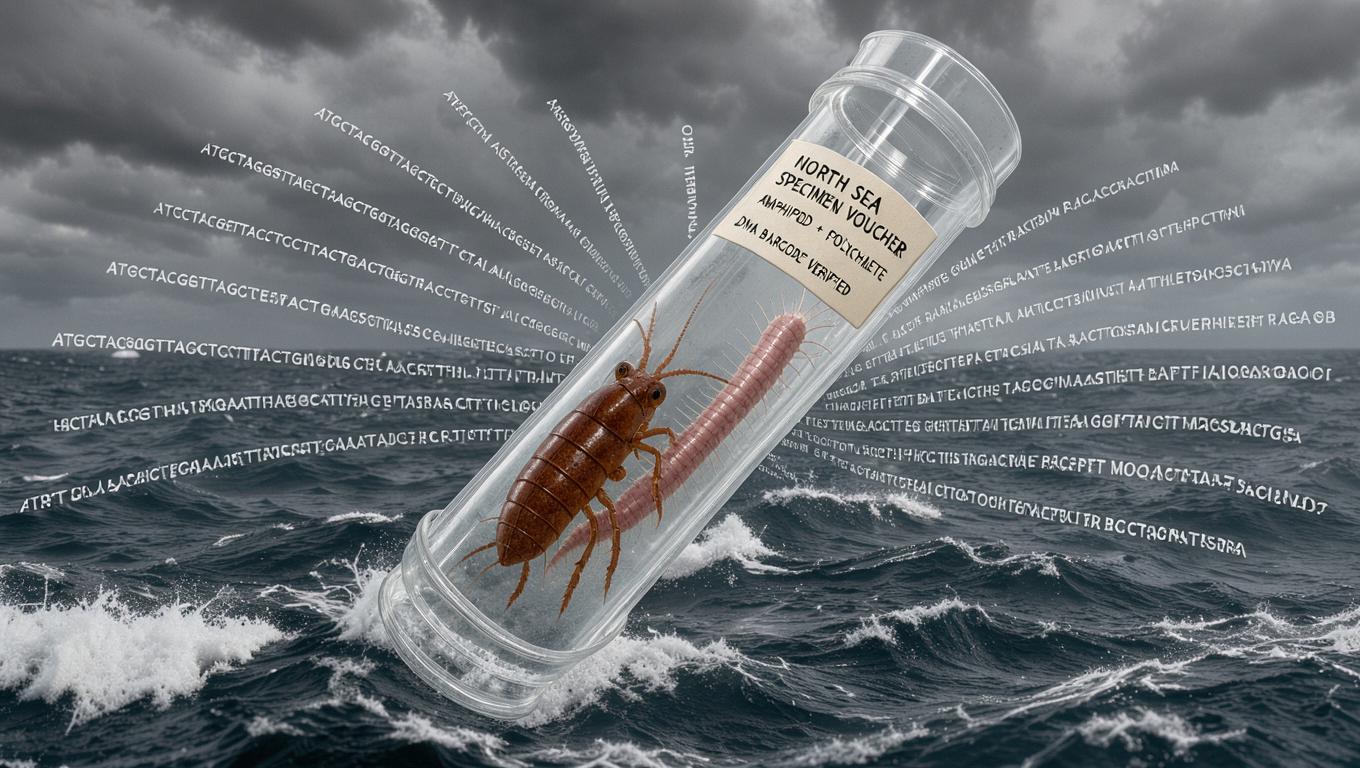
This GEANS project delivers a curated COI barcode reference library for North Sea macrobenthos: 4,005 specimens covering 715 species (>29% of the regional fauna), combining newly generated, non-public, and GenBank/BOLD-mined sequences, with Arthropoda best represented and Bryozoa/Annelida weakest .
Long Explanation
What the paper delivers
The GEANS project (Genetic Tools for Ecosystem Health Assessment in the North Sea Region) built a curated COI DNA barcode library specifically to support DNA-metabarcoding-based benthic biomonitoring required under EU frameworks (MSFD, Habitats Directive) and OSPAR guidelines .
Methodology and strengths
The library integrates three data streams: newly sequenced specimens, pre-existing non-public barcodes, and sequences mined from GenBank and BOLD, then stored with photographs and metadata in a dedicated BOLD project . Curated reference libraries with vouchered specimens and images are the central bottleneck for reliable metabarcoding, so this addresses a genuine, well-recognized constraint .
Critical gaps and caveats
Coverage ceiling: >29% species coverage means ~70% of North Sea macrobenthos remain barcode-free in this library, so detection failure in monitoring cannot be distinguished from true absence for most species (author-reported figure, not a BGPT inference).
Phylum skew: Arthropoda dominates while Bryozoa and Annelida are least covered — yet Bryozoa and Hydrozoa are explicitly flagged as groups where morphological identification is hardest, creating a mismatch between monitoring need and available reference data.
Mining risk: sequences mined from GenBank/BOLD may carry historical misidentifications or lack vouchered specimens; the paper's curation steps mitigate but cannot eliminate this inherited error, and the TEI record does not detail a re-validation protocol for legacy records.
Single-locus scope: COI alone cannot resolve all taxonomic contexts; cryptic species reported among common macrobenthic species (cited by the authors) could cause under-assignment even with perfect library coverage.
Verification data unavailable: full-text extraction lacked the complete figure/table set (e.g., per-phylum specimen counts, intraspecific vs. interspecific distance thresholds), so barcode-gap analysis cannot be independently re-evaluated here.
Verdict (confidence: moderate-high): a solid, practically valuable data descriptor that fulfils its stated purpose, limited by its ~29% coverage ceiling, phylum-level imbalance, and reliance on COI alone. The claims would be undermined if mined sequences prove to contain misidentified records, or if independent re-sequencing fails to reproduce species assignments for the weakest-coverage phyla.
Feedback:
Updated: October 27, 2026
BGPT Paper Review
Study Novelty
50%
Regional curated barcode libraries are a known genre (e.g., freshwater fish libraries for Java/Bali); the novelty is geographic scope (whole North Sea macrobenthos), EU-policy linkage, and integration of mined + new sequences rather than a conceptually new method.
Scientific Quality
80%
Large specimen count, multi-country consortium, curated BOLD deposition with photos and metadata, and explicit phylum-level honesty about coverage gaps are strengths. Deductions: mining legacy sequences without (fully documented) re-validation, single marker (COI), and coverage ceiling below one-third of the fauna.
Study Generality
60%
Regionally bounded (North Sea macrobenthos) but the workflow — combining new, non-public, and mined sequences with BOLD curation — is a transferable template for other regional barcode libraries.
Study Usefulness
80%
Directly enables DNA metabarcoding for MSFD/Habitats Directive/OSPAR benthic monitoring; a high-utility infrastructure paper for regulators and ecologists, though limited by the ~71% of species still uncovered.
Study Reproducibility
90%
Data and metadata are deposited in a public dedicated BOLD project with photographs; the workflow (new sequencing + mining + curation) is well specified, though exact curation filters for mined records are not fully extractable from the provided text.
Explanatory Depth
60%
A data descriptor: documents what was built and coverage statistics, but offers limited mechanistic or analytical depth (no full barcode-gap analyses or distance thresholds extractable from the provided text).
We'll email you the results when your analysis is finished.
Hypothesis Graveyard
Assuming the library is 'comprehensive' because 715 species sounds large: it covers only ~29% of the fauna, so comprehensiveness claims are not supported.
Assuming mined sequences are as reliable as newly vouchered ones: legacy GenBank records without voucher confirmation remain the weakest link and cannot be fully rescued by post-hoc curation.

 Explore by Goal
 Quick Explanation
 Long Explanation
 Top Data Sources
 Ask a Follow-Up
 Key Insight
 Keep Exploring
 Hypothesis Graveyard
 Potential Experiments
 Discussion
