Analyze how experimental results and claims are presented, scoped, and limited in a paper.Know what the science actually supports before you trust the answer.
Press Enter ↵ to analyze
Explore by Goal
"Nothing in life is to be feared, it is only to be understood. Now is the time to understand more, so that we may fear less."
- Marie Curie
Quick Explanation
Copied
This 2013/2014 addendum by Pluznick (Gut Microbes) compellingly argues that the olfactory receptor Olfr78 (human OR51E2) is a novel SCFA receptor linking gut microbial propionate/acetate to blood pressure via two opposing pathways: Olfr78-mediated renin release (hypertensive) and Gpr41-mediated vasodilation (hypotensive) Evidence is strong mechanistically but entirely murine.
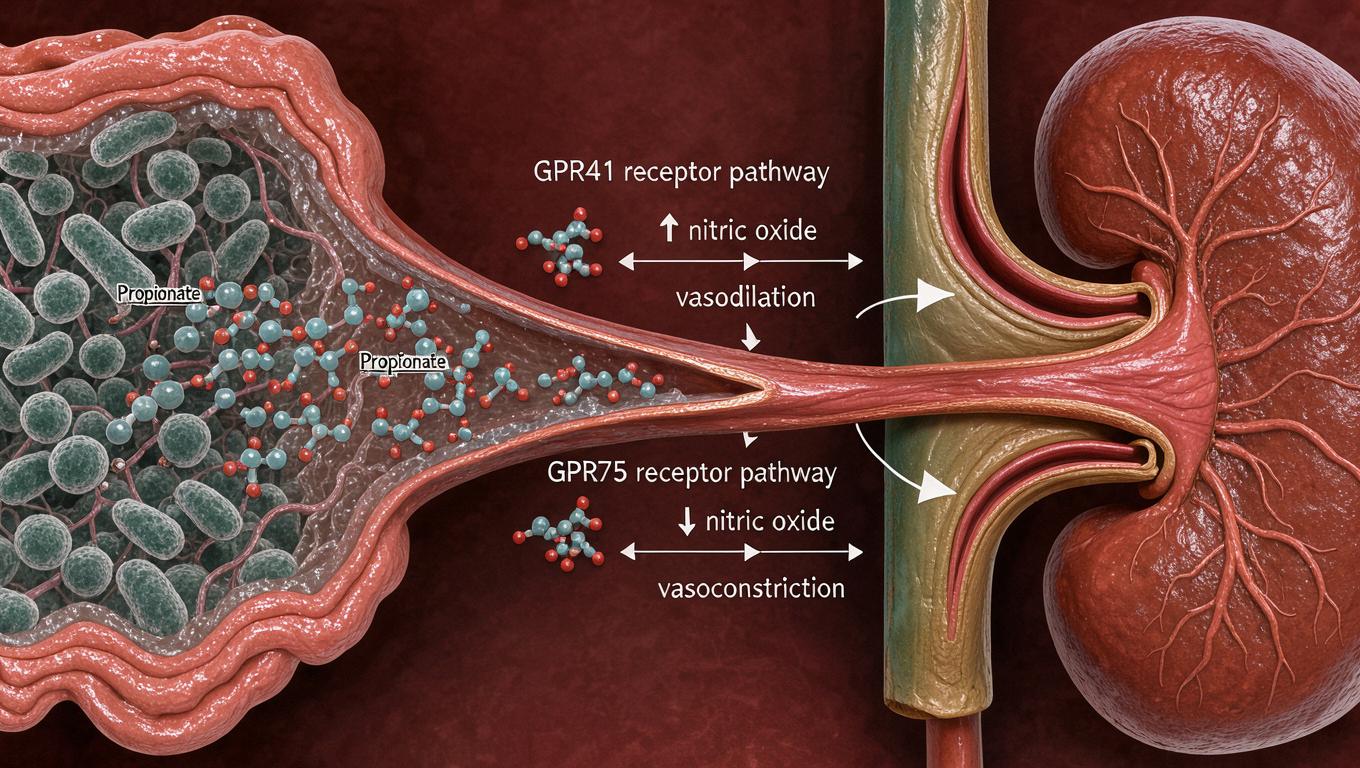
The addendum distills the parent PNAS study into a parsimonious two-receptor model: gut microbiota–derived propionate (<0.1–10 mM plasma) activates the low-affinity receptor Olfr78 (EC50 propionate 920 µM) to raise BP via renin release from afferent arteriole JG cells, while simultaneously activating the higher-affinity receptor Gpr41 (EC50 propionate 274 µM) to lower BP via vasodilation . The EC50 differential elegantly explains the 'brake' logic: Gpr41 is active at basal propionate, Olfr78 only at higher concentrations, preventing dangerous hypotensive dips.
Affinity ordering (Gpr43 ≈ Gpr41 << Olfr78) is the paper's strongest quantitative argument for its functional model .
Evidence Strengths and Critical Gaps
Strengths: convergent methods (β-gal reporter localization, luciferase ligand screen, quinacrine renin-granule release, IV propionate telemetry, antibiotics + 16S rRNA), human ortholog (OR51E2) confirmation, and a falsifiable antibiotic experiment — BP rose in Olfr78−/− but not +/+ mice when microbiota were depleted, exactly as the buffering model predicts .
Critical gaps: (1) Gpr41/Gpr43 were localized to vessels only by RT-PCR on intact vessels — endothelial vs. smooth muscle cell identity remains unknown, leaving the downstream signaling mechanism (Gi/cAMP vs. NO) unresolved; (2) the basal hypotension in Olfr78−/− cannot be attributed to vascular tone vs. chronically low renin; (3) all data are mouse; human plasma propionate (1.4–13.4 µM in later reviews) is far below Olfr78's 920 µM EC50, challenging direct translation ; (4) 'postprandial hypotension facilitates absorption' is speculative teleology, not tested; (5) no confounder control for antibiotic effects independent of microbiota (e.g., direct vascular effects). The authors candidly flag several of these, which is a credibility positive.
Historical Significance
This work seeded the now-large microbiome–cardiovascular field: Olfr78/OR51E2 is now routinely listed among canonical SCFA receptors alongside FFAR2/FFAR3 in gut–brain and renal physiology reviews . Confidence: mechanistic claims well-supported in mice (strong); human BP relevance remains inferred (moderate).
Feedback:
Updated: October 29, 2026
BGPT Paper Review
Study Novelty
90%
First identification of an olfactory receptor as a SCFA sensor regulating BP via microbiota — a genuinely unexpected receptor class in vascular/renal physiology, later validated as canonical.
Scientific Quality
80%
Rigorous multi-method mouse work with human ortholog confirmation and a falsifiable antibiotic test; but purely preclinical, localization of Gpr41/43 incomplete, and basal-BP causality (renin vs. tone) unresolved.
Study Generality
70%
Establishes a broad principle — microbiota metabolites as endocrine BP signals via ectopically expressed sensory receptors — though specifics are murine and receptor-specific.
Study Usefulness
80%
Opened microbiome–hypertension therapeutic avenue (diet, probiotics, OR51E2 drugs); directly shaped subsequent renal, gut–brain, and cardiovascular SCFA research.
Study Reproducibility
70%
Methods (luciferase assay, reporter mice, KO lines, quinacrine assay) are standard and described; no raw data deposit, and some figures rely on parent-paper methods.
Explanatory Depth
80%
EC50-based quantitative logic linking receptor affinity to physiological buffering is genuinely mechanistic; but downstream signaling (Gi vs Gs vs NO) remains hypothesis-level.
Generated scientific data; not direct experimental measurements.
Get emailed when your analysis is done!
We'll email you the results when your analysis is finished.
Hypothesis Graveyard
SCFAs lower BP purely through a single vasodilatory receptor — falsified by the Olfr78−/− hypersensitivity and hypertensive Gpr41−/− response showing opposing receptor actions.
Olfr78's renal role is a tagging artifact of β-gal reporter expression — rejected because propionate-induced renin release is absent in Olfr78−/− JG cells measured functionally by quinacrine efflux.

 Explore by Goal
 Quick Explanation
 Long Explanation
 Top Data Sources
 Ask a Follow-Up
 Key Insight
 Keep Exploring
 DataGen
 Hypothesis Graveyard
 Discussion
