Ask questions across claims linked to experiments, exact results, limitations, and sources.Know what falsifiable science actually supports before you trust the answer.
Press Enter ↵ to search evidence
Explore by Goal
"In nature, nothing exists alone."
- Rachel Carson
Quick Explanation
Copied
Verdict: This preprint provides unusually convergent evidence—from Ca²⁺ imaging, patch-clamp, optogenetics, connectomics, and synaptic tagging—that dFBN slow-wave activity (0.2–2 Hz) is generated by a bilateral glutamatergic half-center oscillator and encodes sleep pressure, rather than passively mirroring it .
Long Explanation
Core Mechanism: Oscillator, Not Mirror
dFBNs (dorsal fan-shaped body neurons, R23E10-GAL4) produce rhythmic GCaMP transients at 0.2–1 Hz in vivo. Somata within one hemisphere are largely uncorrelated (r = 0.05 ± 0.15), yet a few pacemaker-like cells dominate the dendritic compound signal (mean R² = 0.66, range 0.46–0.81) . Whole-cell recordings show alternating UP/DOWN states with ~120 Hz intra-burst spiking; left and right hemispheres oscillate in antiphase, consistent with reciprocal inhibition. Connectomes (hemibrain v1.2.1, FlyWire FAFB v783) confirm dense, symmetric, reciprocal dFBN connectivity (network density 0.66–0.96 within layers) .
Causality: Necessity and Sufficiency
VGlut RNAi or the EKO K⁺ channel reduces baseline and rebound sleep and disrupts SWA without morphological or locomotor confounds . Optogenetic replay—compressed 500-ms bursts with saturating ~40 Hz intra-burst frequency—induces sleep, whereas tonic stimulation of identical pulse counts does not . This resolves the prior contradictory claim (De et al., ref 23) that dFBN activation is ineffective—attributing the discrepancy to continuous depolarization-induced cross-inhibitory stalemates and coincident UV awakening.
Sleep Pressure Encoding
Sleep deprivation (>6 h) increases SWA power and transient amplitude (P=0.0004, Mann–Whitney), which decay over 12–24 h; SWA persists during behaviorally verified arousal, with dopamine flip-flop antagonism and post-inhibitory rebound . Crucially, sleep loss depresses dFBN efferent synapses (BRP::V5 reduction P=0.0009; reduced iGluSnFR glutamate release P=0.0002) — the opposite of the potentiation seen elsewhere in the sleep-deprived fly brain (R5, Kenyon cells, clock neurons) . A minimal spike-response model shows this homeostatic depression is required: without it, enhanced dFBN excitability would cut off its own excitatory drive (Fig. S8c).
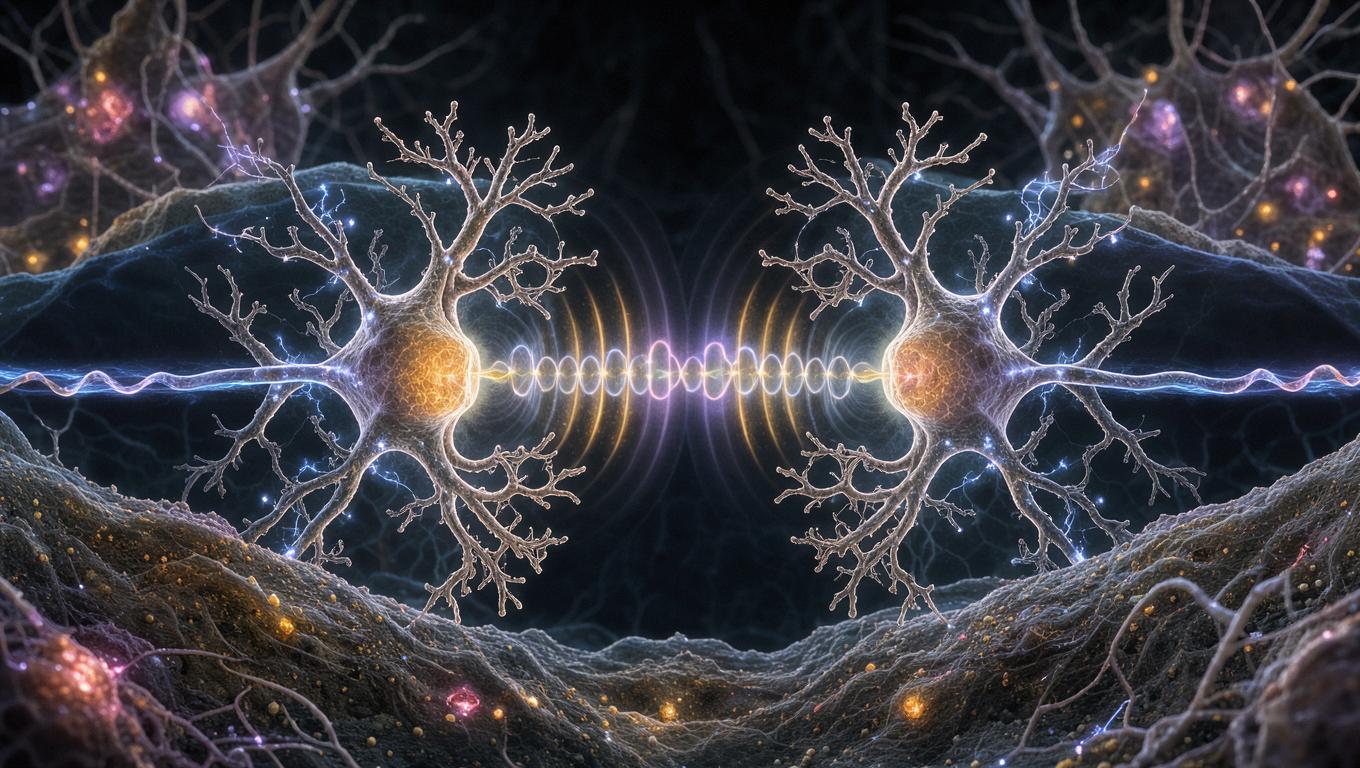
Illustrative simulation of antiphase UP/DOWN alternation with burst structure — schematic only; parameters qualitatively inspired by the reported ~2 s period and bursting, not fitted to raw data.
Limitations and Blindspots
Permissive SWA during wake: dFBN oscillations occur awake (head-fixed treadmill), yet 'arousal' is chemically/thermally induced — relation to natural wake states in freely behaving flies is not directly established.
Analog-to-digital gap: the authors themselves leave open how amplitude-modulated periodic output is converted to binary sleep-wake transitions downstream .
Subpopulation attribution: connecting the strongly-coupled layer 6 dFBN subsets to the slow-rhythm cells is only tentative; Ca²⁺ imaging cannot exhaustively classify activity patterns due to somatic low-pass filtering.
Model minimality: recurrent R5-dFBN feedback is simplified into direct Poisson-unit connections, so quantitative predictions depend on these abstractions.
Overall: mechanistically deep, multi-level causal work (imaging, electrophysiology, genetics, connectomics, modeling) with unusually tight internal convergence — the strongest current evidence that invertebrate SWA is instructive, not epiphenomenal.
Feedback:
Updated: November 17, 2026
BGPT Paper Review
Study Novelty
90%
First causal demonstration that a central pattern generator actively generates SWA and encodes sleep pressure in its amplitude, with counterintuitive sleep-dependent synaptic depression.
Scientific Quality
80%
Multi-modal convergence (imaging, patch-clamp, optogenetics, connectomics, STaR tagging, modeling) with blinding and replication. Limitations: preprint status, tentative pacemaker-cell attribution, simplified model; no major methodological red flags.
Study Generality
70%
Drosophila-specific circuit, but principles (half-center oscillators encoding homeostatic need, anti-cyclical synaptic depression) generalize conceptually to mammalian thalamocortical and hypothalamic flip-flop sleep circuits.
Study Usefulness
80%
Resolves a contested claim (dFBN effectiveness), provides a testable circuit framework for SWA function, and supplies reusable tools (intersectional drivers, BRP::V5 tagging) for sleep-pressure research.
Study Reproducibility
70%
Extensive methods (strains, imaging parameters in Supplementary Table 1, statistics, sample sizes, blinded analyses) support replication, but reliance on specialized fly lines, custom rigs, and unpublished companion data limits direct reproducibility.
Explanatory Depth
90%
Mechanistic chain from mitochondrial redox sensing through channel-level memory, oscillator dynamics, synaptic scaling, and model-predicted SWA adjustment—deep, testable mechanistic integration.
Simulated antiphase half-center oscillation shown above (dFBN L vs R), labeled as schematic; assumptions: ~2 s period, bursty UP states, qualitatively matched to reported imaging.
Generated scientific data; not direct experimental measurements.
Get emailed when your analysis is done!
We'll email you the results when your analysis is finished.
Hypothesis Graveyard
'SWA is merely an epiphenomenal byproduct of sleep' — weakened by optogenetic burst-structured replay inducing sleep dose-dependently while tonic stimulation does not.
'dFBN activation does not promote sleep' (De et al.) — explained by ineffective continuous depolarization causing cross-inhibitory stalemate and UV-induced awakening, not circuit ineffectiveness.

 Explore by Goal
 Quick Explanation
 Long Explanation
 Top Data Sources
 Ask a Follow-Up
 Key Insight
 Keep Exploring
 DataGen
 Hypothesis Graveyard
 Discussion
