Check a paper's claims against linked experiments, exact results, stated scope, and limitations.Know what falsifiable science actually supports before you trust the answer.
Press Enter ↵ to search evidence
Explore by Goal
"Science is not only compatible with spirituality; it is a profound source of spirituality."
- Carl Sagan
Quick Explanation
Copied
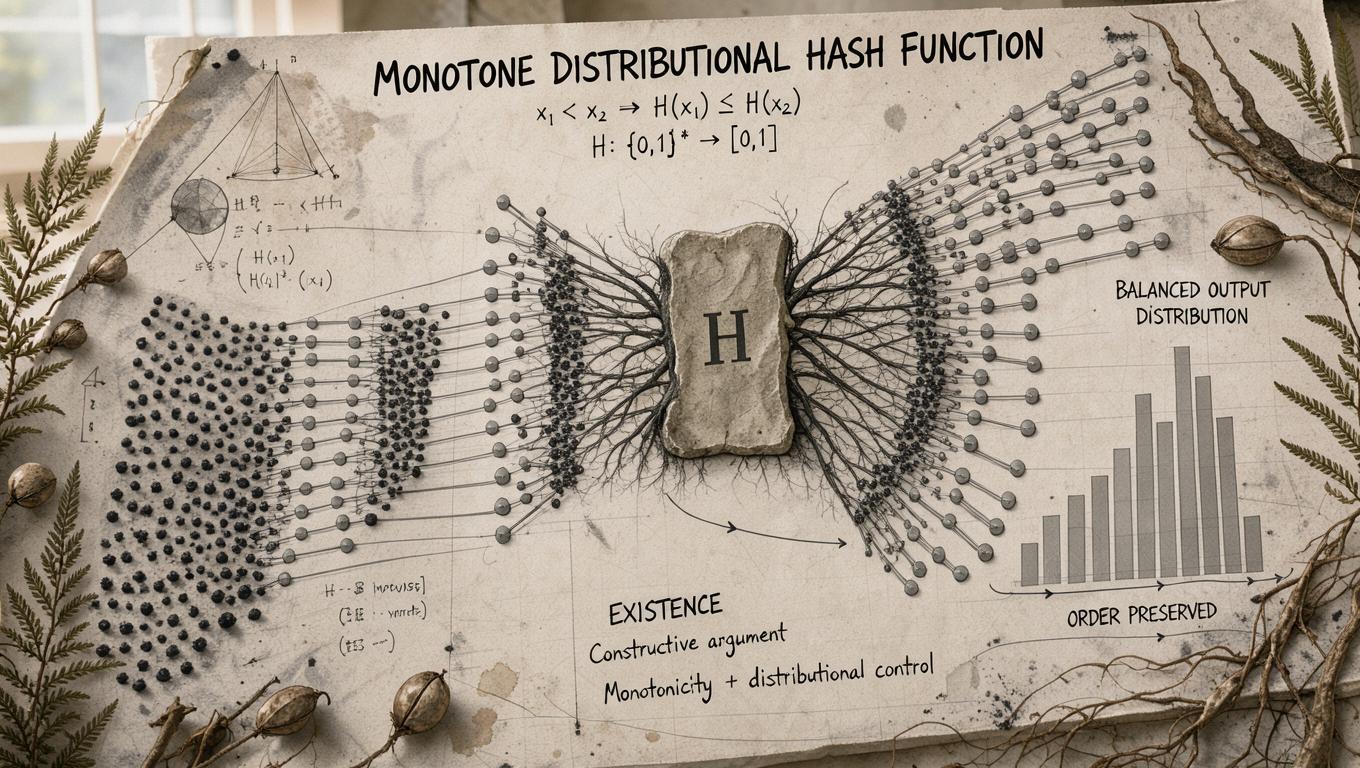
Assuming any collision-resistant hash function (CRH) exists, the paper constructs a monotone distributional collision-resistant hash function with inverse-square-root security by applying the Goldreich–Izsak middle-slice threshold transformation to a 4λ→λ CRH, proven via density and compression lemmas
Long Explanation
Main Result and How It Is Proven
Building on Goldreich and Izsak's result that monotone one-way functions exist while monotone PRGs cannot , the paper defines h′ as the threshold function of a CRH h on the middle slice (inputs of Hamming weight ⌊n/2⌋), mapping other inputs to 0^m or 1^m. Since equal-weight inputs are incomparable, h′ is trivially monotone. Security rests on two supporting lemmas: the "diminished" middle slice (excluding preimages of 0^m and 1^m, which cannot be dense or h would not be CR) retains density ≥ 1/(8√n), and a compression lemma guarantees that any set S with log|S| > m contains collisions with probability ≥ ½·2^(m−log|S|−1) . Combining these yields the inverse-square-root security bound.
The inverse-polynomial (not negligible) 1/(32√n) security is a reported structural feature of the middle-slice technique—standard for this method, and adequate since BHKY-style applications tolerate it .
Critical Assessment
Strengths. The proof is clean, self-contained (the multi-output monotone circuit theorem is made explicit where GI only implied it), and honest: the authors state that the transformation requires a sufficiently compressing CRH (factor 4), that depth preservation requires assuming the CRH is in NC¹ (e.g., from SIS), and that the construction does not go through from dCRH alone since the middle slice of a dCRH may hold no hard collisions. The result meaningfully extends the small monotone-primitives list (OWFs, one-way injections via MSSV ) and sharpens the dCRH-vs-CRH separation landscape given Simon's black-box separation OWP ↛ dCRH .
Weaknesses and blind spots. The core technique is entirely borrowed from GI; the contribution is verification-plus-adaptation rather than a new method. The compression lemma is credited as a generalization of an idea in a textbook (MF21), so even a supporting tool is not novel. Assumption-strength mismatch is the central limitation: proving a weaker primitive exists from a stronger one leaves open the natural question (monotone dCRH from dCRH alone), which the authors correctly flag. The non-black-box caveat—both primitives being monotone means a monotone OWF→dCRH construction is not ruled out by the GI gap argument—is noted but not explored. Also, Lemma 3's induction (log|M′| ≥ n/2 for n ≥ 10) is elementary but adds bulk; a direct asymptotic argument would suffice.
What would change the verdict. A distributional PPT adversary succeeding with advantage ≥ 1/(32√n) against the constructed family would falsify Theorem 2; a monotone dCRH construction from dCRH alone would supersede this result entirely.
Feedback:
Updated: November 25, 2026
BGPT Paper Review
Study Novelty
70%
First existence proof of a monotone dCRH, extending a known technique (GI12) to a new primitive; incremental but genuinely new membership in the monotone-primitives list.
Scientific Quality
80%
Peer-reviewed (IACR Communications in Cryptology, accepted 2026-04-16 after reviewer corrections); proofs appear sound and self-contained, though the core technique is borrowed and supporting tools are generalizations of prior ideas.
Study Generality
50%
A niche theoretical result within monotone cryptography; it maps one primitive to another under a stronger assumption, with limited transferability beyond this subfield.
Study Usefulness
60%
Useful for the monotone-cryptography research program and for understanding the dCRH/CRH separation landscape; no immediate practical deployment impact.
Study Reproducibility
70%
All definitions, the construction, and full proofs are included and checkable; no code exists but formal proofs are fully specified and verifiable by a reader.
Explanatory Depth
70%
Clear mechanistic exposition of why the middle slice preserves hardness and monotonicity, including density/compression lemmas and explicit circuit construction; depth limited by reliance on an existing framework.
We'll email you the results when your analysis is finished.
Hypothesis Graveyard
Middle slice of a dCRH directly inherits hardness: falsified by the paper's own observation that the middle slice of a dCRH may contain no hard collisions, since dCRH security does not concentrate on any specific Hamming weight.

 Explore by Goal
 Quick Explanation
 Long Explanation
 Top Data Sources
 Ask a Follow-Up
 Key Insight
 Keep Exploring
 Hypothesis Graveyard
 Potential Experiments
 Discussion
