Claims linked to experiments and exact reported outputs, with scope and limitations and source provenance.Know what falsifiable science actually supports before you trust the answer.
Press Enter ↵ to search evidence
Explore by Goal
"Look deep into nature, and then you will understand everything better."
- Albert Einstein
Quick Analysis Plan
Copied
A rigorous Kcnc4 (Kv3.4) analysis plan should integrate its two-exon Shaw-family genomic structure on human chromosome 1 (accession M81253) with transcriptomic maturation data in olfactory neurons, dysplasia/carcinoma protein-expression datasets, astrocyte-Tcf4 snRNA-seq dysregulation, and salivary exRNA biomarker performance, prioritizing cross-context differential expression validation.
Long Analysis Plan
Evidence Base for Kcnc4 (Kv3.4) Analysis
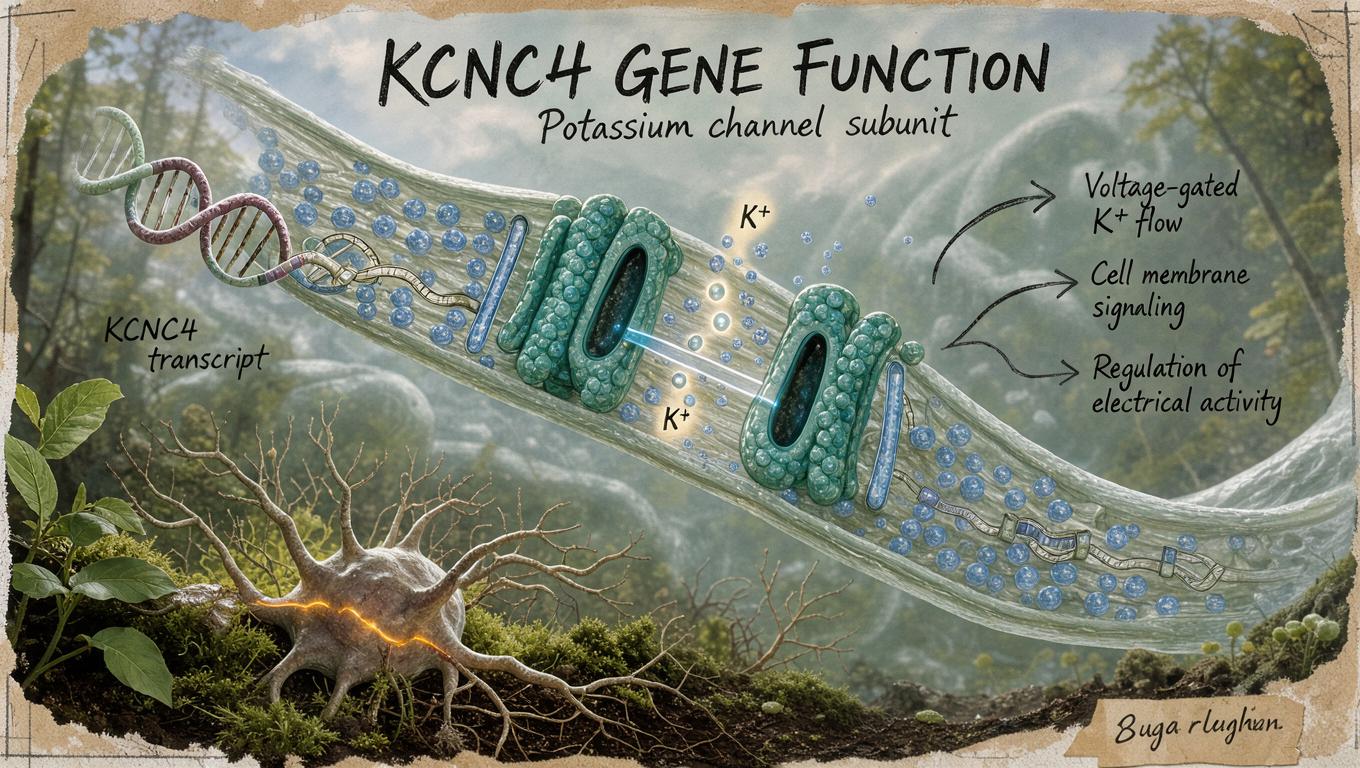
Kcnc4 encodes the Shaw-related voltage-gated potassium channel Kv3.4. The foundational cloning study mapped human KCNC4 to chromosome 1, identified the hydrophobic core (S1–S6) in the second exon (5' exons unresolved at that time), and deposited the sequence as GenBank M81253 via a 4.7-kb HindIII clone (KC247) screened across 59 human–hamster hybrids .
Four independent expression contexts give the analysis plan its comparative axes: (1) Kcnc4 is upregulated during olfactory sensory neuron maturation alongside Kcna2/Kcna5/Kcna6/Kcnb1 in the Brann scRNA-seq dataset (GSE151346; 29,585 cells), matching electrophysiologically observed emergence of a 4-AP-sensitive transient A-type K+ current in mature OSNs ; (2) Kv3.4 protein is expressed in 40% of head and neck carcinomas and 52% of dysplasias, with Kv3.4-positive dysplasias showing higher cancer incidence (49% vs 22%, p=0.04) ; (3) Kcnc4 is a differential expression hit in astrocyte-specific Tcf4-deficient mice (Pitt-Hopkins model; snRNA-seq of 59,306 nuclei with recurrent seizures in 93.3% of males) ; (4) KCNC4 is a downregulated salivary exRNA biomarker for gastric cancer (61.61% single-marker accuracy within an 8-mRNA panel achieving AUC 0.905; 198 individuals) .
Limitations to encode in the plan: the 1992 study did not resolve Kv3.4 5' exons or perform direct electrophysiology; the HNSCC cohort was small, retrospective, and male-predominant with no significant correlation of Kv3.4 to most clinical variables ; the gastric-cancer biomarker work is purely computational without wet-lab validation ; the olfactory and Tcf4 studies are correlative transcriptome–physiology links in mouse models that may not generalize across strains or to humans.
Phased Bioinformatics Plan
Phase 1 — Sequence/genome: Retrieve M81253 and current KCNC4 annotations; use Biopython to resolve the historically missing 5' exons against GRCm39/mm39 and GRCh38; map conserved S1–S6 segments across Kv3.1–Kv3.4 paralogs with alignment and dN/dS analysis.
Phase 2 — scRNA-seq re-analysis (scanpy/Seurat): Re-download GSE151346 (29,585 cells), annotate iOSN vs mOSN, and quantify Kcnc4 log2FC with pseudobulk differential expression; cross-reference the Tcf4-deficient astrocyte snRNA-seq DEG list.
Phase 3 — Cross-context meta-expression: Compare Kcnc4 directionality across OSN maturation (up), Tcf4-deficient astrocytes (DEG), HNSCC (54% mRNA-increased tumors), and saliva (downregulated) — testing whether context-specific isoforms or 3'UTR usage explain divergent regulation.
Phase 4 — Protein/structure: Fetch Kv3.4 AlphaFold structure; annotate S1–S6, N-terminal ball-and-chain inactivation domain, and N-glycosylation motifs predicted from the Shaw-family consensus.
Phase 5 — Biomarker/statistical validation: Reproduce the gastric-cancer classifier on GSE121870 (scikit-learn Extra Tree/Random Forest pipeline), then test KCNC4's marginal contribution and confounder control against 61.61% reported single-marker accuracy.
Phase 6 — Functional hypothesis testing: Use NEURON-style conductance modeling (as validated for Kv-family changes in BXD alcohol-drinking models where Kcnc4 changed with CIE exposure) to simulate how Kcnc4 upregulation alters A-type current onset (mature OSN K+ onset −30 mV vs immature −10 mV) and AP half-width (3.9–8.5 ms mature vs 21.2 ms immature).
Building a cross-context Kcnc4 differential expression atlas from GSE151346 olfactory scRNA-seq, Tcf4-deficient astrocyte snRNA-seq, HNSCC qPCR percentages, and salivary exRNA accuracy data to compare regulation directionality.
Get emailed when your analysis is done!
We'll email you the results when your analysis is finished.
Hypothesis Graveyard
Kv3.4 is a universally upregulated oncogenic driver: rejected as over-general because salivary KCNC4 is downregulated in gastric cancer and HNSCC correlations with most clinical variables were non-significant.
Kcnc4 expression alone predicts seizures in Tcf4-deficiency: insufficient — Kcnc4 is one of multiple DEGs (Kcnj3, Slc2a1, Arc) and causality remains untested.

 Explore by Goal
 Quick Analysis Plan
 Long Analysis Plan
 Top Data Sources
 Ask a Follow-Up
 Key Insight
 Keep Exploring
 Analysis
 Hypothesis Graveyard
 Potential Experiments
 Discussion
