Use claims, exact reported results, scope, limitations, and falsification criteria to shape your next experiment.Know what falsifiable science actually supports before you trust the answer.
Press Enter ↵ to search evidence
Explore by Goal
"We cannot solve our problems with the same thinking we used when we created them."
- Albert Einstein
Quick Analysis Plan
Copied
A rigorous metformin longitudinal biomarker RCT should randomize adults with insulin resistance to immediate-release (IR) versus extended-release (XR) metformin plus placebo, with serial HbA1c, fasting glucose, insulin/HOMA-IR, ALT, and serum B12 measured over 12–24 weeks, because prior evidence shows equivalent glycemic and safety outcomes between formulations but modestly better compliance with XR (80% vs 72%) and a 5.8% B12 deficiency prevalence in metformin users versus 2.4% in non-users
Long Analysis Plan
Recommended Longitudinal Biomarker RCT Design
Population and randomization: Enroll adults with type 2 diabetes or insulin resistance, stratified by baseline HbA1c and renal function. Randomize 1:1 to metformin XR versus IR, titrated per standard protocols. The XR-vs-IR comparison is justified by pooled RCT evidence showing no significant differences in HbA1c (MD 0.04%, 95% CI -0.05 to 0.13%), fasting plasma glucose (MD -0.03 mmol/L, 95% CI -0.22 to 0.15), or gastrointestinal adverse events (RR 1.09, 95% CI 0.93-1.29), while XR showed better compliance (80% vs 72%; 62%→81% after switching) .
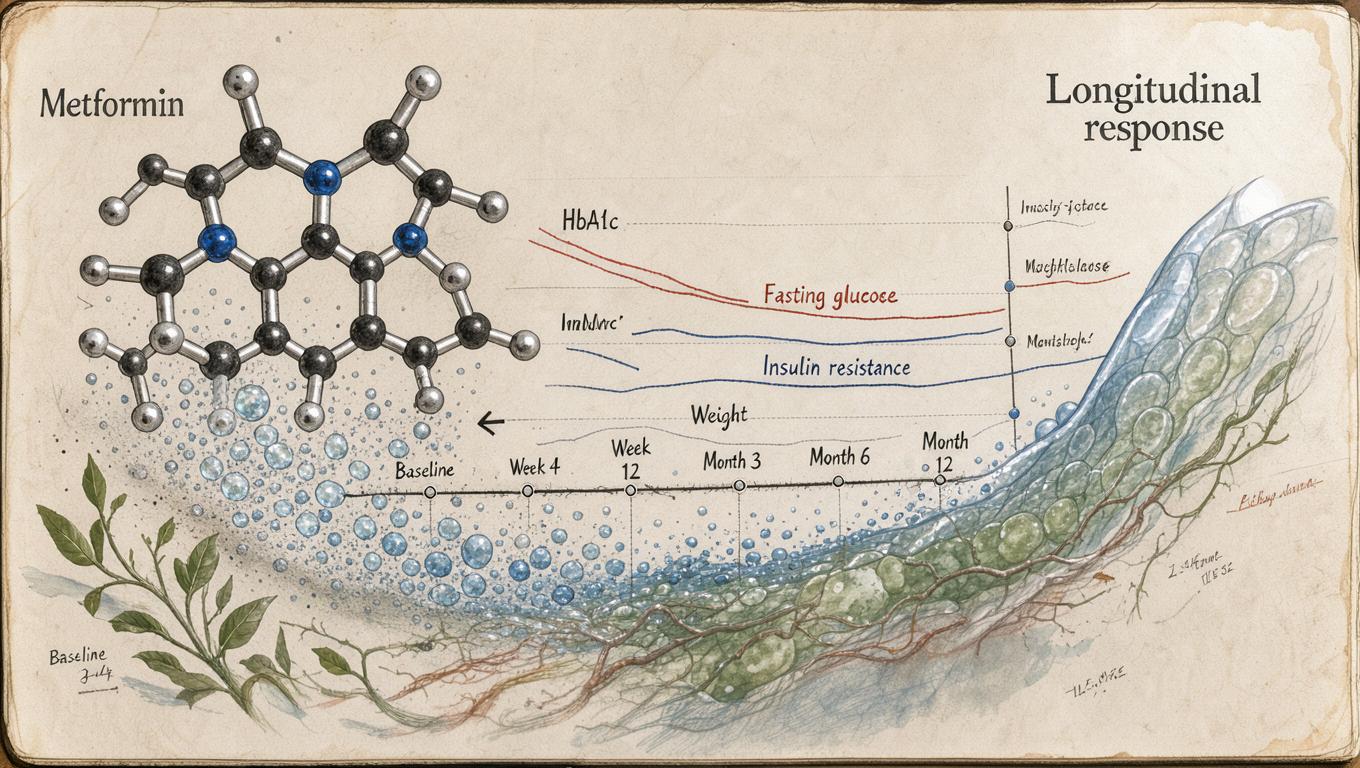
Longitudinal biomarker panel (baseline, week 6, week 12, week 24): HbA1c, fasting glucose, fasting insulin with HOMA-IR, ALT/AST, serum B12, and body composition. HOMA-IR and insulin are included because a metformin-resveratrol-HMB combination reduced insulin from 62 to 43 µU/mL and HOMA-IR from 29 to 19 in diabetic mice, though this is preclinical evidence with industry sponsorship (NuSirt Sciences) and requires human confirmation . ALT monitoring is warranted because uncontrolled NASH data (n=20, metformin 500 mg TID x 4 months) showed substantial transaminase reductions, e.g., ALT 152→52 in one patient, but without randomization or follow-up biopsy .
Safety monitoring: Measure serum B12 at baseline and 12 months given the 5.8% deficiency prevalence in metformin users versus 2.4% in non-users and 3.3% in non-diabetics (NHANES 1999-2006, n=575 metformin users, 1,046 non-users, 6,867 non-diabetics) . Monitor renal function given that in accumulation cases (n=12, mean pH 6.88, lactate 14.8 mmol/L), terminal metformin half-life was prolonged to 51.9 h in plasma and 43.4 h in erythrocytes, with detectability up to 13 days despite dialysis .
Analysis plan: Intention-to-treat, mixed-effects models for repeated measures with random intercepts per participant; primary endpoint is change in HbA1c at week 24; secondary endpoints are HOMA-IR, compliance, ALT, and B12. Pre-specify subgroup analyses by baseline renal function. Report both complete-case and multiple-imputation results given heterogeneous compliance.
Key limitations and blind spots: Prior RCT evidence on XR vs IR has short follow-up (12-24 weeks), open-label designs with high risk of measurement bias, and no long-term cardiovascular or renal outcomes . The B12 association is cross-sectional and cannot establish causality or dose-response within individuals. Conclusions would be disproven by a well-powered RCT showing a clinically meaningful HbA1c difference between XR and IR, or a longitudinal cohort showing B12 decline is unrelated to metformin dose or duration.
Simulating longitudinal HbA1c and B12 trajectories for metformin XR vs IR arms to estimate required sample size and pre-register mixed-effects power assumptions.
Get emailed when your analysis is done!
We'll email you the results when your analysis is finished.
Hypothesis Graveyard
'Metformin XR is clinically superior to IR' - rejected by pooled RCT data showing no significant HbA1c, glucose, or GI-event differences; only compliance differs modestly.
'Metformin reliably treats NASH histologically' - rejected as the only available human data are uncontrolled, lack biopsy follow-up, and cannot separate transaminase improvement from confounding weight loss.

 Explore by Goal
 Quick Analysis Plan
 Long Analysis Plan
 Top Data Sources
 Ask a Follow-Up
 Key Insight
 Keep Exploring
 Analysis
 Hypothesis Graveyard
 Potential Experiments
 Discussion
