Why BGPT?
logo

Design on What Was Actually Done

See the experiments, methods, and limitations behind existing claims before planning your next study.Know what the science actually supports before you trust the answer.

Press Enter ↵ to plan experiment


     Quick Analysis Plan


    A within-subject pre/post design in the Dortmund Vital Study (N=390, ages 20–70) showed post-task iAPF slowing (b = −0.29, p < 0.001), eyes-open alpha power increase (b = −0.09 contrast, p < 0.001), and an age-dependent aperiodic exponent shift (task × age b = −0.003, p < 0.001), replicated in Session 2 (N=100) and an independent older cohort (N=71) . The optimal analysis plan mirrors that pipeline: EEG-BIDS organization, FOOOF spectral parameterization, and BIC-selected linear mixed-effects models with participant random intercepts/slopes .


     Long Analysis Plan


    Sourced quantitative core of the study

    The primary cohort (Dortmund Vital Study Session 1, N=390, ages 20–70) underwent 3-min eyes-open/eyes-closed resting-state EEG before and after a ~2-hour cognitive battery. Reported mixed-effects results: iAPF slowed post-task (b = −0.29, SE = 0.03, t(762) = −9.21, p < 0.001); eyes-open alpha power at iAPF increased (contrast = −0.09, SE = 0.01, t(775) = −8.69, p < 0.001) while eyes-closed power was stable (p = 0.22); the aperiodic exponent showed a task × age interaction (b = −0.003, SE = 0.0005, t(703) = −6.30, p < 0.001) with the age slope significantly more negative post-task (slope difference = 0.003, t(392) = 6.97, p < 0.001). An independent older cohort (N=71, probabilistic reversal learning task) replicated all three effects, and Session 2 (N=100) replicated the task × age interaction (b = −0.002, p = 0.006) though Williams' tests on age correlations were non-significant (both p = 0.17) .

    Recommended analysis pipeline

    • Data organization: structure raw .vhdr/.edf recordings in EEG-BIDS (anat-free BIDS-EEG layout: /eeg subfolders, channels.tsv, events.tsv) for interoperability across MNE-Python, EEGLAB, and FieldTrip .
    • Preprocessing (matching the paper): clean_rawdata for line-noise/dead channels, ASR for artifact removal, ICA with ICLabel for ocular/cardiac components; re-reference to global average; epoch into 3-min eyes-open/closed segments.
    • Spectral parameterization: FOOOF (specparam) over 2–40 Hz to extract iAPF, power at iAPF, aperiodic offset and exponent per participant × eye × task.
    • Statistics: in R/lme4, fit EEG ~ eye * task * age + sex + (eye + task | participant); use BIC-based model comparison, emmeans post-hoc contrasts, Pearson correlations and Williams' tests for the Session-2 replication; report ICC for test-retest reliability.
    • Longitudinal layer: model 5-year change (Session 1 → Session 2, N=100) for iAPF and exponent against cross-sectional age slopes.

    Key limitations to encode as warnings in the pipeline

    • No passive control condition: order/time-on-task effects cannot be excluded from the exertion interpretation; a sham/no-task arm is the top falsification test.
    • Transient state variables (sleep, caffeine, mood, arousal) were unmeasured; log them covariate-first in any replication.
    • Global electrode averaging may obscure local dynamics; add a sensor-level secondary analysis.
    • Session 2 Williams' tests (p = 0.17) underpower the claim that post-task age correlations are stronger than pre-task — treat the post-task age-sensitivity claim as provisional.

    Reference code exists at the authors' repository (github.com/RCNS-BIC/rsEEG_BANetal2026). Confidence: high for the reported coefficients (strong, multi-cohort replication); moderate for causal attribution to exertion per se (no control condition).


    Feedback:    

    Updated: September 08, 2026


     Top Data Sources ExportMCP


     DataGen


    {'label': 'Simulated aperiodic exponent vs age (pre vs post task)', 'plotlySpec': "{data:[{type:'scatter',mode:'lines+markers',x:[20,30,40,50,60,70],y:[1.35,1.32,1.28,1.23,1.17,1.10],name:'Pre-task (simulated)',line:{color:'#0C3576',width:3},error_y:{array:[0.03,0.03,0.03,0.04,0.04,0.05],type:'data',visible:true}},{type:'scatter',mode:'lines+markers',x:[20,30,40,50,60,70],y:[1.46,1.38,1.29,1.18,1.06,0.92],name:'Post-task (simulated)',line:{color:'#E8863A',width:3,dash:'dash'},error_y:{array:[0.03,0.03,0.04,0.04,0.05,0.06],type:'data',visible:true}}],layout:{title:'SIMULATED: aperiodic exponent age slope pre vs post task (assumes linear age slope, no drowsiness control, b_task×age = -0.003, units: exponent units/Hz)',xaxis:{title:'Age (years)'},yaxis:{title:'Aperiodic exponent (simulated)'},margin:{l:70,r:30,t:60,b:70}}}"} Generated scientific data; not direct experimental measurements.

     Analysis Wizard


    Building a reproducible FOOOF-plus-mixed-model pipeline that tests whether cognitive exertion shifts iAPF, alpha power, and aperiodic exponent differently across the adult lifespan.


     Hypothesis Graveyard


    iAPF slowing after exertion is a generic drowsiness/fatigue artifact indistinguishable from time-on-task: remains viable because no passive control condition was included; the age-differential exponent interaction (task × age replicated in two cohorts and across a different task paradigm) argues against pure fatigue, which would not be age-dependent in the same pattern.


    Resting-state EEG spectral markers are stable trait-like measures unaffected by recent cognitive load: directly contradicted by consistent pre-to-post shifts (iAPF, alpha power, exponent) in three independent samples.

     Science Art


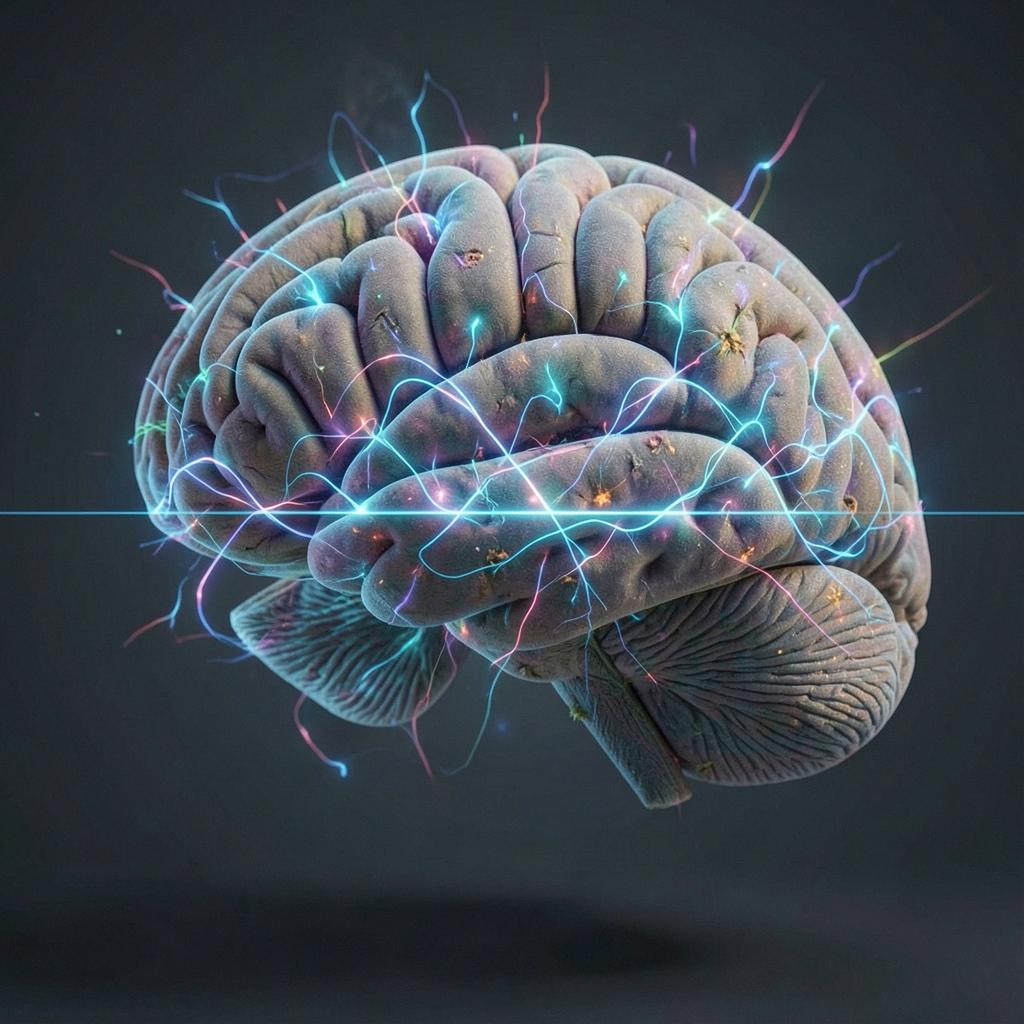
    Cognitive exertion reshapes resting-state EEG markers across the adult lifespan Science Art

     Science Movie


    Make a narrated HD Science movie for this answer ($32 per minute)


     Discussion


    Stay current without chasing every paper.

    Know what changed, what holds up, and what remains uncertain. Every Friday. No ads.


    My BGPT