Verify your claims against versioned evidence records with exact reported results and sources.Know what the science actually supports before you trust the answer.
Press Enter ↵ to review claims
Explore by Goal
"Science is not about why, it's about why not."
- Portal 2
Quick Explanation
Copied
Stefano Volinia is a highly cited, methodologically broad bioinformatician (597 works, h-index 91, ~57,500 citations) best known as a pioneer of cancer microRNA genomics, with landmark 2005-2007 signature papers that anchor the field; the two supplied papers confirm strong, reproducible quantitative work but also reveal a breast/EPCAM-skewed CTC dataset and a striking 2023 output anomaly (132 works, only 34 citations) that warrant scrutiny .
Long Explanation
Author Review: Stefano Volinia
Stefano Volinia presents a three-decade career spanning signal-transduction structural biology (14-3-3 phosphopeptide binding, Cell 1997) to becoming a founding contributor of cancer microRNA genomics . The supplied evidence records show why his citation profile is exceptional: the 2006 PNAS miRnome analysis of 540 tumor samples across six cancer types defined a miRNA expression signature of solid tumors and remains his most cited work (~5,690 citations), while collaborative miRNA signature papers in breast, thyroid, ovarian, and pancreatic cancer each exceeded 1,100 citations .
Recent empirical strength (2026 CTCeek study). The February 2026 preprint integrates 3,302 putative CTCs from 27 public GEO/SRA datasets, retains 1,230 after QC, removes 900 contaminants, and validates CTCeek on 136 cells, achieving 99.96% specificity on pbmc3k (0.037% FPR) and 99.99% on 44,433 Broad PBMCs, with open data (Zenodo) and code (GitHub) — strong reproducibility practices and honest reporting of six misclassified aneuploid cells (4 HSPCs, 2 platelets) . However, the authors transparently note that most CTC data are EPCAM-selected, breast dominates (1,060 of 1,230 QC-passed cells vs. 6 colorectal, 2 lung), and external validation across diverse cancers is still needed . A pending US patent (US 18/811,711) on this work is a declared financial interest .
Mechanistic depth (2011 miR-155 mutator study). The PNAS 2011 paper shows miR-155 overexpression (up to 32.07-fold in MDA-MB-231 clones) and inflammatory stimuli raise mutation rates (2.52-fold with TNF/LPS, P = 0.038; 2.81-fold in HCT116) via WEE1 checkpoint downregulation, using Luria-Delbrück fluctuation analysis across multiple cell lines and Eμ-miR-155 mouse B cells . Stated limitations include supra-physiological Tet-On overexpression, LSMCM being a complex inflammatory mixture, and reliance on HPRT as a surrogate for genome-wide mutation .
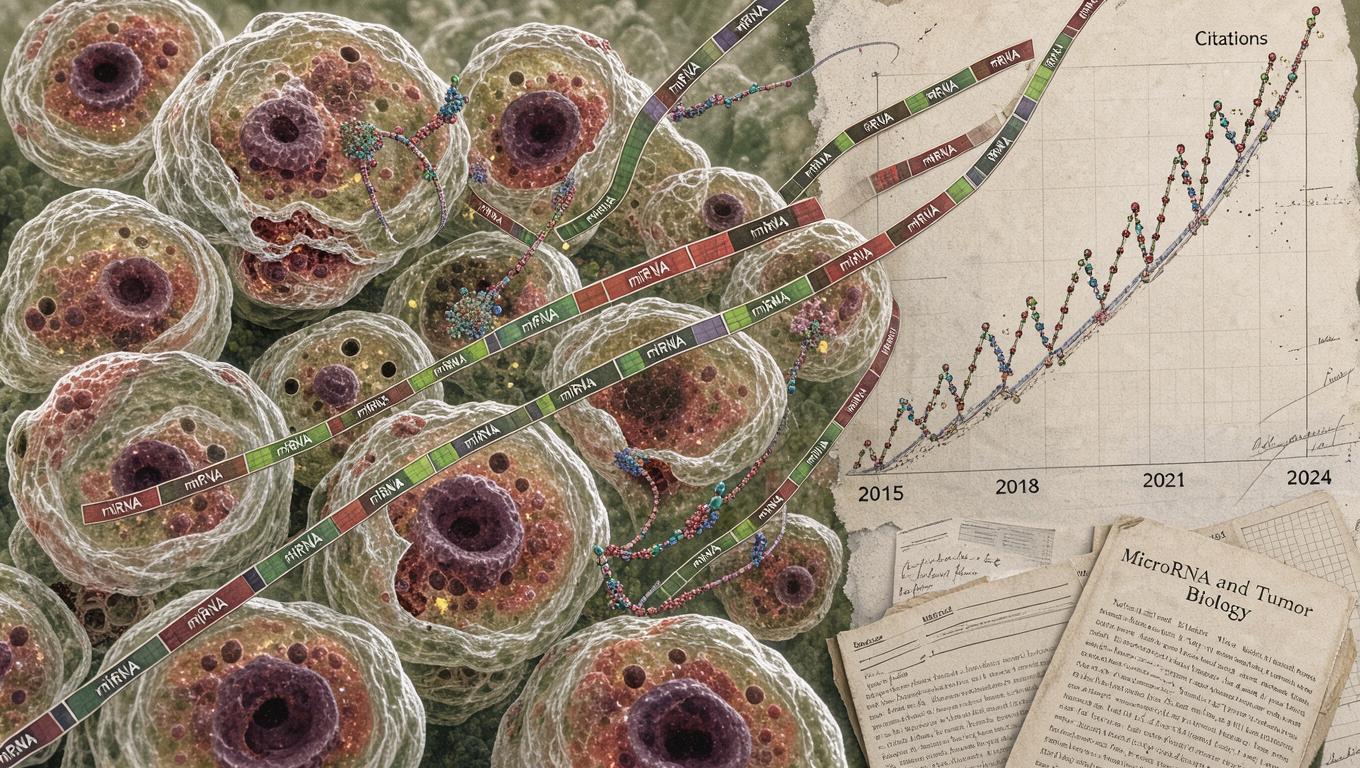
The log-scale trajectory shows a massive citation half-life anchored to the 2005-2009 microRNA era, a long plateau of durable influence, and near-zero citations for the 132 works produced in 2023 — an anomalous productivity spike whose impact is not yet visible and cannot be evaluated from these data alone .
What would change this assessment: independent failure of CTCeek's markers on external non-breast cohorts, non-replication of the miR-155 mutator effect at physiological miR-155 levels, or evidence linking the 2023 output spike to low-quality venues would lower the evaluation; conversely, prospective validation of CTCeek markers across cancer types would confirm the recent-direction strength. Uncertainty: the CTCeek paper is a 2026 preprint with zero incoming citations and unverified peer review .
Feedback:
Updated: October 28, 2026
BGPT Author Review
Scientific Quality
80%
H-index 91 with 57,470 citations reflects field-defining contributions: the 2006 solid-tumor miRnome paper and the 2005 CLL/NEJM prognostic signature papers are foundational to cancer miRNA genomics. Early structural biology (14-3-3, Cell 1997) shows breadth beyond one field. Recent CTCeek work demonstrates modern single-cell computational competence with strong open-data practices. Deductions: the 132-works-in-2023 anomaly with only 34 citations is a red flag for output quality or venue selection that the data cannot resolve; the 2011 miR-155 mutator study has reproducibility limitations (supraphysiological overexpression, HPRT surrogate); no primary-lab wet-lab leadership is evident in the recent computational work.
Communication Quality
70%
Papers show clear quantitative reporting with explicit limitation sections, declared COIs, falsification criteria, and accessible tool delivery (Shiny app, GitHub, Zenodo). However, as a co-author on many large consortium papers, first-person scientific communication and standalone writing clarity are hard to judge; the CTCeek paper's dense multi-tool methodology may challenge non-specialist readers.
Author Novelty
80%
The 2005-2007 miRNA signature papers were genuinely groundbreaking at the dawn of cancer miRNA genomics, establishing expression signatures across solid tumors and linking miR-15/16 to BCL2. The 2011 miR-155 mutator mechanism linking inflammation to genome instability via WEE1 was conceptually novel. The 2026 CTCeek work is incremental-but-novel: pan-CTC markers beyond EPCAM and a contaminant-aware classifier fill a real gap, though it is a tool/aggregation paper rather than a conceptual advance.
Scientific Rigor
70%
Strengths: Luria-Delbrück fluctuation analysis with multiple clones and cell lines in the 2011 study; multi-tool QC pipeline (CopyKAT, SCEVAN, scATOMIC, doublet detection) with explicit misclassification reporting in CTCeek; data and code openly deposited. Weaknesses: supra-physiological Tet-On overexpression confounds physiological inference; HPRT is a narrow mutational surrogate; LSMCM is an ill-defined inflammatory mixture; CTC datasets are EPCAM/breast-skewed, limiting marker generality; CTCeek lacks independent external validation; the 2023 output spike raises unresolvable venue-quality questions.
We'll email you the results when your analysis is finished.
Hypothesis Graveyard
That HPRT mutation-rate fold-changes directly quantify genome-wide mutator activity — abandoned because HPRT captures only a narrow locus and deletion/frameshift signatures, not genome-wide SNV burdens; WGS-based signatures are now the standard.
That CTC marker discovery requires prospective sample collection — weakened by CTCeek showing curated public scRNA-seq integration can yield validated markers, though external prospective validation remains the definitive test.

 Explore by Goal
 Quick Explanation
 Long Explanation
 Top Data Sources
 Ask a Follow-Up
 Key Insight
 Keep Exploring
 Hypothesis Graveyard
 Potential Experiments
 Discussion
