Review an author's claims as they appear in the record: linked experiments, exact results, limitations, and sources.Know what falsifiable science actually supports before you trust the answer.
Press Enter ↵ to search evidence
Explore by Goal
"The saddest aspect of life right now is that science gathers knowledge faster than society gathers wisdom."
- Isaac Asimov
Quick Explanation
Copied
Sébastien Soubiès is a productive, methodologically grounded veterinary virologist (h-index 15–18, ~727–898 citations across 34–64 works) whose recent work on avian influenza environmental surveillance and feline H5Nx serosurveillance is practical and well-executed, though modest in explanatory depth and dependent on partial or indirect evidence.
Long Explanation
Scientific Profile and Track Record
Sébastien Soubiès is a veterinary virologist (ORCID 0000-0003-3065-3558) trained at ENVT, Freiburg, and INRAE/ANSES, with a career spanning influenza A host-adaptation biology (NS1 ESEV motif, MxA restriction, lambda interferon in chickens) and infectious bursal disease virus (IBDV) molecular epidemiology. His most-cited work, the species-specific NS1 C-terminal virulence study (114 citations), anchors a citation profile of h-index 15 (Semantic Scholar: 727 citations, 34 papers) to h-index 18 (OpenAlex: 898 citations, 64 works), with rising annual citation rates (145 citations in 2024, 77 in 2025) indicating growing rather than fading influence. His recent pivot to avian influenza (H5Nx clade 2.3.4.4b) field surveillance is visible in two 2025 first-/co-authored studies.
Recent Evidence Quality
In the duck slurry study, 173 samples from 37 French duck farms yielded 82% AIV RNA positivity, with 30% of AIV-positive samples harboring H5 and zero H7; the optimized pellet-Trizol-beads protocol improved sensitivity (median Cq ~25.99 vs ~30.6–31.1 for supernatant methods). The work is practical and novel as an environmental surveillance matrix, but key weaknesses temper it: virus isolation failed in all 39 tested samples, genome recovery was partial (segments 1–3 often failed; only HA/NA consensus sequences reliably obtained), no accession numbers were deposited, and raw data are only available "upon reasonable request" — all of which limit independent verification .
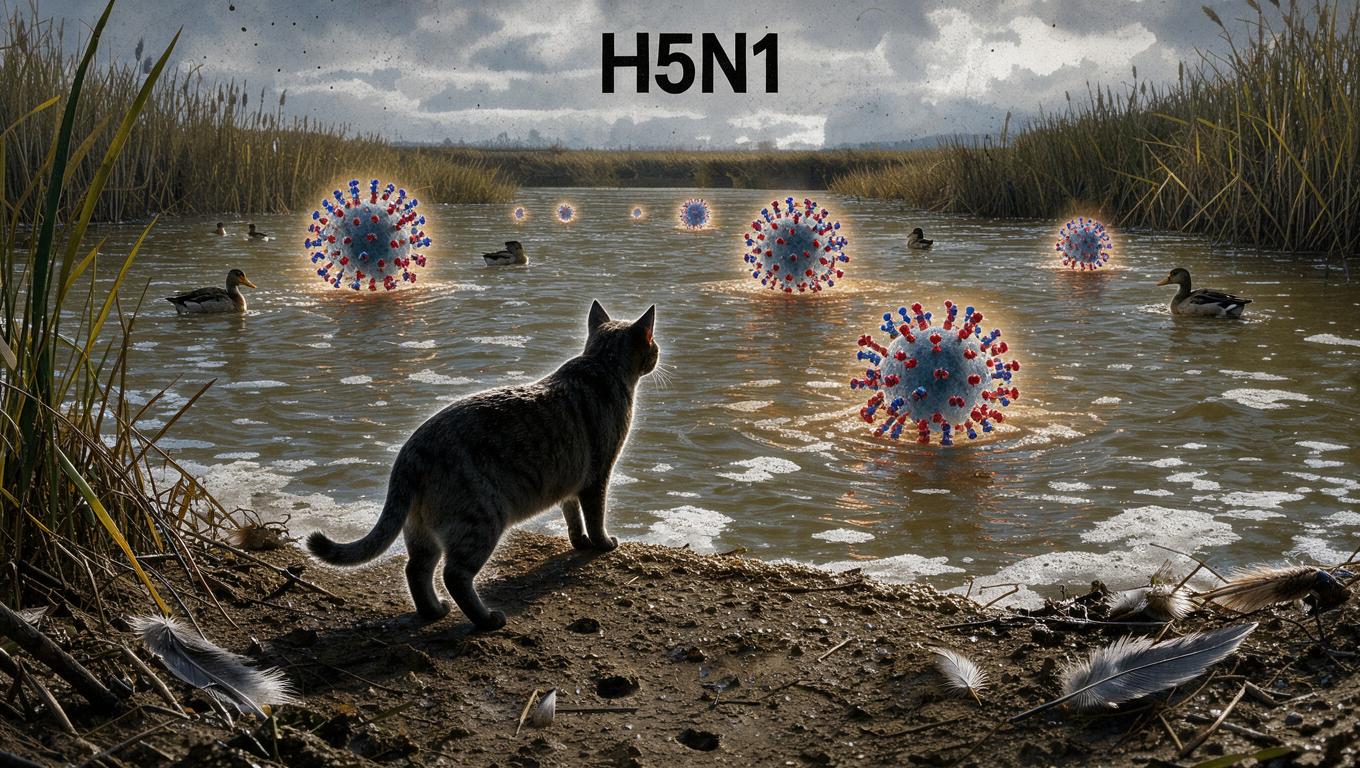
The feline serosurveillance study (728 outdoor cats, 2.6% raw seropositivity; 1.8% Rogan-Gladen adjusted, 95% CI 0.66–3.4) demonstrates competent epidemiological practice: two-stage confirmatory testing, sensitivity/specificity adjustments, Firth regression for sparse data, and open code/data on GitLab. Its headline interpretation — hunting behavior outweighing geography — rests on a single unadjusted association (p = 0.043) that lost significance after adjustment (p = 0.13), and the standout stray-vs-owned odds ratio (0.06) carries a CI touching zero. With only 19 seropositive cats, subgroup inference is fragile .
Critical Assessment
Strengths: methodological versatility (wet-lab virology, serology, nanopore sequencing, epidemiological modeling), sustained funding (ANR, ANRS-MIE, region grants), transparent conflict-of-interest declarations, and a valuable One-Health surveillance orientation. Weaknesses: explanatory depth in recent work is thin (descriptive rather than mechanistic), some negative results (zero isolates) are under-explored as to cause, and a chronic gap exists between claims ("cost-effective surveillance complement") and demonstrated capability (partial genomes, no viable virus). These are inferred limitations, not author admissions. The cross-disciplinary career trajectory — from T-cell biophysics (2008) to avian virology to field epidemiology — suggests adaptability but also that his citation base is split across subfields.
Feedback:
Updated: November 21, 2026
BGPT Author Review
Scientific Quality
70%
Mid-career researcher with solid h-index (15-18 depending on database), consistent output, first-authorship on well-cited mechanistic papers (NS1 virulence, 114 citations), and successful transition into timely H5Nx surveillance. Recent work is competent but descriptive; failed virus isolation and un-deposited sequence data reduce verifiability. Rising citations suggest momentum but not yet field-leader status.
Communication Quality
70%
Papers are clearly structured with explicit funding and COI statements, and the cat study includes open data/code (GitLab), which aids accessibility. However, key interpretation of the hunting-behavior association is stated more strongly than the adjusted statistics warrant, and data 'upon reasonable request' with missing accessions hampers scientific communication.
Author Novelty
70%
The duck slurry matrix concept is genuinely novel for environmental AIV surveillance (extraction optimization is a real contribution), and cats-as-sentinels extends an emerging idea rather than breaking new ground. Earlier NS1/MxA/IBDV work was incremental to established frameworks.
Scientific Rigor
70%
Rigorous in protocol comparison (five extraction strategies with Cq quantification), confirmatory serology, and appropriate statistics (Firth regression, Rogan-Gladen correction). Deductions for acknowledged cross-contamination risk, zero isolation success without mechanistic follow-up, partial genome coverage, lack of deposited accessions, and interpretation exceeding adjusted statistical support.
We'll email you the results when your analysis is finished.
Hypothesis Graveyard
Cats acquire H5Nx exposure primarily through geographic proximity to at-risk départements — weakened because seropositive cats appeared in 2 of 7 non-risk départements and geography lost to behavioral factors in adjusted analysis.

 Explore by Goal
 Quick Explanation
 Long Explanation
 Top Data Sources
 Ask a Follow-Up
 Key Insight
 Keep Exploring
 Hypothesis Graveyard
 Potential Experiments
 Discussion
